


Featured Item
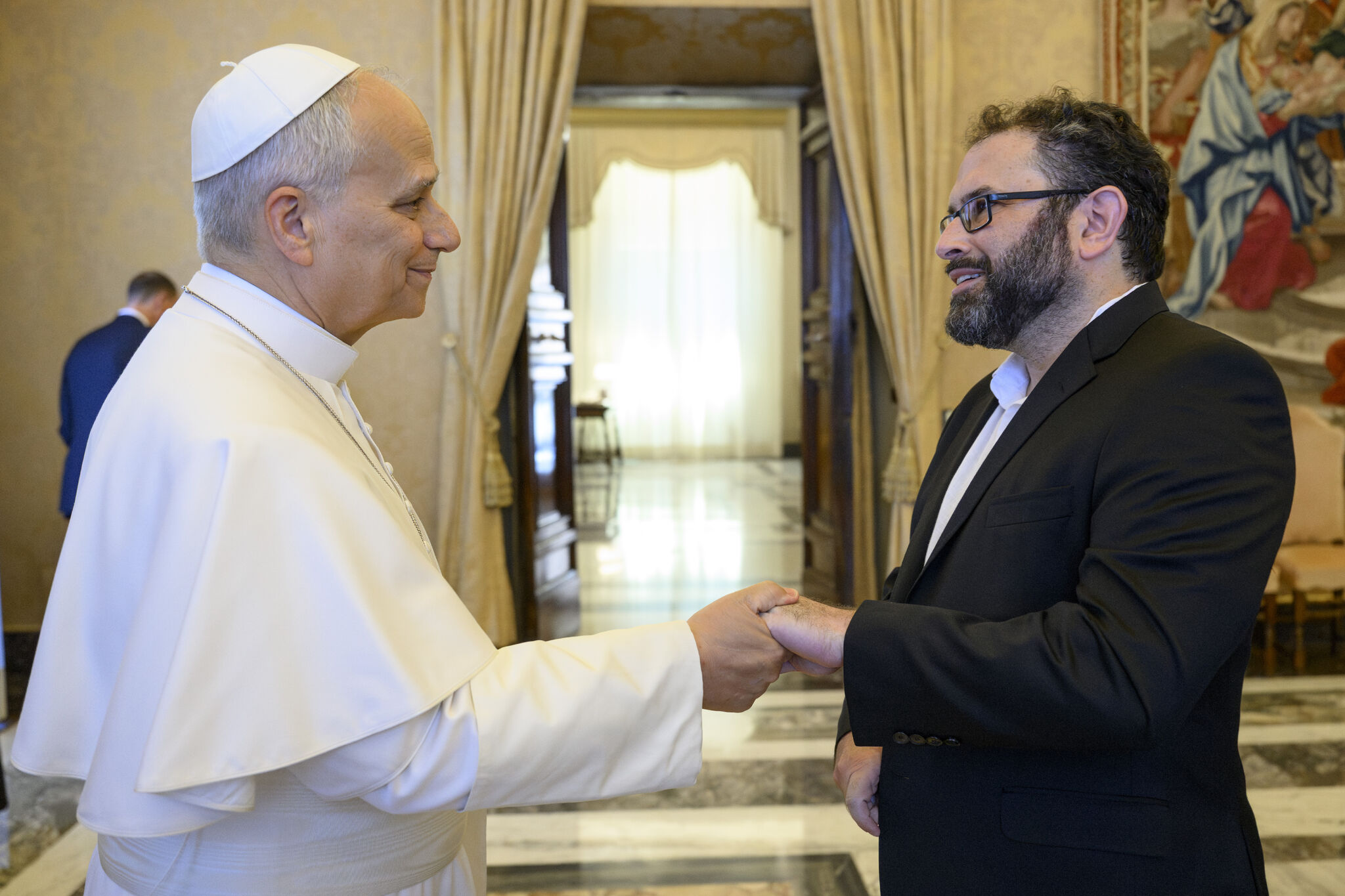
Benji Rosman talks AI with the Pope

Few South Africans get to shake hands with the Pope. Yet two weeks ago, Professor Benji Rosman did just that after attending an international conference, titled “Preserving Human Voices and Faces”, at the Pontifical Urbaniana University in Vatican City.
Organised by the Dicastery for Communication, the gathering on 21 and 22 May brought together experts from around the world to discuss the opportunities and challenges posed by artificial intelligence (AI), culminating in an audience with the Pope.
Rosman, a professor in the School of Computer Science and Applied Mathematics at the University of the Witwatersrand and a leading figure in AI research, was the only African participant among a select group of 15.
The academics, religious leaders, and communications professionals considered how technological innovation can be harnessed responsibly in an increasingly interconnected world, exploring the ethical, social, and practical implications of AI.
“The conference was around preserving human voices and faces in the time of AI, and some of the risks and challenges posed by AI,” said Rosman. “The Pope’s been releasing quite a few documents and talking a lot about AI. He’s invested in it and discusses it a lot.”
The Vatican has been interested in the ethics behind AI since Pope Francis became Pope. He would argue that AI should serve humanity rather than replace, control, or diminish it. Since 2020, the Vatican has raised issues regarding the ethics of AI with software companies such as Microsoft and global organisations such as the World Economic Forum.
Similarly, Pope Leo has repeatedly spoken about the need for AI to remain centred on human dignity, ethics, and responsibility, rather than profit or power. He has now brought many of these concerns together in his first encyclical, published on 25 May, “Magnifica humanitas: On Safeguarding the Human Person in the Time of Artificial Intelligence.”
Both Rosman and Pope Leo were on Time magazine’s list of the 100 most influential people in AI, so when the professor got the invitation in his inbox, he felt he could not pass it up.
“Being concerned these days about AI safety and the way that it’s being rolled out and developed, any opportunity to engage with key people to figure out how to navigate us into a safer future, I think, is very important,” he said.
“Particularly at the moment, a lot of the risks that we’re facing around AI come from the arms race-type dynamics that we’re in, where there are countries racing against each other and companies racing against each other. And that’s not really a situation that anyone from the inside can change. You need people trying to intervene externally to change the setup of the way that it’s being developed,” he said. “A large entity like the Vatican and the Pope being invested in it, as outsiders invest in trying to steer for a better future. And if they’re talking to people in the community to look at how they should do that best, then that really feels like a key opportunity to try and influence things in a positive direction.”
He said that meeting Pope Leo was certainly daunting.
“Everyone who was there was worried about the procedures, but they were actually fairly relaxed about the formalities. But then, when we were there, there was quite a lot of procedure, like being driven up to the Apostolic Palace. We were greeted with a red carpet and had to wait in a room, and were then ushered to another room and then ushered to another room and then seated. When the Pope came in, he gave an address, and we stood up in the right order and filed up to meet him and talk to him,” he said.
When Rosman eventually got his brief face-to-face moment with the Pope, he introduced himself and spoke about his work in the AI space, drawing on his involvement with the Wits Machine Intelligence & Neural Discovery Institute; the Robotics, Autonomous Intelligence and Learning (RAIL) Lab; the Deep Learning Indaba; and his company, Lelapa AI.
Rosman thanked the Pope for the leadership he has shown on the issue, while highlighting what he sees as one of the defining risks of the current technological moment: that humanity is increasingly being shaped by AI, rather than shaping it ourselves.
Meeting Pope Leo was a huge honour for Rosman. But the impact that this conference and visit had feels even more monumental.
“It’s not so much that it’s the Catholic Church in particular, but it’s about the kind of different entities around the world playing different roles in society, or taking such an active role in the discussions around AI, that gives me hope. Before that, we were sitting in a situation where basically the large frontier AI labs are the ones really driving the narrative. Now we’re getting some global leadership trying to steer things.”