





OpEds
War prepped me for danger – but not this explosion

For three decades, I’ve lived my life in the media. Twenty of those years have been in war zones – Gaza, Syria, Lebanon, Libya, Ukraine, Russia – dodging bullets; crawling through tunnels; watching cities crumble. I thought I’d seen it all. Then, at 51, my life exploded in a way no rocket ever could.
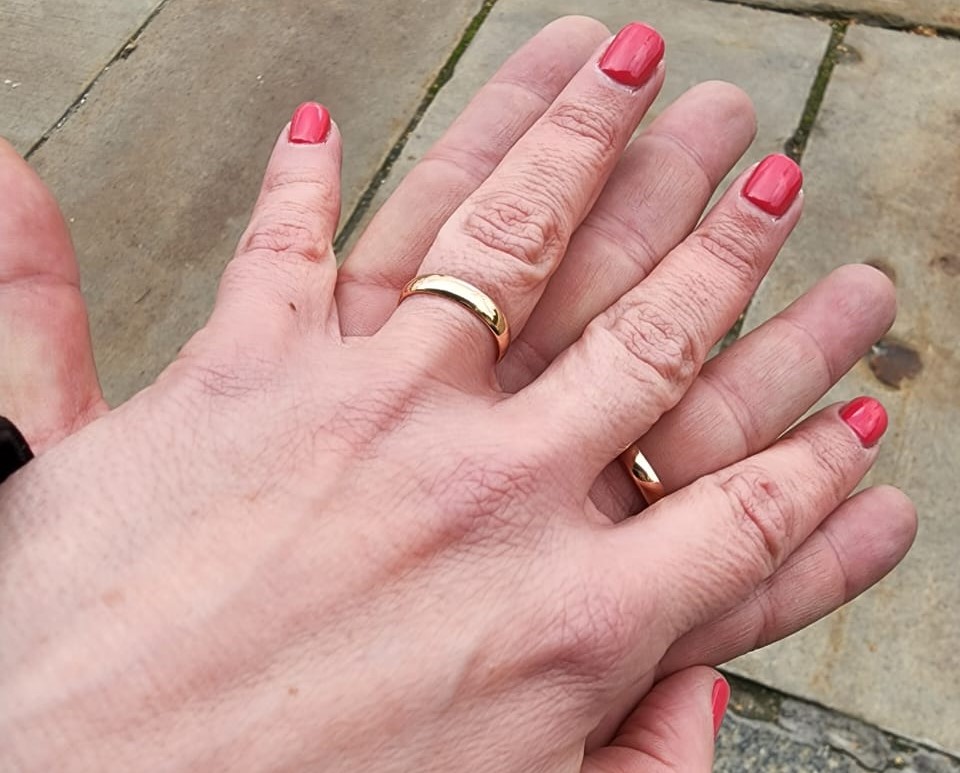
At 49, I met the man of my dreams. At 50, I married him. And at 51, I realised he never really existed.
I’ve worn flak jackets, ducked for cover, interviewed men with blood on their hands. In 2008, I was commended for being one of the first women journalists to crawl through a Gaza tunnel. Years later, in Ukraine, I lay for nearly two hours under relentless gunfire in Illovaisk, bullets cracking above me as I weighed up whether to push forward or pull back. But the war that nearly destroyed me came without an explosion. It was a bullet without sound. A battlefield I never signed up for.
When you report on conflict, you learn to read the danger. In Ukraine, while working for Russian TV, we sometimes had mere seconds to figure out if a checkpoint ahead belonged to Russians or Ukrainians, and adjust our story accordingly.
But the most dangerous war I ever lived through happened in my own home, with the man I loved. In war zones, you usually know who the enemy is. They wear uniforms. They carry guns. My enemy wore aftershave. He made me tea. He tucked me into bed at night and called me “cooks”.
The red flags are always there. The hardest part is seeing them.
I remember standing on the Israel-Gaza border, doing a live report, when rockets began falling behind me. I couldn’t see them – I was facing the camera – but I saw my cameraman’s face twist in horror before he turned and ran. Calmly, I said on air, “The rockets appear to have landed close behind me.” Only later, when I watched the footage, did I realise just how close! I hadn’t flinched. Not because I was brave, but because I hadn’t known the danger. That’s how it was in Gaza. I couldn’t see the rockets behind me. And in my personal life, I couldn’t see the lies in front of me.
I met Trevor Bester through my ex best friend, Samantha. He told me he was a mercenary, which explained why he had no social media presence. He told me he had brain cancer, with only a year to live, and his greatest wish was to marry me. He was good-looking, charismatic, muscled, with tattoos across his body. On the inside of his left arm was Arabic script. He said it was the name of a little girl he had mistakenly killed in Iraq, permanently inked to remind him of what he had done.
I had never met someone who seemed to understand me so completely. He mirrored my interests, listened endlessly, and it felt like I had finally found my person. But when something feels too good to be true, it usually is. What I thought was a compliment – him saying he’d followed me on TV for six months before meeting me – was actually chilling. He’d been studying me. Con artists work like that. They groom. They isolate. They strip you of your anchors until you are alone in their world.
For years, I had harboured a fascination with Saudi Arabia. Trevor exploited that. He told me he had connections inside the Saudi government, and that they wanted me to head up a 24-hour English news channel as the Kingdom prepared to join BRICS (the intergovernmental organisation comprising Brazil; China; Egypt; Ethiopia; India; Indonesia; Iran; the Russian Federation; South Africa; and the United Arab Emirates). Every week, sometimes twice a week, he claimed to be meeting his contact at the Saudi embassy in Pretoria – a man called Marwan.
Under his spell, I poured my life into the project. I used all my savings, cashed in all my policies, sold my future. I built a newsroom with 40 people in Sandton, Johannesburg, produced documentaries, magazine shows, news bulletins – ready to go live the moment the Saudis gave the word. That went on for nearly a year-and-a-half.
And then came the explosion.
Encouraged by my sister and a few close friends – and in the same week my father lay dying – I went to the Saudi embassy. I gave the guard the name “Marwan”. He looked at me blankly. “There’s no one here by that name.” I showed him Trevor’s picture. He shook his head, saying, “We’ve never seen him.”
In that instant, my life collapsed. I wandered the streets of Pretoria sobbing, unable to find my car, not only because the money was gone, but because the life I thought I was living had never existed. Sitting at my father’s bedside as he took his last breaths, I went through my bank statements and discovered that Trevor had stolen more than R6 million directly from my accounts. Millions more vanished into the phantom Saudi project. Twenty years of earnings from war zones, every dollar I’d ever saved, every policy I’d signed up for – gone.
I had been so focused on building the dream that I didn’t notice the foundation was fake. Even professionals miss things. Even truth-tellers get duped. Sometimes it’s not the loud liars we fall for. It’s the soft, convincing ones. Romance fraud is one of the fastest-growing crimes worldwide – worth $3.8 billion (R65.9 billion) globally last year, R113 million in South Africa alone. The fraudsters – from Nigerian “Yahoo Boys” working shifts online to men like Trevor – prey on loneliness, vulnerability, or simple trust. Victims believe they’re being love-bombed by one man giving them constant attention, when in reality, it’s a factory line of scammers taking turns. And yes, I became one of them.
But here’s the other truth: in every explosion, there’s grace. Sometimes it comes as friends. Sometimes family. Sometimes faith. But it comes. In Algeria in 2003, I was covering an earthquake in Boumerdes when I met the Djibouti family, who had lost their 17-year-old daughter, Jasmine. She had run back into the collapsing apartment to fetch a scarf to cover her hair. They never saw her again. When her body was recovered, her father, Krimo, told rescuers, “I am Muslim. In my faith, it is important to have something to bury – even a nail, even a hair.” Later, her mother gave me a golden hijab, “This is for when you get married,” she smiled.
Years afterwards, Krimo wrote to me, “We are Muslim, you are Jewish – it makes no difference. We lost a daughter that day, but we found another in you.” In the middle of devastation, the most powerful act isn’t resistance, but grace. That’s how you rebuild. Not with bricks, but with love.
When I spoke at Limmud in Johannesburg recently, I was anxious about the reaction I’d get. A close family member cautioned whether I really wanted the Jewish community to know my story. But any doubts I had disappeared into the hugs, warmth, and acceptance I was flooded with afterwards. Something very powerful happens when you share your shame – and are then embraced for speaking out. Women told me they, too, had been conned. Men came forward with similar stories. Others worried it was happening to people they knew. For the first time in a year, I woke up the next day without wanting to pull the covers back over my head.
A year ago when this happened, I reported Trevor to the police. The Hawks said they would investigate. Nothing has transpired. That is the South Africa we live in – where you can quite literally get away with murder.
I’m still rebuilding. Some days are harder than others. I still sometimes struggle to get out of bed. But slowly, slowly, I am finding my voice again.
Your wars may be different. Maybe they are not fought with bullets, but with betrayal, diagnosis, or grief. But the choice to rebuild is universal. It is not enough to survive. Rebuilding is how we reclaim our power.
Twenty years in war zones. One conman’s mess. I’m still here. At 52, I’ve learned that bombs don’t define you, your fight does. Midlife, later years, whatever’s exploding around you – divorce, debt, doubt – we all have an inner warrior. I found mine in Gaza’s tunnels, Libya’s chaos, Trevor’s betrayal. Writing this is proof of that. And maybe that’s the point: we are not alone in the rubble. We mourn, we march, we rise. One messy, brave step at a time.
- Paula Slier is an international journalist, media trainer, and public speaker. She founded Newshound Media International and Newshound Academy, and has reported from conflict zones for more than 30 years.






Sharin Gluckman
September 21, 2025 at 10:39 pm
I have worked with Paula and have always found her to be an amazing lady and a journalist of note. May she go on to greater things.
Gill Katz
November 11, 2025 at 2:17 pm
Dearest Paula
My claws are out.
They’re sharpened .
I want to dig them deep into this coward’s neck and whip his veins out like spaghetti dripping in ketchup . How DARE he?
I have known and admired you for years and I’ve followed your reports and smugly patted my head and said ‘I know this person personally ‘
A willing show off am I.
I know you have this steel carapace but I also think I know the jelly baby inside .
You’re in my heart
❤️
Paula Slier
December 23, 2025 at 4:42 pm
Gill, thank you for seeing me so clearly – and for holding both the strength and the softness with such care!
Paula Slier
December 23, 2025 at 4:39 pm
Thank you Sharin. That means a great deal – especially coming from someone who knows the work behind the scenes.
Leon Singer
October 1, 2025 at 1:40 pm
I remember you when you stayed in a block in Linksfield. Must have been sometime in 1997 around the time Princ ess Diana died. You were working at the SABC. I have always followed your articles and broadcasts. Wishing you all the best.
Paula Slier
December 23, 2025 at 4:43 pm
Leon – that took me right back. Thank you for following my work all these years.
Debbie Rosenberg
October 1, 2025 at 1:58 pm
What a brave woman. Good luck , happiness and prosperity to u.
David Polovin
October 1, 2025 at 3:51 pm
Heartbroken for you, dear Paula. May your faith in humanity never desert you. May you find the love and comfort you so richly deserve.
Kathryn Nathan
October 1, 2025 at 5:04 pm
It’s hard to accept that there just are really nasty people in the world who will gain your trust and simultaneously take everything they can from you and leave you with nothing. Thank you for sharing this so bravely. Some sort of divine justice might prevail, but sometimes you aren’t there to see it. Wishing you all the good things in life.
Paula Slier
December 23, 2025 at 4:48 pm
Thank you Kathryn. I appreciate the care and humanity in your message.
Bendeta Gordon
October 3, 2025 at 6:56 am
Paula Slier is a very brave lady.
Shchaach for sharing your vulnerability.
HaShem and your Jewish brothers and sisters embrace you and will always share your pain with open arms.
It’s not always the wealthy or the well-known where you will find a home, it’s in the ordinary (gewone) community which embraces, does not judge and does not ask for something in return.
Onwards and upwards strong sister🙏🏻🧿💙💜
Paula Slier
December 23, 2025 at 4:47 pm
Thank you Bendeta. Your words – and the sense of community you describe – mean more than I can say. They remind me why telling these stories matters.
Ringeta
December 19, 2025 at 1:27 am
How I wish those who were caught in this mess at least received their salaries? Sadly we didn’t even get an appology.