Lifestyle/Community
Families forced to spend yomtov apart

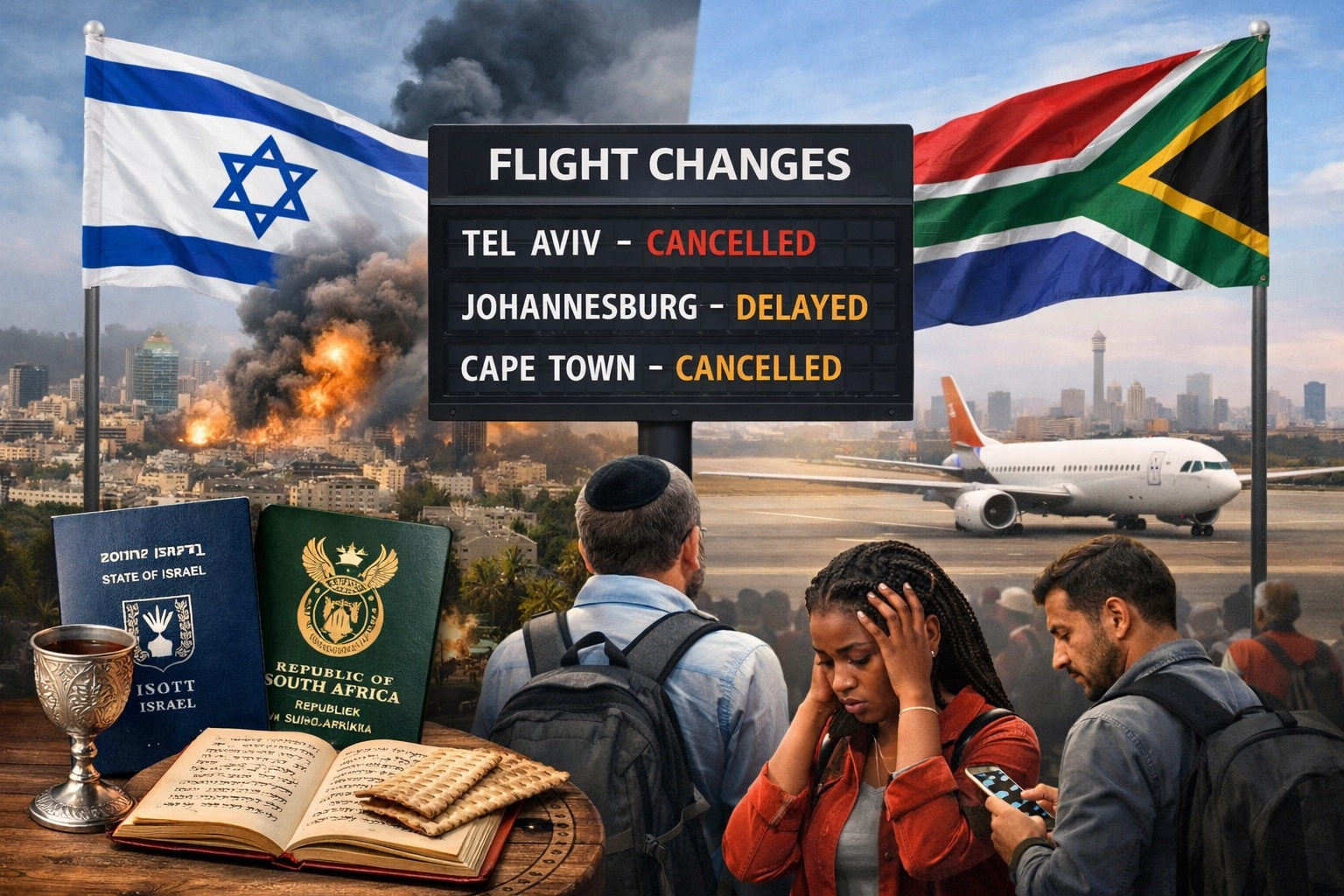
In an ordinary year, the weeks before Pesach would see families confirming flights, preparing for reunions, and finalising holiday plans. Instead, many travelling between Israel and South Africa are facing cancellations and uncertainty.
Airlines have reduced or suspended flights as shifting airspace restrictions across the Middle East have made travel unpredictable. Passengers are being forced to reroute through multiple countries, delay departures, or cancel trips entirely, as the usual routes between Tel Aviv and Johannesburg are becoming increasingly difficult to navigate.
For many families, the disruption is more than logistical; it means confronting the reality that, for the first time in years, they may not be together around the seder table.
Vanessa Gruskin had travelled to Israel to visit her three sons, hoping to spend time with the eldest following his recent marriage, before returning to South Africa with the other two to celebrate Pesach with her elderly parents. Those plans were upended when all their flights scheduled for 15 and 21 March were cancelled. Now they are all spending Pesach in Israel together, but without her daughter-in-law, who is stuck in Russia.
“Pesach would’ve been spent with my parents, who are in their 80s, and haven’t seen their grandsons in three years, [although] my eldest son and his wife came through in January to show her South Africa. Now, unfortunately, my daughter-in-law is stuck in Russia and we are all stuck in Israel. But I’m very grateful that at least I get to spend Pesach with my three most favourite people in the world,” she said.
Still, not being with her parents for Pesach is tough, and her sons are extremely disappointed that they can’t be with their grandparents, especially since the grandmother is a fantastic cook.
“For all of us, the yomtavim are about family, it’s about being together and having special quality time, which is going to be very sorely missed because of the war,” she said.
Gruskin explained that she’s feeling pretty much how the whole of Israel is feeling – exhausted. “The constant sirens, alarms, and alerts are hard and disturbing. My heart goes out to all the parents carrying babies and children in and out of shelters at all hours, and, of course, all the poor animals,” she said.
Lorelle Schwartz, who lives in Ra’anana, planned to come to South Africa on 19 March with her husband and two young daughters to celebrate a family wedding, when suddenly their flights were cancelled.
Worse, the Friday night before the war started, her father passed away from a brief illness. Since the war started early the next morning, and no flights were coming in or going out of Israel, she was forced to stay home and mourn without her family.
“I had to sit shiva by myself and unfortunately watch the funeral via Zoom. It is probably one of the hardest, most heartbreaking things I’ve ever had to go through,” she said, “Just to not have a support system there, to not feel like I’ve buried my father with respect and the way that he should have been buried, is just so incredibly unfair. And to have to go through sitting shiva on your own is just awful.”
This gloom was compounded by the fact that she didn’t have a single day uninterrupted by sirens.
“The first day was just horrendous. It was the first day after my dad passed, and then having to deal with all the rockets and the sirens and the stress that goes along with that. Then in the bomb shelter in town, and there were ongoing rockets, so it was a very stressful situation, and I felt helpless,” she said.
Eva Waldman and her husband, who usually spend time with her daughter in Australia for Pesach, were planning to go to Israel after the seders, but are now unsure they will make it. They have cancelled trips to Israel before, in December 2023 and December 2025, because of security concerns.
“It’s like sitting on an explosive. You don’t know where you stand. And I really would like to know,” she said. “So I’m preparing as though we’re going. I’m booking my hair appointment, and I told everyone we’re going. But we may not go, and to be quite honest, I don’t want to go. I’ve reached a stage where I say, ‘What do you want to go for? Look what’s going on. You saw the news this morning. A bomb hit a car in Tel Aviv.’”
Melissa Genede, who managed to leave Israel through Egypt, spent more than 30 hours getting back to South Africa, leaving her son and his young family behind.
“Being home has been very challenging, having anxiety about family there. Exhaustion in the first few days was debilitating,” she said. “It was invaluable help to my kids, so I don’t regret being there, and neither do I regret coming home to the rest of my family.”