News
Iranian ambassador asks SA people for support

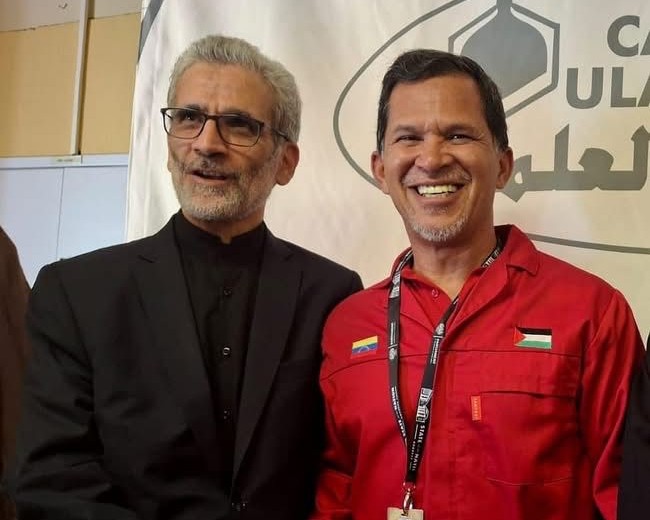
Cape Town politicians, anti-Israel extremists, members of civil society, and local media made it clear they have no problem with the atrocities of the Islamic Republic of Iran when they unashamedly met with the Iranian ambassador to South Africa, Mansour Shakib Mehr, at a briefing on Friday 20 March in Cape Town.
There, the ambassador said that the Islamic Republic “really appreciates the strong stance of Dirco [the Department of International Relations and Cooperation]” in maintaining South Africa’s relationship with Iran, and asked Pretoria to “use its influence” to stop the war.
“We also ask the people of South Africa to show their solidarity with the Republic of Iran and to demonstrate to the global community their strong will in opposing the aggression,” he said.
The event was hosted by the Cape Town Ulama Board, an Islamic organisation, which called it a “rare opportunity for first-hand insight into Iran’s perspective on resisting international aggression and navigating complex regional dynamics.”
Representatives from 56 local organisations attended, including a representative from PAGAD (People Against Gangsterism and Drugs), which has been implicated in episodes of urban terrorism, and retired Judge Siraj Desai.
Wearing a pin of the South African and Iranian flags, which were handed out at the event, the leader of the opposition in the Western Cape Legislature, African National Congress (ANC) Member of the Provincial Legislature Muhammad Khalid Sayed, said the briefing was a “brave” move and he was “honoured to participate”. He said that the current war aims to “weaken Iran so that it can no longer play the role of being in the vanguard of the struggle for Palestine”.
Economic Freedom Fighters (EFF) Member of Parliament Mogamad Nazier Paulsen attended the briefing and wrote afterwards that the Iranian ambassador is “a friend and a brother – [it is] a brotherhood based on the principle of love for humanity and a quest for justice for oppressed people across the world”.
Paulsen went on to say that “we are equally appalled by the Epstein class and those who like to cosy up to them”.
His use of the term “Epstein class” is “a textbook example of modern antisemitism in coded form”, according to the chairperson of the Cape South African Jewish Board of Deputies, Simone Sulcas. “By invoking Jeffrey Epstein and turning his name into a category of people, it acts as a dog whistle, inciting people to ascribe collective guilt and moral depravity to Jews, while preserving deniability.”
She says that “this is how contemporary Jew-hate often operates: implied, deniable, but rooted in the same old tropes”. Public figures like Paulsen “legitimise discrimination by using language like this. While we have come to expect such statements from Paulsen, it is no less dangerous than overt antisemitism, and must be called out plainly.”
Sayed and Paulsen’s comments came a day after the Iranian regime executed a 19-year-old Iranian wrestler for taking part in protests, and two days after an Iranian missile killed four Palestinian women in the West Bank.
The mission of the Cape Town Ulama Board is “advocating for intellectual growth and rejecting radical ideologies in Islam”, and the organisation faced some backlash for hosting the briefing. But Desai defended the gathering, saying the Cape Town Ulama Board took the “historically correct position” in hosting it.
The event was held at the Castle of Good Hope, just weeks after many of the attending organisations protested events being held at the site.
Director of the Middle East Africa Research Institute Benji Shulman explains that the briefing can be seen in the context of Iran being extremely isolated, both internationally and locally. This was evident from the outset of the war, when Russia and China abstained from supporting Iran at the United Nations, and when Iran targeted the Gulf states, Turkey and Azerbaijan.
Locally, “we have Iranians living in South Africa who’ve been extremely vocal [in opposing Iran]. In addition, several Muslim community groups have come out with statements that have either been lukewarm in condemning Israel and America, or have said outright that that they’re happy that the Ayatollah has died,” says Shulman.
So, Iran has been looking for diplomatic support, “and some of their key players here in South Africa have not been so supportive”, he says. “They’re trying to shore up whatever support they can, and the one place they can still get that is from the EFF and the ANC. They’ve pushed hard to activate that support and to work with parts of the Muslim community that might be more supportive, and that’s what we’re seeing on display.”
This was evident when, at the briefing, the Iranian ambassador called for “solidarity” and told local media and religious leaders, “Don’t let Western media stories cover the eyes and hearts of those seeking the truth. Publish the Iranian narrative of this conflict.” This was echoed by religious leaders, politicians, and anti-Israel extremists at the briefing, who all called for “unity” in supporting the Islamic Republic of Iran.
The Democratic Alliance (DA) spokesperson on International Relations and Cooperation, Ryan Smith, told the SA Jewish Report that the ANC and EFF’s “close proximity and public allegiance” to the Islamic Republic of Iran “only proves that these parties show total disregard for the principles enshrined in the South African Constitution, and continue to see the world through a complete subversion of reality”.
He emphasises that “Iran is not, and has never been, South Africa’s friend”.
Rather, it has made a “useful global pawn” out of the ANC through patronage and influence. “In pledging its allegiance to a violently oppressive theocratic autocracy, the ANC has shown that it has forgotten its roots as fighters for democracy, and sold its values to the highest bidder,” says Smith.
He says the ANC’s “misplaced alliance” with Iran is “not only a betrayal of its own principles, but a betrayal of democratic South Africa’s very existence”. The DA “will not allow the ANC’s political international alliances to tarnish the reputation of the South African republic,” says Smith. “South African people are freedom-loving, and we don’t stand with countries like Iran.”
Veteran journalist and ANC critic William Saunderson-Meyer told the SA Jewish Report that such a briefing isn’t surprising given “the anti-Western narrative that now almost completely dominates public discourse in South Africa”.
He says the South African government is “becoming increasingly hardline and irrational in its embrace of rogue and dangerous regimes, oblivious to its growing isolation from the countries that have been its historic allies”.
Ray Hartley from the Platform for African Democrats agrees, saying, “South Africa continues to alienate itself from the democratic world with its uncritical embrace of the autocratic and violently repressive Iranian government. This irresponsible approach puts the country at odds with key trading partners and with countries that prize democracy. We are once again on the wrong side of history.”