


Lifestyle/Community
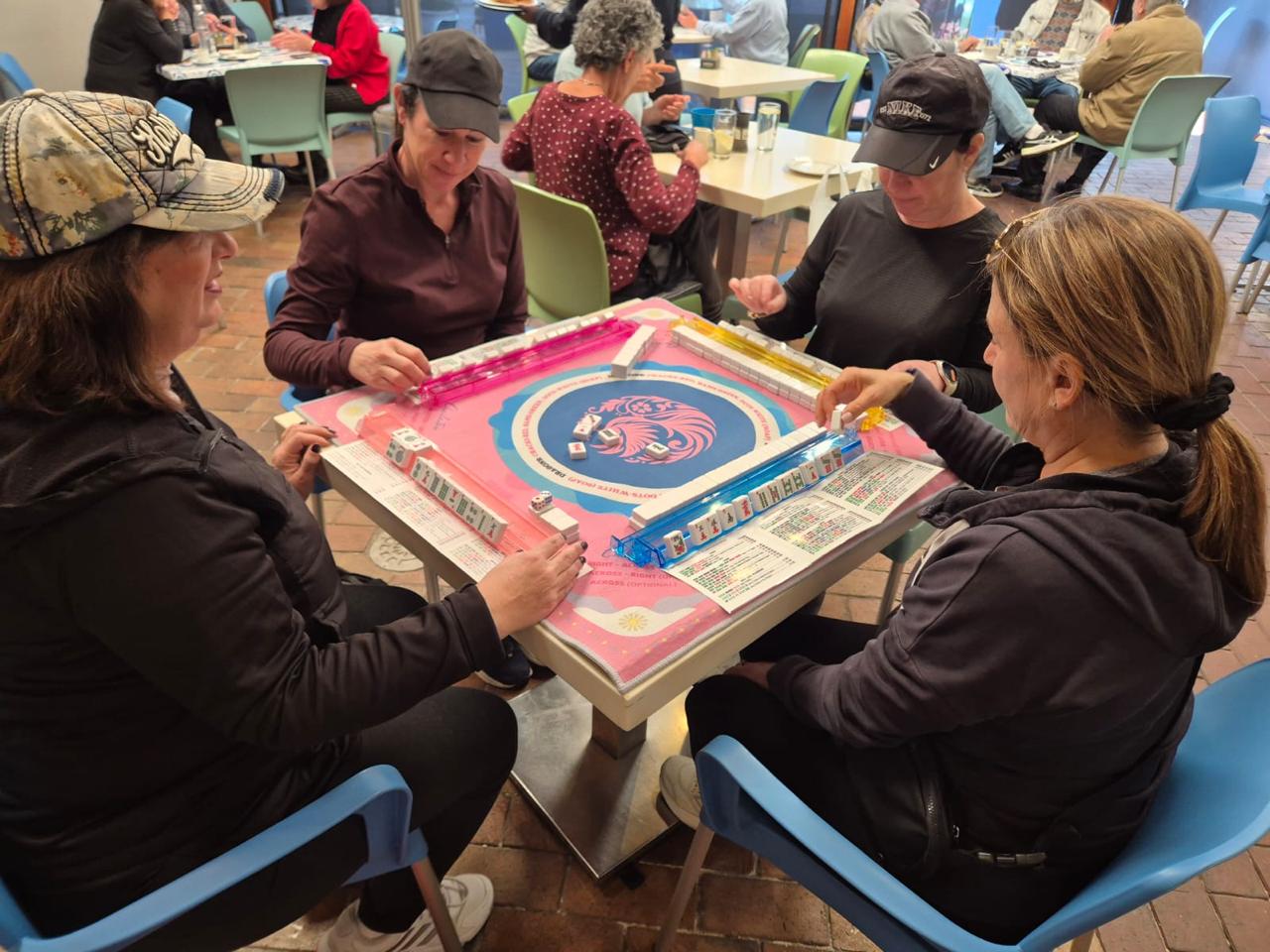
Mahjong is the latest social craze

Forget card games; Mahjong is rapidly becoming the game of choice for many South African Jews. The ancient Chinese tile game has experienced a recent boom in popularity, drawing in newcomers eager to test their strategic thinking while enjoying a social afternoon.
The four-player strategy game with 144 tiles – some versions use slightly fewer – has attracted people who want to use their intelligence while also building community. The goal is to be the first player to complete a winning hand by collecting sets of matching or related tiles.
There are two distinct versions of Mahjong. In the traditional Chinese version, instead of following a card, players generally aim to complete a winning hand of four sets, such as three identical tiles or a sequence of three consecutive suited tiles, and one pair.
The American version of the game, played according to National Mah Jongg League (NMJL) rules, was started in 1937 by a group of Jewish women in New York. The goal of American Mahjong is to be the first player to complete a valid winning hand listed on the NMJL card.
Johannesburg Mahjong teacher Tracy Jay says that after selling her business last year, and with both of her children out of school, she was looking for something to keep herself busy. “I play kaluki, klaberjass, and am always up for a game of any kind. A couple of friends were starting and I jumped at the opportunity to join.”
“Mahjong has both cognitive, psychological, and social benefits,” she says. “I love challenges and brain stimulation as much as the social aspect. This is why the American version has grabbed me. Just when you know the cards by the end of this year, the NMJL in the US will release a new card for 2027 around April,” says Jay, who plays according to the strict American rules.
Sue Blou, who teaches Mahjong with Jay, says she found the game through a friend and was enticed by the idea of playing something new.
“I ordered my first set and practised by playing on my own. I also practised playing on apps. Then I played my first in-person game, and I was hooked,” she says.
“I realised that I had a passion for teaching others to play so that they could get the benefits that I have gotten from playing. As a bit of a rule follower – one group that I play with calls me the Mahjong Police – I wanted to teach people to play according to the rules of the NMJL so that they can play anywhere in the world where American Mahjong is played,” she says.
When Cape Town moms Sarin Goott and Ady Cohen couldn’t get into bridge lessons, and since Stern had a Mahjong set, they decided to learn how to play. When they wanted to spread knowledge about Mahjong, they started the Bam Bam Club, where they teach people how to play and sell Mahjong sets so they can play at home. They have taught 10 groups of students so far and are planning for more.
“It’s not so much about learning and teaching people and selling the sets. It’s about really building a community of people who want to do something together and socialise. It’s a fun game. So you can learn it quite quickly. And once you get it, you can apply your skills to any cards,” says Goott.
Gilla Mac Gregor started playing Mahjong with her father when she was six or seven years old and has continued to play for about 40 years since then. She now teaches people how to play Chinese Mahjong.
“We played weekly games every week when he was still at home. And then when he moved into Sandringham Gardens, he carried on there. And he teaches and has his own game group there,” she says.
Leon Lipschitz, who runs Mah Jong South Africa, discovered the game in 1965 through a magazine, Games and Puzzles, and has been hooked ever since, playing nearly every day. When he was going to propose to his wife 50 years ago, he told her that if she didn’t learn to play Mahjong, they could not get married.
“When I die one day, and they bury me, and someone says that they want to play Mahjong, I’ll get up and I’ll go play. That’s how much I like Mahjong. I’m totally addicted to it,” he says.
Even when he moved to Sandringham Gardens, he ensured that he would continue to play, and now has around 50 people coming faithfully to play at different times throughout any given week.
“It keeps your mind active. You have to remember what’s been discarded, so it’s similar to games like Rummikub or cards in that it exercises your memory. Unfortunately, many people come to the home and end up sitting staring at the four walls and the ceiling, with very little to do. This group gives them something to look forward to and helps keep their minds engaged.”
Transformational catalyst, leadership coach, and facilitator Janet Goldblatt started playing Mahjong some 15 years ago when her friend’s mother started to teach them. Since then, she has played regularly with about six of her friends and has taught her two children.
Goldblatt sees it as a good way to meet with her friends while also stimulating their minds, as there is a fair bit of strategy needed to play. Because of this, she also has started teaching Mahjong with one of her friends.
“When I stopped working for a while, there was always this gap, and then you tend to just have coffee and talk rubbish, which can sometimes be meaningless,” she says. “I was learning Torah, which helped. But not everyone is into that. And I just think that there’s a lot of loneliness. And I see, for me, I think that what would be amazing is if there is a space where people can come and learn and play and also have joy and meet other people.”
“For the two or three hours while you are playing, you set aside your worries and just enjoy being in the moment of playing and laughing, whether you win or lose. It’s a great distraction from the mundanities of life,” says Blou.