



SA
Myanmar genocide ruling’s impact on SA’s ICJ case

A landmark genocide ruling against Myanmar has given South Africa new legal arguments in its case against Israel, but has also reaffirmed the high standard required to prove genocide.
At the centre of the debate is genocidal intent: the specific intention to destroy a national, ethnic, racial, or religious group, in whole or in part. The killing of civilians, even on a large scale, doesn’t automatically constitute genocide. That particular intention must also be established.
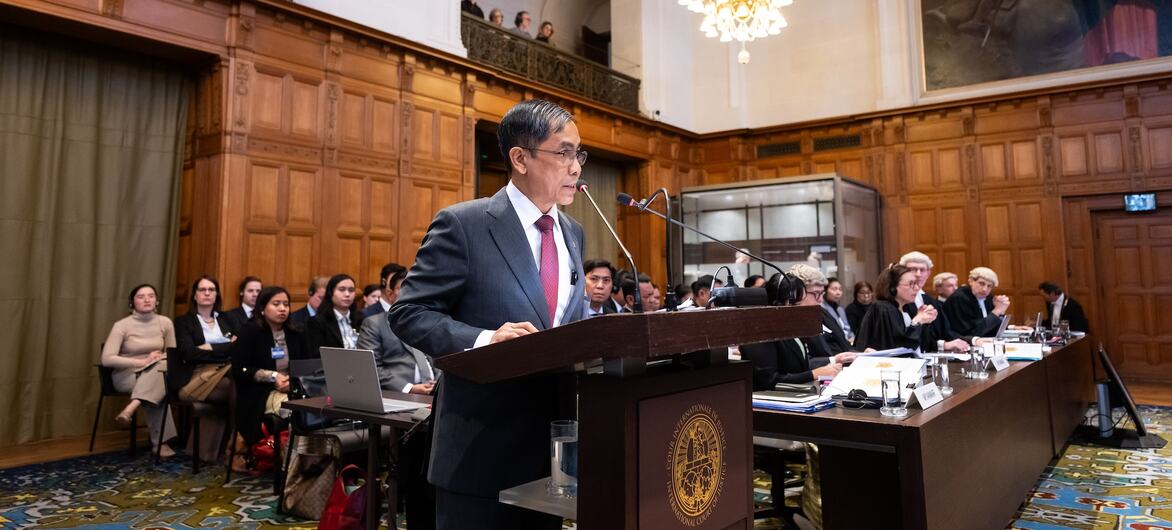
The International Court of Justice (ICJ) ruled by nine votes to six on 19 November that Myanmar committed genocide against its Rohingya Muslim minority during military operations in 2017. It was the first time the court had found a state directly responsible for committing genocide.
The ruling has divided legal experts and the court’s own judges over how genocidal intent should be proved, with potentially important consequences for South Africa’s case against Israel. The court maintained that genocidal intent must be the only reasonable inference from the evidence. But it also found that such intent can exist alongside other objectives, including military ones. That distinction matters for Israel, which maintains that its military campaign in Gaza was directed against Hamas following the 7 October attacks, rather than against Palestinians as a group.
South Africa has welcomed the judgment. The Department of International Relations and Cooperation said it would study the implications for other cases under the Genocide Convention, including ongoing proceedings.
But international law expert Professor André Thomashausen believes the ruling could work in Israel’s favour. He pointed to the court’s finding that Myanmar had acted with the specific intention of physically destroying the Rohingya, in whole or in part, as an ethnic or religious group. “The only reasonable inference that can explain Myanmar’s actions is an intention to destroy a substantial part of the group,” he said, quoting ICJ president Yuji Iwasawa’s reading of the judgment. “I doubt that such a finding can be made against Israel.”
Thomashausen stressed that the court hadn’t abandoned the requirement to prove specific genocidal intent. “The central element of manifest genocidal intent was confirmed, not conditioned or taken as implied.”
The judges were sharply divided over whether that requirement had been met in Myanmar. Six of the 15 judges, led by ICJ vice-president Julia Sebutinde, issued a joint dissenting opinion. They acknowledged the suffering inflicted on the Rohingya, including killings, sexual violence, displacement, and the destruction of homes, but concluded that the evidence hadn’t established genocidal intent to the required standard.
Their objection went beyond disagreement over the facts. They argued that the majority had given too much weight to discrimination, forced displacement, and attacks on the foundations of Rohingya community life without adequately explaining how these established an intention to physically or biologically destroy the group.
They also challenged the majority’s method of examining whether genocide was a reasonable inference before considering whether it was the only reasonable one. They warned that this could effectively shift the burden towards Myanmar to demonstrate another explanation for its conduct. In their view, the court risked blurring the distinction between genocide and other serious international crimes. That distinction is important. War crimes and crimes against humanity can involve widespread killings and terrible suffering without necessarily meeting the legal definition of genocide.
For South Africa, the question is whether the evidence from Gaza, including civilian deaths, destruction, restrictions on humanitarian aid, statements by Israeli officials, and the conduct of military operations, establishes the specific intention to destroy Palestinians in Gaza as a protected group.
Anne Herzberg, legal adviser and UN representative for NGO Monitor, rejects the suggestion that the Myanmar judgment strengthens South Africa’s case.
She argues that the circumstances in Gaza were fundamentally different, citing Hamas’s 7 October attacks, rocket fire against Israeli civilians, hostages taken into Gaza, and Hamas’s extensive tunnel network. She also challenged the court’s interpretation of genocidal intent. “The court was somewhat incoherent in its interpretation of the special intent standard for genocide.”
Herzberg questioned how a state could comply with international humanitarian law governing armed conflict and nevertheless be found to possess genocidal intent. She also argued that judges had substituted their own assessments of military decisions for those of military experts.
An analysis published on 23 November by Israeli international law scholars Yuval Shany and Amichai Cohen suggests that the implications for Israel may be more complicated. Writing in the legal publication Just Security, they argued that the Myanmar judgment has made genocide law less predictable by giving judges greater scope to assess the overall pattern of conduct. They identified several issues that could affect South Africa’s case, including how the court considers civilian displacement, damage to religious and cultural sites, statements by officials, and evidence from UN investigations. They also said that compliance with the laws of armed conflict would not, on its own, defeat an allegation of genocide.
But Shany and Cohen stressed that there are important differences between Myanmar and Gaza. Myanmar’s operations followed attacks by a relatively lightly armed insurgent group. Israel, by contrast, faced a heavily armed and organised force following the 7 October attacks, when 1 200 people were killed and 250 taken hostage. They also noted Israel’s warnings to Gazans, evacuation orders, humanitarian arrangements, and ceasefire negotiations, although the effectiveness and adequacy of those measures have been disputed.
The Myanmar case was brought by The Gambia in 2019 following military operations that forced hundreds of thousands of Rohingya to flee to neighbouring Bangladesh. The ICJ examined evidence of killings, serious bodily and mental harm, sexual violence, and measures intended to prevent births within the Rohingya population. Myanmar maintained that its operations were directed against insurgents. But the majority of ICJ judges concluded that the only reasonable inference from Myanmar’s conduct was an intention to destroy a substantial part of the Rohingya group.
The Myanmar ruling doesn’t determine the outcome of South Africa’s case against Israel, brought in December 2023. But it gives South Africa and Israel a new judgment to draw upon, with arguments that could be used by both sides. What remains to be seen is how the ICJ will apply those principles to the very different circumstances of the war in Gaza.