





OpEds
Standing our ground 25 years after Durban hate fest

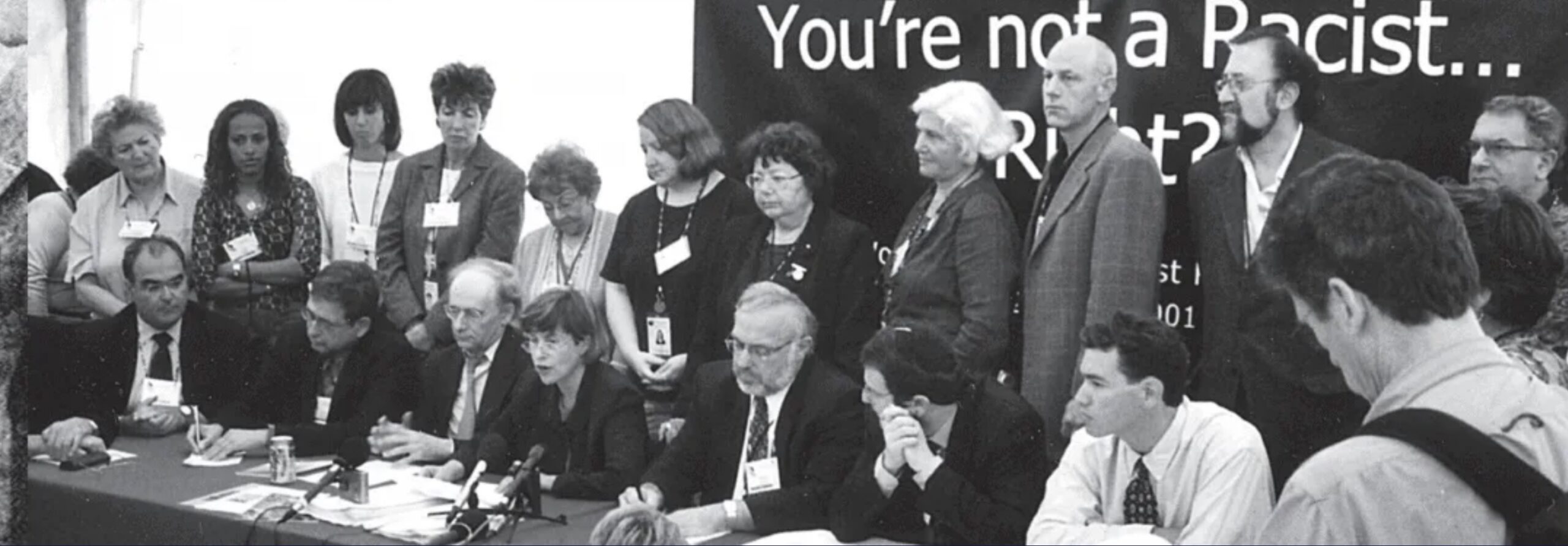
Twenty-five years ago this week, the traditionally laid-back coastal city of Durban became the epicentre of an organised international anti-Jewish hate campaign the likes of which had not been seen since the Holocaust – the infamous United Nations World Conference against Racism. Nine days later, on 9/11, the world would fix its gaze on the burning Twin Towers of Manhattan and call that the day everything changed. But for me, and a small band of fellow Jewish student activists, the implosion had already taken place two weeks before in Durban.
How could this happen at a major anti-racism conference held under the auspices of the most powerful human rights organisation in the world and hosted in a country that was the paragon of non-racism?
At the time, I was an executive member of the South African Union of Jewish Students, part of a generation that had come of age during what Francis Fukuyama called “the end of history”, when democracy seemed on an unstoppable march and antisemitism, the oldest hatred, was a relic swept into history’s dustbin. For South African Jews specifically, the “New South Africa” held the promise of a revival after decades of decline and isolation under apartheid.
Together with a handful of students from the World Union of Jewish Students, we would form part of the larger Jewish Caucus with leading Jewish human rights academics, activists, and leaders from around the world. The Jewish Caucus’s main aim in attending the United Nations (UN) Racism conference was to celebrate the strides we’d made in the fight against antisemitism.
There had been some red flags that Israel might come in for criticism over its handling of the then recently launched Palestinian Intifada. The final preparatory conference had been held in Tehran, from which all Israeli and Jewish Caucus delegates had been barred by the Islamic Republic. Also, the draft declaration had some inflammatory language against Israel and the West. But it was felt that American and South African pressure for a successful, inclusive conference would moderate this. We were totally unprepared for what was in store for us.
We arrived in Durban at a well-organised and funded festival of hate directed against Jews and the Jewish State. Thousands of people from around the world wore T-shirts branding Israel the last bastion of apartheid. Leaflets unashamedly declared that the world would be a better place if Hitler had won the war and solved the Jewish question. The notorious antisemitic forgery The Protocols of the Elders of Zion was openly on sale. Posters showing hook-nosed Jews controlling the world stared down on us. Jewish delegates were harassed, and even the official conference panel on antisemitism was disrupted by anti-Jewish protesters claiming they were the real semites.
African National Congress member of Parliament Pallo Jordan denounced it as “utterly disgraceful”, and so disgusted was UN conference secretary-general Mary Robinson with what had taken place that she declared, “When I see something like this, I am a Jew.”
Faced with this avalanche of hate, the official Israeli and American delegations, as well as many of the Jewish nongovernmental organisations (NGOs) in attendance, chose to withdraw. But the Jewish student delegation took the alternative approach and decided to fight back. We realised that with most of the world’s media on the ground, this could be an opportunity to debunk the big lie the conference was perpetuating and expose the true face of our detractors.
So, with the help of the resourceful Durban Jewish community, we printed and distributed within hours thousands of T-shirts with a proud Magen David on the front, calling on people to “Fight racism not Jews”. We worked through the night putting together pamphlets and posters to hand out, as the Israeli Foreign Ministry produced no hasbara material at the time. The climax of our campaign was a peace rally where, in a gesture of reconciliation, we even attempted to hand out flowers to our opponents.
Never missing an opportunity to miss an opportunity, they responded with the most vile antisemitic abuse in full view of the press. So aggressive were they that police had to be called in to prevent us being lynched. That image of a handful of Jewish students, singing peace songs, being attacked by a large, angry mob at an anti-racism conference was broadcast on every major TV news channel and in hundreds of newspapers around the globe – the equivalent of going viral in a pre-social media world.
Durban was the harbinger of what was to come. The hatred we encountered there was only the tip of a much larger iceberg. Twenty-two years later, after 7 October, its full extent was revealed. Almost every major city in the West, and practically every major university campus, became its own Durban. The same T-shirts. The same chants. The same visceral Jew hatred.
The Durban strategy is to isolate Israel from the community of nations, to portray it as an apartheid and genocidal state, uniquely illegitimate, and, ultimately, as beyond the pale. For the 25 years since Durban, that campaign has seeped into NGOs, UN bodies, and Western universities, fuelled in part by Qatar’s vast investments in this project.
South Africa, too, with its human rights halo, has played a particularly important legitimising role, culminating in its decision to place Israel in the dock at the International Court of Justice.
In the Book of Numbers, the pagan prophet Bilaam looks down upon the Jewish people and declares, “Behold, it is a people that shall dwell alone, and shall not be reckoned among the nations.”
For 25 years since Durban, we have watched as that prophecy has been turned into a political programme. And there is a real danger that we succumb to this fate.
“Dwell alone” cannot mean withdraw. Isolation cannot become our instinct. If we surrender the universities, the media, the cultural institutions, and the public square, we leave our enemies to define us.
That was the choice confronting the Jewish student delegation in Durban. We could have walked away. Instead, we stayed and confronted the lies. We did not change the minds of the mob but we changed the story that the world was watching.
Twenty-five years later, that is the lesson we need to remember. The answer to the curse of dwelling alone is not to pretend the hostility isn’t real. It is to refuse to let our enemies decide where we stand.
- Michael Kransdorff is the chairperson of the Jewish National Fund SA and was the SA Union of Jewish Students national treasurer and Wits political officer. For a deep dive into the Durban conference, listen to the podcast Durban 2001: How Zionism became a Dirty word on Unpacking Israeli History?






Errol Price
September 4, 2026 at 1:00 am
A worthy reminder that the scourge of anti-semitism is continulally metamorphosing and appearing in new guises.
These days it it alliances from the left including ‘ liberationists’ like the ANC, woke university leftists and jihadists who present the biggest threats to Jewish communities across the globe.
Durban will go down in Jewish history as the 20th century ” Kristalnacht .
Alfreda Frantzen
September 4, 2026 at 9:33 am
I am aghast to read this, i was living here and know nothing about it. Well, the fight goes on against these horrors – may peace and understanding win the day!!