


World
Take a look at the antisemitism command centre inside Boston’s Gillette Stadium

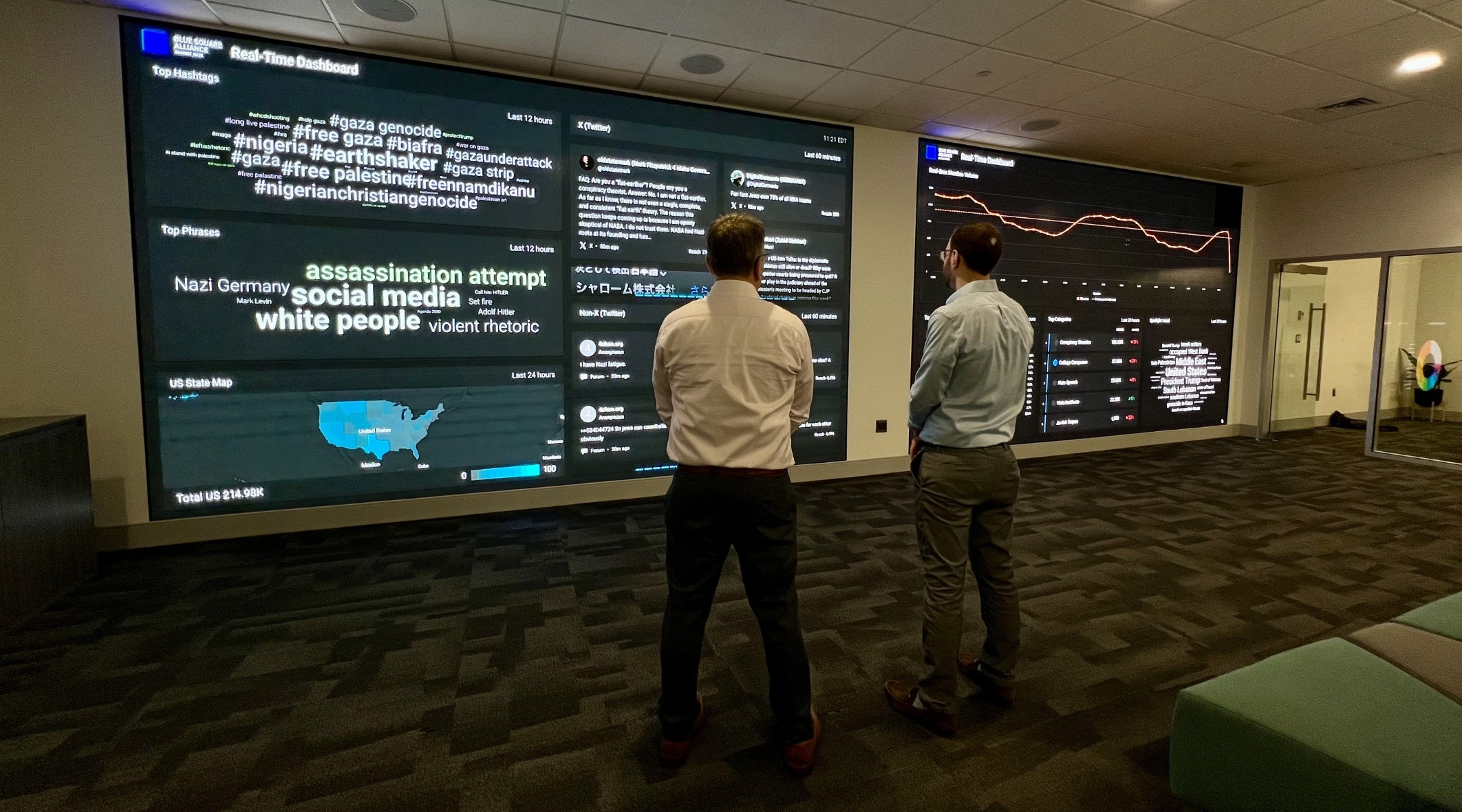
JTA – For the past five years, a speciality “command centre” that researches antisemitism has been operating inside the New England Patriots’ home stadium in the Boston suburb of Foxborough.
Wall-sized screens, refreshed every minute, show live updates on public conversation topics related to antisemitism. Tweets featuring antisemitic dog whistles are also blasted onto an enormous dashboard, hand-me-down technology formerly used by the Patriots during team practice to run plays.
The command centre is where the Blue Square Alliance Against Hate monitors more than a billion social media posts every day. It’s a project of the Patriots’ Jewish owner, Robert Kraft, the Boston-area philanthropist who founded the alliance in 2019.
On Tuesday, 23 June, the nonprofit anti-hate organisation announced the formation of a new advisory board featuring a slate of high-profile names: former Secretary of State Condoleezza Rice; Warner Bros. chief executive David Zaslav; Bank of America chief executive Brian Moynihan; Salesforce chief executive Marc Benioff; and Dentons chief executive Kate Barton.
The advisory board will guide the organisation on strategy and “deepen institutional relationships”, its website said.
The statement said the board will help further the mission of the roughly dozen analysts who staff the command centre. They monitor trends in antisemitic rhetoric online, craft research reports based on their findings, and use search engine optimisation to make links with their resources float to the top of Google search results. The wall-sized screens are filled with word clouds, pie charts, bar graphs, tweets, and Facebook posts, detailing what everyday Americans encounter online.
Since 7 October, the Blue Square Alliance has been on particularly high alert, monitoring shifts in the online conversation around antisemitism, which often included ordinary social media users swapping the word “Zionist” for “Jew” in derogatory ways, the group says. But in late February, when the United States and Israel entered the war with Iran, the Blue Square Alliance began noticing new trends in their data.
“What we saw, especially right after the operation began, is Hitler glorification was the first thing to spike,” Rotem Leiba, a lead analyst at Blue Square Alliance, said. “In terms of all the antisemitic things we’ve seen happening at this time, Hitler glorification was the first to spike.”
Using Brandwatch, the social media monitoring software, the team found that terms like “Hitler was right”, “We owe Hitler an apology”, and “Hitler knew what he was doing” appeared with increasing frequency, more than in the aftermath of 7 October. A new term, “Hitler in heaven”, also began popping up across social media, topping similar sentiments at 21.4 million impressions.
One area the analysts are still investigating is bots: studies have shown that automated software programmes frequently amplify levels of hate speech.
“We’re starting to talk to other partners that can help us understand who are the actors behind these conversations and … their echo chambers, and who’s the one publishing it,” Leiba said.
Efforts to manipulate public opinion and inflame social tensions are often pinned on Russia, Iran, and other countries, although most of the bots Blue Square is tracking appear to be homegrown, Leiba said. “Even some of the bots that we have seen in some reports amplifying content are bots that are created domestically, not necessarily from foreign actors.”
As Israel and the United States joined forces to attack Iran, and Israel pursued its proxies in Lebanon, rhetoric dehumanising Jews also spiked. CyberWell, a compliance partner to social media organisations that helps them follow content moderation and regulatory policies, found similar results.
Tal-Or Cohen Montemayor, founder and executive director of CyberWell, said the users would compare Jews to “rats, pigs, monkeys, or cockroaches in the comments section ‒ that’s human beings being really disgusting”.
The Foxborough-based command centre resembles that of the Secure Community Network in Chicago, where the group that coordinates security for Jewish institutions set up an office in 2021 to monitor antisemitic threats.
At the stadium, which will also have hosted seven matches by the end of the current Fifa World Cup, it’s clearly Kraft’s team’s turf. Photos of Kraft, framed OpEds he wrote about antisemitism on college campuses, and pictures from his alma mater, Columbia University, decorate the office. Blown-up images of the Patriots’ Super Bowl rings adorn the hallways leading into the command centre.
The alliance is part of a crowded field of antisemitism watchdogs that includes CyberWell, the Combat Antisemitism Movement, the Secure Community Network, and the Anti-Defamation League (ADL) Center for Antisemitism Research. The ADL and Blue Square Alliance announced the formation of a partnership in February to expand educational programming on antisemitism prevention in schools and providing support for synagogues and faith communities.
“They’ve built delivery trucks going to all these different places, and the trucks aren’t full,” Katz said, referring to their blue square pins and other “blue square content” and “blue square messaging”. “We have stuff we’re trying to get onto delivery trucks to get to these places. It’s an obvious match.”
Their efforts are based on the idea that monitoring can help identify rising risks of violence and detect dangerous trends before they escalate. Susan Benesch, who directs the Dangerous Speech Project at Harvard University, has written that such early warning systems are helpful, but only so long as they are matched by actions.
In a working paper for the US Holocaust Memorial Museum, Benesch suggested steps like promoting “counterspeech” by influential members of a community, changing the design of social media platforms that amplify such speech, or strengthening social norms in the communities from which the hate speech and misinformation emerges.
Blue Square may be the most public-facing of these monitoring efforts, and, with Kraft’s money and platform, the best known, thanks to its Super Bowl ads and its association with America’s most popular sport.
Having captured the public’s attention, the alliance is seeking to shape its discourse. When regular internet users look up an antisemitic conspiracy theory or a trending dog whistle, Blue Square wants its results to be the first they see.
“Our default use case is: what does mainstream America see and hear on this topic?” said the group’s president, Adam Katz.
Steven Fransblow, chief data and technology officer at the Blue Square Alliance, provided a typical example. “We’re trying to crack the code on: how can we continue to be surfaced when Candace Owens says, ‘Go research this’,” Fransblow said. “They’re finding us, versus Reddit.”
Owens, a far-right commentator who frequently promotes antisemitic conspiracy theories, has nearly eight million followers on Twitter, and nearly six million subscribers on YouTube. Once a well-regarded voice in the conservative political space, she has been disavowed by her former supporters in more recent years as her content has become increasingly anti-Israel and antisemitic.
In January, Owens suggested that her former employer, the conservative podcaster Ben Shapiro, who is Jewish, sought to grab the mantle of Turning Point USA’s slain founder, Charlie Kirk, saying Shapiro was acting as if he was promised the role 3 000 years ago. The “3 000 years ago” phrase is an antisemitic meme, mocking Jews for claiming ancestral ties to the Land of Israel and alleging they exploit history to assert a nefarious agenda. That phrase, which Blue Square says arose as early as 2014, but took off after 7 October, is one that the organisation is working to counteract with its web presence.
Search “3 000 years ago” and “Jews” on Google and hits explaining its antisemitic intent pop up from the American Jewish Committee, CyberWell, the Times of Israel, and social media sites like Reddit and Quora. This week, anyway, Blue Square’s explanation of the term showed up on the second page of search results.
The alliance has its critics. A controversial $15 million (R247.7 million) Super Bowl ad, which aired in February, featured a Jewish high school student who discovers a Post-It note scrawled with the words “Dirty Jew”. Critics of the word choice found it outdated or unrealistic, or called the ad spending outlandish, arguing that there are better ways to address antisemitism or help the Jewish community.
Katz defended the ad, saying it was a vindication of the “command centre” and its data-driven approach to monitoring antisemitic language and memes.
“We were looking at what are the most ubiquitous slurs on social media that are happening with high volume and frequency and are understandable by everybody,” Katz said. “And that’s why we went with ‘dirty Jew’.”
According to the Blue Square Alliance’s research, the phrase “dirty Jew” made nearly 500 million impressions across 140 000 posts on X, Facebook, Instagram, Threads, Reddit, Bluesky, and 4Chan between 2023 and 2025 ‒ an increase, Fransblow said, of 174% from the previous three years.
“With the Super Bowl, you have 30 seconds,” Katz said. “It’s got to hit and land with as close to 140 million people as possible. So you’re trying to find language that is recognisable, that is ubiquitous, that is common, that is inarguably antisemitic.”
Said Katz, “We can’t afford to be too subtle.”