Religion
The aroma of Yom Kippur

Yom Kippur is the day we stand together. Not only as individuals auditing our own ledgers, but as one body, Klal Yisrael, appearing before Hashem as a single congregation. That is the aroma of the day. Not the ketoret (incense) itself, which we no longer have, but the unity it was always meant to represent.
The Midrash Tanchuma (commentary on the Torah) tells us that the Mishkan (Tabernacle) was fully assembled, the Altar, the Table, the Menorah, everything in its place, and the Shechinah did not descend until the ketoret was brought. Why the ketoret? Because it contained every spice, including chelbenah, the one with the foul smell. The Torah itself includes that spice among the ingredients, teaching that no one is left outside the circle.
The Kohen Gadol entered the Holy of Holies as the representative of the entire nation, not only those with a beautiful fragrance, but also those who are distant. There is no King without a people, and the rendezvous in the Kodesh Kodashim was a rendezvous of the King with His people, all his people.
That is the aroma I recently smelled in Johannesburg.
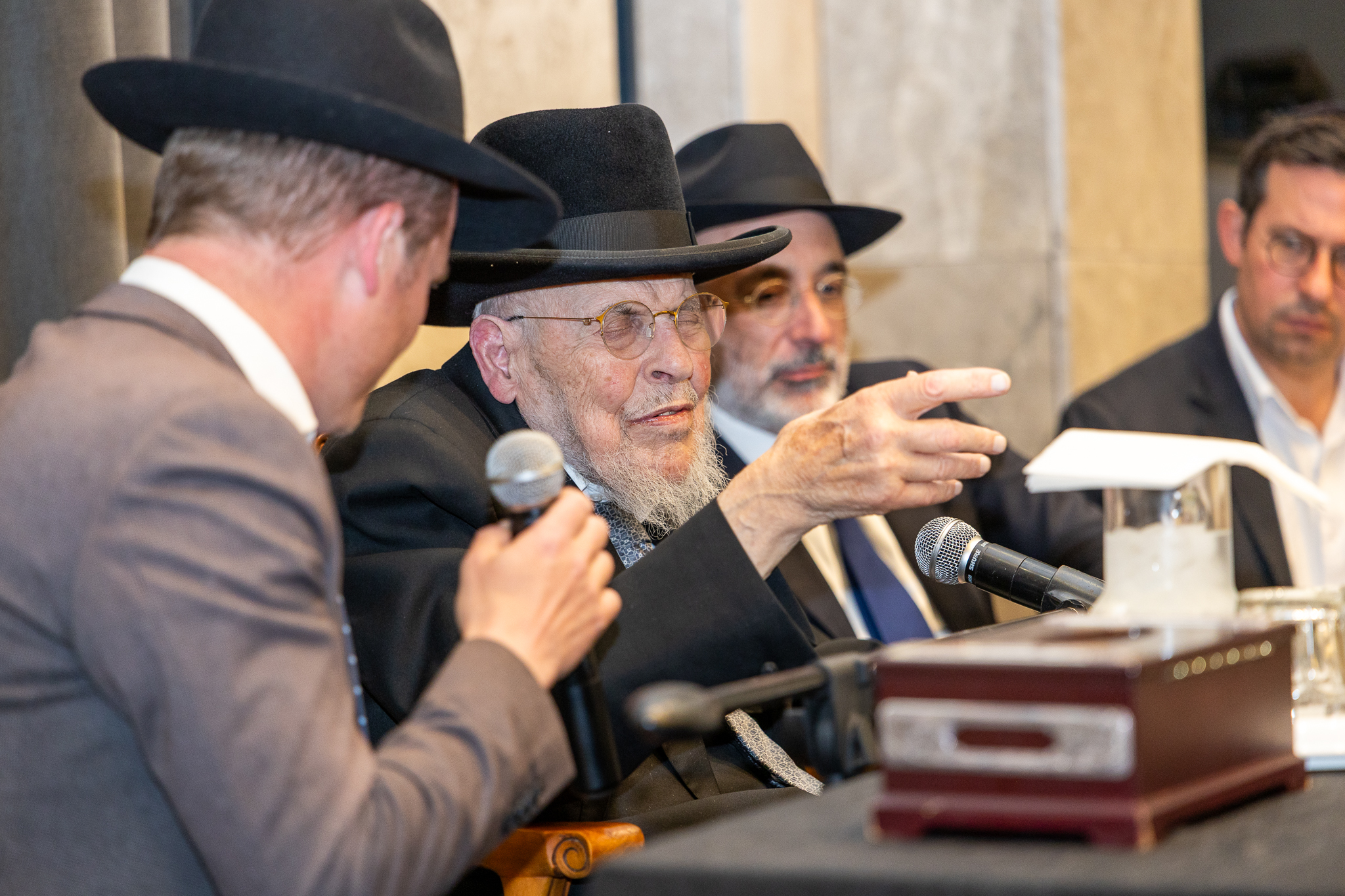
It wasn’t really planned, at least not in the way it turned out. A friend of mine had just met the Rosh Yeshiva of the Mir, Rav Yitzchok Ezrachi, and I suggested we ask him to come to South Africa. I thought it would be a tremendous merit for us all to host a very special man, a great sage of Israel. And more than that, I have been feeling of late that there is so much noise in the world around us that if we could just get back to basic core values, it would also be a really good thing.
The trip itself was at short notice. We confirmed his coming only on the Thursday night before the planned arrival on Sunday. A few calls were made, a few messages sent out, and we were astounded by the sheer volume of people who arrived at the airport, from many different communities, with their leadership present, the whole reception done in a very formal fashion.
The excitement, the respect, and the awe were palpable. Singing and dancing began. When everyone was standing and dancing around him, the Rav refused to remain seated in his wheelchair. He wanted to stand after a long flight; he wanted to stand and dance with the people who were standing and dancing for him.
In the car, he kept repeating how he had dreamed about what Johannesburg could be like, and then to see what it actually is, and this was only the beginning. “What a community. What a community!” That was his refrain. The love of Torah. The honour for Torah. The excitement about Torah and mitzvot. He was amazed by the connection and commitment he saw, not in one shul or one school, but across the board. He also spoke of still more potential, and of how important it is to be grateful for what we already have. If we nurture it, he said, there will be tremendous further growth.
Beyond the talks themselves, which were focused on strengthening our Torah focus and values, what keeps coming back to me is the way the Rosh Yeshiva loves the Jewish people, each and every Jew, regardless of affiliation. With unimaginable patience he sat with whoever came before him, whether they were going through a difficult time or asking about someone else. And quite literally hundreds of people came to him individually.
From the early hours of the morning until the early hours of the next morning he went from school to school, shul to shul, with all the difficulty of getting in and out of the car and into each venue. That was the level of his energy, and of his desire to reach as many people as possible. Add up the participants and you are into the thousands. The reception from the community was phenomenal.
Standing at his grandfather’s grave in Brixton Cemetery was profoundly emotional. His grandfather Rav Boruch Shlom, of blessed memory, originally of Kelm in Lithuania, became rabbi of a remarkable community in Oudtshoorn, a small town whose influence reached far beyond its borders. His Lithuanian roots are our roots too. A century later, one of the greatest sages of Israel stood at Shlom’s grave. It was an intensely special privilege to be there now with him, to watch the Rosh Yeshiva daven there, the way he said tehillim, the way he cared for each person he prayed for. He told us it was a very special place to daven, and that anyone who did so would have their tefillos heard.
On a personal note, the time I spent with him brought me so much chizuk (spiritual strengthening), it was mind-blowing. It was a great merit for me, for my family, and for our community, The Base, to facilitate this trip, together with partners Ari Slasky and Rabbi Raff. Baruch Hashem, many others came forward as well.
From the moment he arrived, we realised the power of the visit. Rav Ezrachi brought so many different people together without ever making a speech about unity. Whoever interacted with him came away inspired, understood, supported, and more positive about the future.
And I think that is the point. First, we realise, as individuals, how much is contained within us. Then we experience that together, and the “we” becomes something filled with possibility, how much we do have, and how much we can have, when we double down on what is truly important.
This may be why we recite Shehechiyanu out loud immediately after Kol Nidrei. The Tur writes that we recite it in shul because we do not recite Kiddush at our tables on Yom Kippur. Perhaps there is another reason. After the community has stood together and invoked the eternal covenant, it is as if we are born anew. What more appropriate time to say a blessing “that He gave us life, sustained us, and brought us to this time”?
As we approach Yom Kippur, that is what we need to carry with us: the potential contained within us, and the core values that are critical. When we work together and care for one another in that context, the return on the investment is unimaginable. May the aroma of this Yom Kippur rise before Hashem, and may the outcome be a Gemar Chasimah Tovah for all of us.
- Rabbi Aharon Zulberg is the rabbi of The Base in Johannesburg.