OpEds
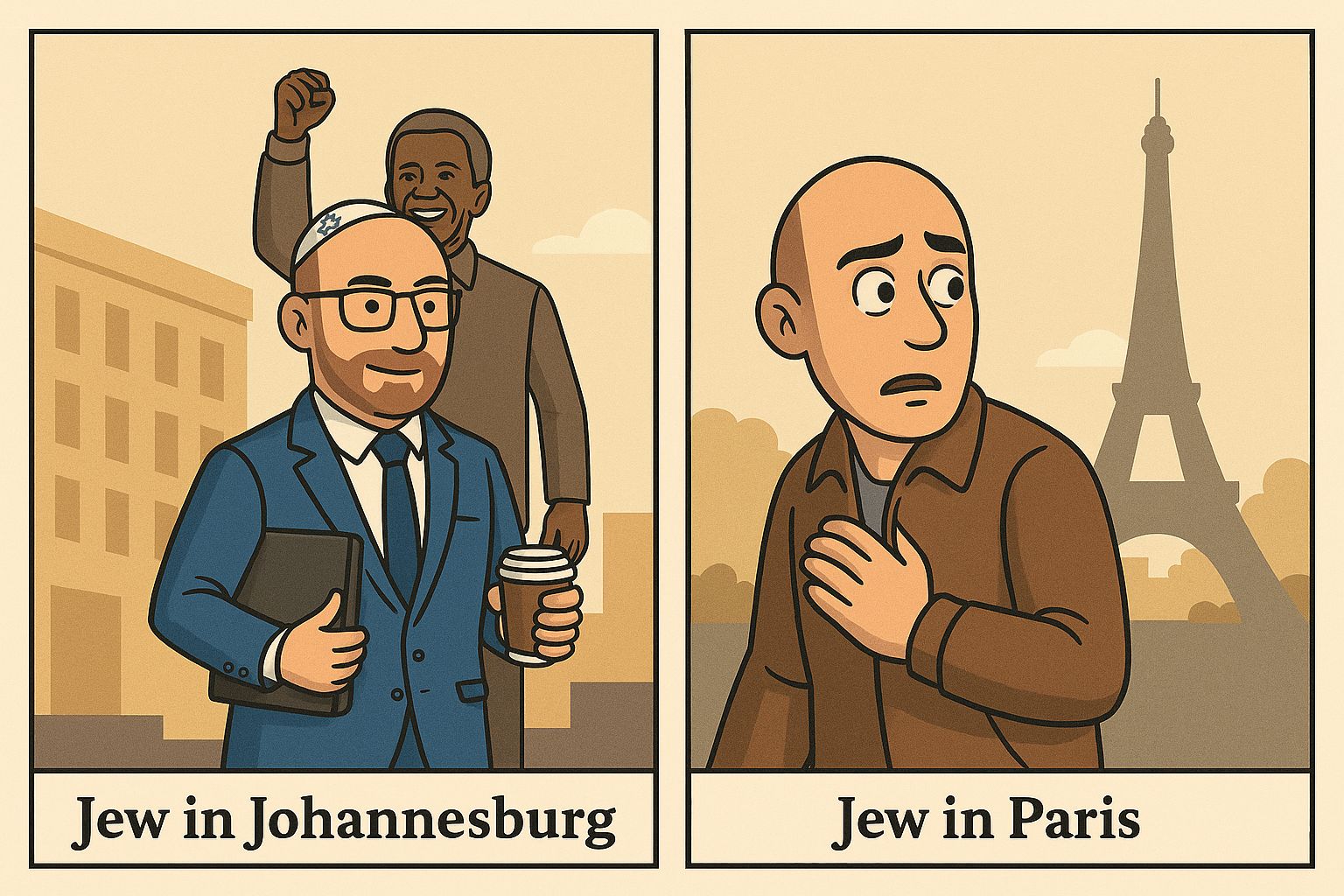
The kippah and the cap: a tale of two failed states

I’ve recently returned to South Africa after a few weeks in France and Spain. And to be honest? I feel relieved. I feel alive again. That might sound strange. Most people think of leaving South Africa as an escape from dysfunction. But sometimes dysfunction is better than suffocation. Sometimes the chaos of home is still a better bargain than the polished brutality of Europe.
Before we left Johannesburg, I made a quiet but deliberate choice. When I packed my bag, I included a cap, not a kippah. Not because I’m scared. Not because I’m ashamed. Because I’m realistic. I read the news, I follow the trends, I know the score. For every single day in Europe, the cap stayed firmly on my head. My yarmulke never saw daylight.
And two moments in Toulouse showed me exactly why.
The first was in a quiet kosher restaurant. Just us, the owner, and his staff. It felt normal, almost homey. For a moment, I could almost forget the undercurrent. But as we got up to leave, I noticed something. The owner, a man who had been confidently running his business, welcoming customers, wearing his kippah, reached up, removed it, and only then walked outside. No drama. No speech. Just instinct. A reflex as old as persecution itself.
The very next day, it happened again. The manager of a kosher grocery store. Same routine. Yarmulke off before stepping onto the street. Not a word said, no need to explain. Because everyone already knows the rule: Jewish visibility is dangerous.
That’s Jewish life in France in 2025. A life of constant calculations. A life of self-erasure.
Finding kosher food isn’t like popping down to Pick n Pay. You hunt for it. You search for specialist stores, tucked away, hidden, anonymous. Because there’s no easy, public Jewishness in France. You are either invisible or you are a target.
And it doesn’t stop at France. The same feeling followed us to Spain. Spain, the country that once expelled its Jews entirely, now boasts a Jewish community supposedly the size of South Africa’s. But you’d never know it. The infrastructure is a ghost. Kosher food exists, technically, but you’d better be in Madrid or Barcelona, and you’d better know exactly where to look. Beyond that? Forget it.
The cap stayed on.
Even in London, at Heathrow – the great crossroads of the world – I kept the cap on. And I wasn’t alone. We bumped into another family from our Johannesburg community. All of them wearing caps. They knew the drill. The same silent rulebook applied. In Europe, you blend in. You mute yourself. You reduce yourself to survive.
And then, OR Tambo International.
You know you’re home when an entire A380 full of passengers is being funnelled through just three working passport counters. The dysfunction greets you like an old friend. The queues snake endlessly, the kids are grumpy, the lack of planning for predictable flight schedules is staggering. It’s South Africa in one moment.
But in that queue, I saw something else. The family from Heathrow. The caps were gone. The kippot were back. And so was mine.
On the plane, just before landing, I’d done the same. Shed the cap. Put the kippah back on. And suddenly, in the middle of the chaos, in the middle of the brokenness, in the middle of the maddening inefficiency, I felt at home. Visible again. Jewish again. Alive again.
And that’s the paradox I can’t shake.
We all know Cyril Ramaphosa’s government is an antisemitic disgrace. That’s not news. His speeches, his grandstanding on the world stage, his open hostility toward Israel, it’s all there. But here’s the thing: Ramaphosa isn’t South Africa. He doesn’t speak for the people on this.
In Europe, it’s the opposite. Emmanuel Macron used to say all the right things. He played the part of defender of the republic. He gave the speeches. He posed as the shield against antisemitism. But the reality on the ground tells another story. The streets tell the truth. And now, with Macron pushing recognition of a Palestinian state, even the mask is gone.
I know this contrast personally. In the Johannesburg Council, I’m arguably one of the most publicly targeted Jews in South African politics. I’ve had the word “Hitler” hurled at me across the chamber, not whispered behind my back, but spat out in the record of a formal meeting. And yet I stand there. Kippah on my head. Values on display. Because here, the rhetoric of the political class doesn’t translate into the physical endangerment you can taste in the air in Europe. Here, the threat is loud, ugly, brazen, but not yet in your bones.
And so, you’re left with this choice: one country with a president who despises us, but a society that still allows us to live visibly. Another country with a president who pretends to protect us, but a society that quietly demands that we disappear. That says everything.
It makes you ask the harder question: what’s a failed state?
Is it just broken infrastructure? Non-functioning traffic lights; endless power cuts; water outages; collapsing roads; theft; or corruption? If that’s the definition, then South Africa is the poster child. But maybe failure runs deeper. Maybe the truest sign of a failed state is when your oldest minorities are forced to erase themselves in order to survive. When your public spaces are no longer safe for a kippah, when your so-called freedom exists only on the condition that you amputate a piece of your identity. That’s failure at its most profound.
France still parades around under the banner of “liberté, egalité, fraternité” (liberty, equality, fraternity). But it’s a sick joke now. A hollow slogan. You can chant “freedom” all you want, but if you have to slip off your kippah to buy groceries, your republic is already dead.
That’s why the small things matter. The sheer fact that in the middle of the Karoo, you can walk into a supermarket and buy kosher cheese is a deeper measure of freedom than all of Europe’s efficient trains put together. That little act of normality means more than the polished infrastructure of a continent where Jews survive by hiding.
South Africa is failing, yes. But it’s failing in ways we can fight for. It’s failing in the ways that are visible, material, infrastructural. Broken things can be rebuilt. Corruption can be rooted out. Power grids can be fixed. Those are battles of governance, and governance can be changed.
But when a society has decided that you cannot exist openly as who you are? That’s not failure you can fix. That’s death.
The return of the kippah at OR Tambo wasn’t just a wardrobe change. It was a reclamation. An act of breathing out. The irony is savage, but also undeniable: I had to leave a so-called third-world country to know what it feels like to be a second-class citizen in the first world. And I came back knowing exactly which fight is worth having.
This one. Right here.
- Daniel Schay is a member of the City Council of Johannesburg and is on the committee of Jewish National Fund South Africa. The views expressed are the views of the author alone, and don’t represent the views of any organisation or political party.