


Featured Item
Top leaders pay tribute to struggle hero Max Coleman

President Cyril Ramaphosa, top politicians, and civil society leaders joined the Coleman family on Wednesday at a memorial to honour the life and legacy of the late Dr Max Coleman.
Coleman, who died at 95 on 16 January this year, was an anti-apartheid activist, human rights commissioner, and businessman who made an immeasurable contribution to South Africa. He was most well-known for his leadership and contribution to the Detainees’ Parents Support Committee (DPSC), which he and his wife, Audrey, joined when one of their four sons, Keith, was detained by the notorious security police of the 1980s. The couple devoted their hearts and souls to the needs of detainees, working tirelessly behind the scenes to provide everything from food packages to legal assistance. In September 1988, Coleman was elected chairperson of the newly established Human Rights Committee.
It was two months before his passing that he and Audrey were formally honoured by the country by being awarded the Order of Luthuli Silver Award by Ramaphosa in recognition of their contribution to the fight for liberation and promotion of human rights.
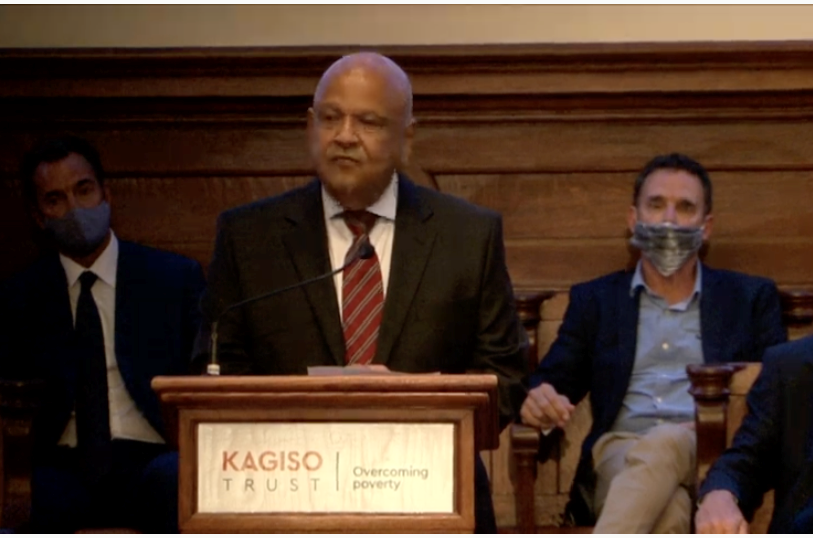
Now, weeks after his passing, Ramaphosa took time on the day before his State of the Nation Address to deliver remarks at Coleman’s memorial ceremony, which was hosted by the Kagiso Trust and the Coleman family. Coleman founded the Kagiso Trust in 1985 along with other civil society leaders to overcome poverty through sustainable-development programmes.
Neil Coleman said the family didn’t want his father to be “lionised or hero-worshipped” and they saw his contribution as part of larger movement of people in “the darkest years of repression”. He said his family’s experience of detention was “like a parking ticket” compared to what other detainees and their families went through. He also noted that this year is the 40th anniversary of trade unionist Neil Aggett’s death, and his murder in detention was one of the toughest moments for the Colemans.
Coleman said his father never stopped championing human rights, justice, and the voices of the voiceless. “Max wasn’t interested in politics or factions, he was interested only in what the movement was doing to improve people’s lives. He hated corruption and dishonesty. To honour Max and others, we need to develop a new generation of ‘servant leaders’, to serve society and not benefit themselves.
“He also hated injustice, inequality, and poverty, which he saw as forms of violence,” Coleman said. “He showed us what it meant to live a principled life. He was a humble doer of deeds and respected people from all walks of life and engaged with their lived realities. His greatest hero was Audrey – she was a relentless dynamo who the security police dreaded. They say that the only thing necessary for evil to triumph is for good people to do nothing. Well, our dad did something.”
Minister Pravin Gordhan, a close friend of Coleman, said, “Aunty Audrey and Uncle Max had a massive and indelible impact on thousands of South Africans. I remember clearly the meetings in your house where activists discussed resistance and struggle. Above all, I felt your presence in my police cells in each of my detentions, especially after the passing of Neil Aggett. We could see the impact of the work that you initiated. Those were dark and fearsome days, and were characterised by your courage and respect for others and their well-being.”
He said the Colemans could have decided to “enjoy the fruits of being whites in apartheid”, but instead devoted themselves to the betterment of South Africa for all. “Some would call him a man for all seasons” Gordhan said, describing the many realms in which Coleman quietly made an impact.
“It’s hard for the post-1990s generation to imagine the courage it took to stand up to the security police,” Gordhan said, noting that Coleman was “an organiser and a mobiliser who engaged in a struggle for a wider set of causes and organised around them until his last days”. The younger generation, “who think using their thumbs to type on Twitter is enough to make a difference”, could learn from the Colemans. “It’s going to take much more than that to get South Africa right.”
“What would the Max of the 1980s say to us today?” asked Gordhan rhetorically. “He would plead with us not to give up on the democratic dream. He would say our social contract is broken, but it’s our responsibility to build a new social contract that works for the majority. He would say it’s time for a new solidarity with the poor and the marginalised. He would want the spirit and boldness of the DPSC to find itself in our society and activism. He would say that the Freedom Charter and the Constitution are the lodestars that we need to follow as a nation. The most important question, which he answered in his life, was “whom do I serve?” He served society as a whole, and the global good.”
Reverend Frank Chikane addressed Coleman as “the father of detainees” and Audrey as “Mama Audrey … because you are like a mother to all of us”. The apartheid system, Chikane said, “radicalised our father and mother … detaining children radicalised them and catapulted them to the front line of the struggle”.
Addressing the place of “white comrades”, he said their role was critical. “The apartheid system didn’t know what to do with them. We took cover behind them at times. But the security police treated them as traitors and tortured them worst of all.” He said their solidarity was invaluable.
A number of Coleman’s grandchildren paid tribute to him through music. Keith’s youngest son, Sam Coleman, performed his piano composition, Elegy for Max Coleman, while a guitar improvisation based on What a Wonderful World was performed by Neil’s eldest son, Ruben Coleman. An opera performance was given by Denira Coleman, the eldest daughter of Colin Coleman.
Commenting on the livestream of the event, former Finance Minister Trevor Manuel wrote, “May I join with the many to extend sincerest appreciation and condolences to Audrey and the family. The life lessons from Max will live on in the best of us.”