


News
Writers called out for backing Coetzee’s Israel boycott

The same South African writers’ organisation that railed against “censorship” of the antizionist colouring book From the River to the Sea is now backing the boycott of an Israeli literary festival.
The National Writers Association of South Africa (NWASA) released a statement on 3 May expressing its support for South African Nobel laureate JM Coetzee’s boycott of the 14th International Writers Festival, set to take place in Jerusalem at the end of May.
NWASA Secretary-General Dr Lebogang Lance Nawa said, “Professor Coetzee’s refusal [to attend the festival] is a principled act of conscience.” It is “not a rejection of dialogue”, but a “challenge to the conditions under which dialogue is asked to take place”.
NWASA said that boycotting the festival in Israel is “firmly aligned with South Africa’s foreign policy principles, reflected in the country’s decision to pursue legal recourse against Israel”.
Coetzee, who now lives in and is a citizen of Australia, turned down the invitation because of what he called Israel’s “genocide” in Gaza. Nawa said that by supporting Coetzee’s stance, “NWASA echoes the same commitment to justice, accountability, and the rule of law that underpins South Africa’s global posture.”
NWASA represents approximately 700 writers in Southern Africa and the South African diaspora, and works to advance writers’ rights and develop literature.
It said Coetzee’s boycott “calls on all of us to reflect on the ethical implications of our participation in global forums”.
An expert on hate speech and free speech, advocate Mark Oppenheimer says “a growing chorus insists that South Africans should support the government’s stance against Israel, simply because it is official policy, and that doing so is somehow patriotic”.
However, that view mistakes loyalty to the state for loyalty to a particular administration, says Oppenheimer. “In a vibrant democracy, citizens are entitled to scrutinise and criticise their government’s positions, both at home and abroad, especially where those positions are incoherent or are pursued for questionable ends.”
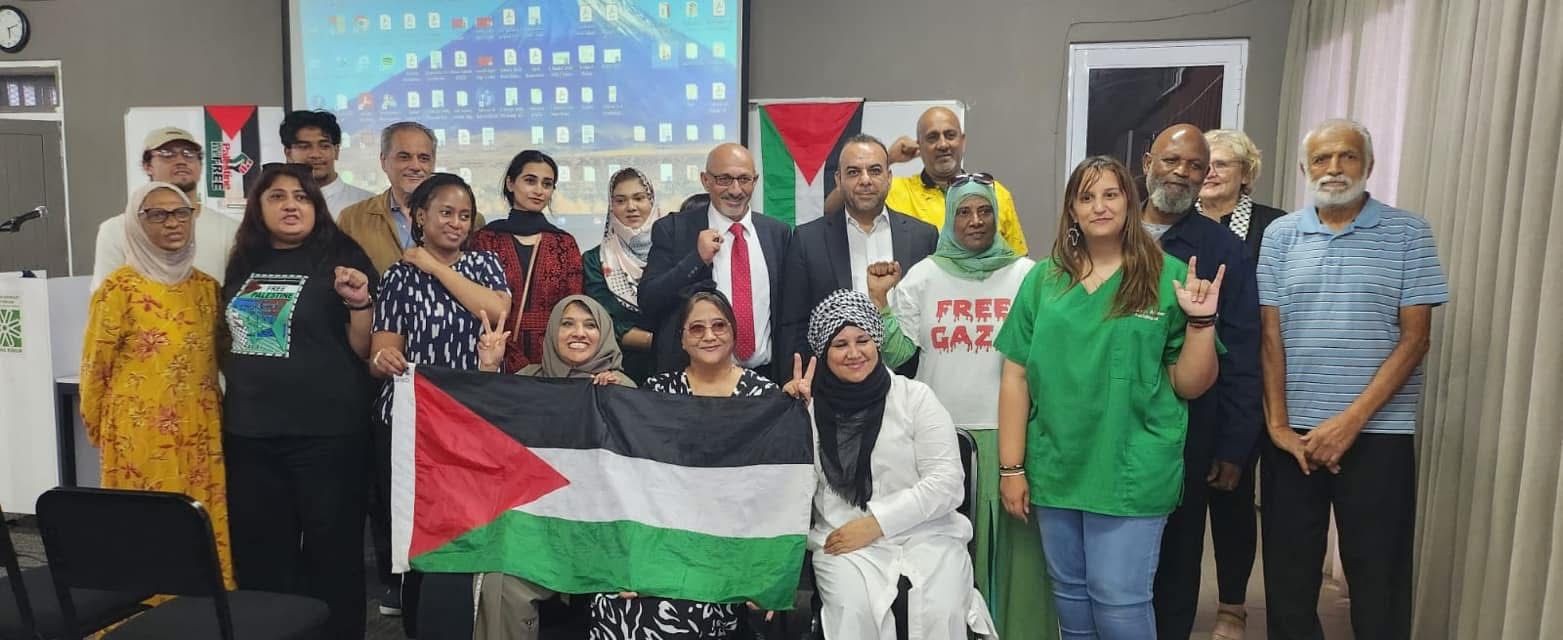
NWASA signed a “cultural partnership” with the General Union of Palestinian Writers (GUPW) in 2024, which “symbolically links South Africa’s national liberation history with the contemporary struggles of Palestinians”. The two organisations signed a declaration called “From Cape to Gaza”, which “affirms the enduring role of writers as agents of resistance and conscience”, and draws parallels between “apartheid South Africa and present-day Palestine”.
According to International Writers Festival director Julia Fermentto-Tzaisler, Coetzee said he was refusing the invitation because Israel’s war on Gaza is “disproportionate to the ‘murderous provocations’ that took place on 7 October”. He said the war has “received enthusiastic support from most of the Israeli public” and so Israeli society “shares in the guilt”.
Fermentto-Tzaisler responded by saying that his term “murderous provocations” wasn’t appropriate for the events of 7 October given that “Hamas terrorists planned this massacre for more than five years, for their genocidal mission ‒ to kill Jews”.
She told Coetzee that 7 October was “an expression of a jihadist ideology that sees the very presence of Jews as intolerable, and something to be fought with absolute and uncompromising violence. As a South African writer who fought apartheid, I would have expected ‒ or perhaps dreamed ‒ that you would extend a hand to me, that you would say to me, ‘Fight, my daughter. Do not stop fighting.’”
Fermentto-Tzaisler told Coetzee, “Writers and literature have a role, and it is not to remain silent or disappear.”
Eight international writers confirmed they would attend the festival, which will close with an event honouring released hostage Eli Sharabi, who will speak about his book, Hostage.
The Creative Community for Peace (CCFP) Literary Alliance is a coalition of leaders in the literary industry committed to educating about rising antisemitism and countering the cultural boycott of Israel.
Speaking to the SA Jewish Report on behalf of the CCFP Literary Alliance, Ari Ingel said the organisation is deeply troubled by NWASA’s embrace of cultural boycotts, and its support for scapegoating Israel and excluding Israeli voices from the global literary community.
“Literature and the arts are powerful cultural bridges,” says Ingel. “Yet increasingly, literary institutions are losing their plot, turning spaces meant for dialogue into platforms for selective outrage and exclusion. Israel and Jewish writers are increasingly targeted. This is discrimination.”
The NWASA statement “distorts the truth and contributes to a climate of misinformation that corrodes the integrity literature is meant to uphold. Using literature and the arts as a boycott cudgel is also anathema to literature itself. Writers and festivals aren’t representatives of governments, nor should they be excluded because of their nationality.”
Cultural boycotts don’t advance peace or justice, says Ingel. “They shut down conversation, harden divisions, and silence the very voices literature exists to elevate.”
At a time of deep global fracture and rising anti-Jewish hatred, “the responsibility of literary institutions is clear: open doors”, says Ingel. “Shamefully, NWASA has chosen to close them.”
South African Zionist Federation National Chairperson Craig Pantanowitz says there is a “glaring contradiction” at the heart of NWASA’s statement. “An organisation that declares ‘silence is complicity’ has, by its own conduct, chosen when to speak and when to look away,” he says. “NWASA’s platforms are saturated with one-sided content, including aligning with the GUPW and participating in Al Quds Day, yet there is a deafening silence on the 7 October massacre of Israeli civilians.”
Just as striking is how little of NWASA’s focus is directed at South Africa itself, says Pantanowitz. For a body that claims to represent South African writers, “its public output is overwhelmingly dominated by ‘Palestine’, with minimal attention to local literary and societal issues”.
This raises “serious questions about whose voices are being amplified and whose are being sidelined”.
NWASA presents itself as grounded in human rights and moral clarity, “yet it adopts contested claims as fact, while aligning openly with a particular political agenda”, Pantanowitz says. “Human rights are not selective. They either apply to everyone, or they mean very little. What we are seeing here is not principled consistency, but advocacy shaped by omission and contradiction.”