OpEds
AI working behind the scenes to influence your vote

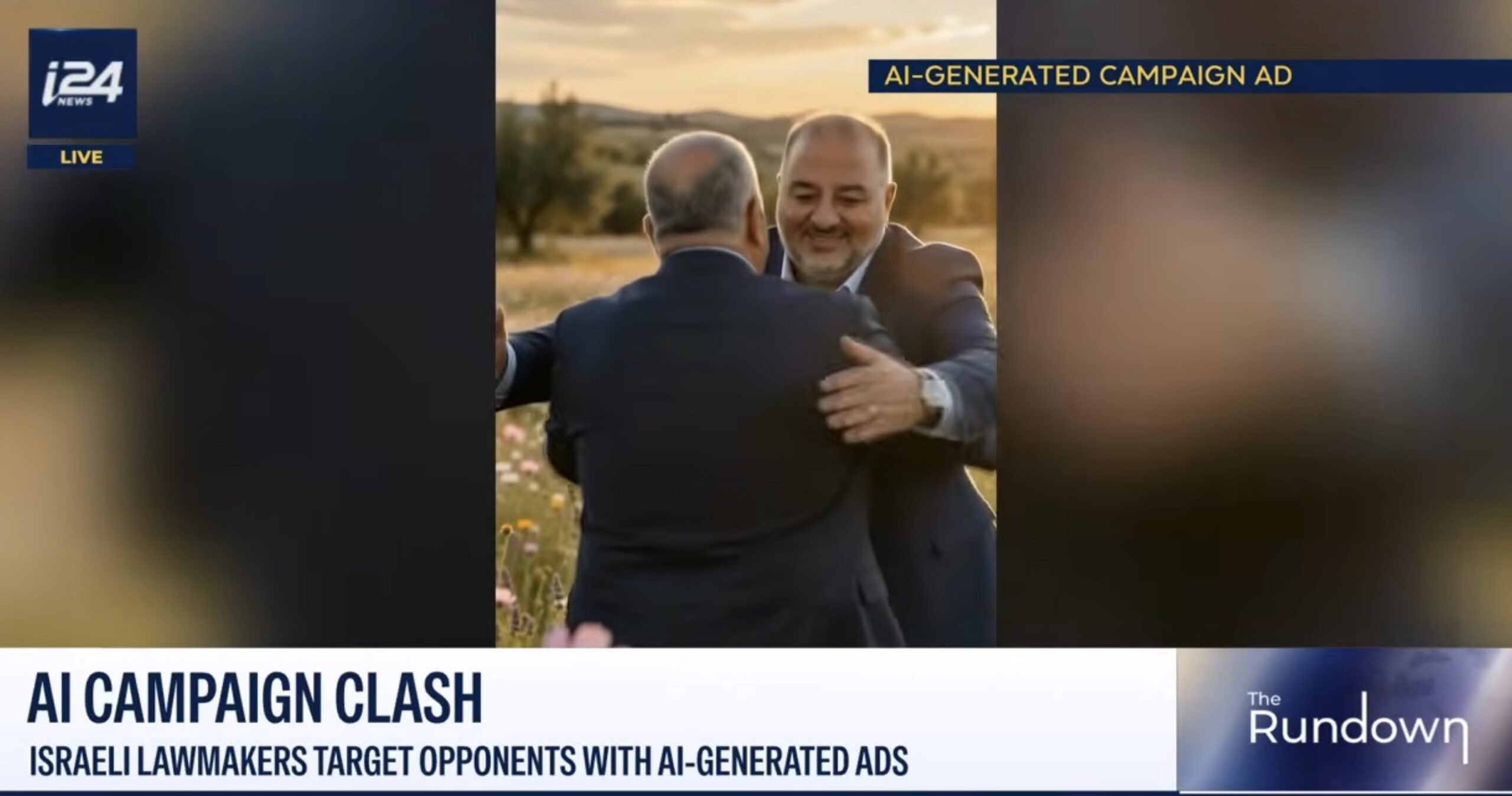
In June, an election video appeared online showing Gadi Eisenkot, the former Israel Defense Forces chief of staff and now one of Benjamin Netanyahu’s main political rivals, shaking hands with Palestinian Authority president Mahmoud Abbas. Mansour Abbas, leader of the Arab Islamist Ra’am party, was shown joining them.
Except the meeting never happened.
The video was created using artificial intelligence (AI) and posted by Finance Minister Bezalel Smotrich’s Religious Zionism party. A month later, Israel’s Central Elections Committee ordered that it be removed, ruling it depicted an event that had never taken place but looked realistic enough to mislead voters. Smotrich and his party were ordered to pay NIS 10 000 (R53 427) in legal costs. While they had posted a disclosure saying parts of the video were created using AI, the committee found it wasn’t enough as it appeared only in the text accompanying the Facebook post and could therefore be hidden from view.
But this fake video may actually be the easiest part of Israel’s first AI election to understand.
An Open University of Israel project, monitoring politicians and political parties, reported last month that AI had been used to create or edit roughly one in eight posts it had tracked since late July. And it wasn’t only politicians using AI. A survey conducted in May for the Israel Internet Association (ISOC-IL) found that one in four Israelis was considering using AI or another online tool to help inform their voting decision.
This changes the game for campaign managers. For years, they worried about search engine optimisation, or SEO. If someone searched for their candidate on Google, the goal was to get their website, policies, and favourable information as high as possible in the results. Now there’s another acronym entering the vocabulary, GEO, or generative engine optimisation. It sounds like SEO for the AI age, but there’s an important difference. With Google, the aim is largely to get information in front of voters and persuade them to click on it. With GEO, the voter may never see the original material at all. Here, the goal is to increase the chances that an AI chatbot finds and uses a candidate’s information when constructing its answer to a voter’s question.
This is already changing what some campaign managers do. In the United States, Run for Something, which supports progressive candidates for state and local office, has developed CampSight to monitor what AI chatbots say about candidates and which sources they use. The organisation says it has seen AI descriptions of candidates change within days of campaigns updating their digital presence.
Imagine a candidate has made housing central to their campaign, but the policy barely appears when voters ask ChatGPT. The campaign can test likely questions, see which sources the chatbot is drawing from, publish clearer and more detailed policy material, put transcripts online rather than leaving information buried in video, and then test the questions again. None of this is necessarily sinister.
But the same basic idea can be used very differently. Researchers are now studying malicious GEO, where online material is deliberately rewritten or designed to manipulate what generative search engines retrieve and use.
A study published this month tested seven such attacks across five AI models. Before the researchers applied their defence, the attacks succeeded on average just more than half the time. This isn’t to say that putting a lie on a website will automatically make ChatGPT repeat it. The research was conducted under experimental conditions and AI chatbots have safeguards and use different sources. But they aren’t foolproof and for an election, the implications are concerning. If political actors can increase the chances that particular material is picked up by AI, the information environment the chatbot searches becomes something worth trying to influence.
A deepfake uses AI to try to influence the voter. A more sophisticated information operation could try to influence the AI that the voter consults. The voter may never see the original website, post, or piece of propaganda but they could encounter its framing later inside an apparently ordinary answer from an AI chatbot they themselves asked for information.
There is no evidence that Israeli political parties are currently doing this, and I don’t want to suggest there is. But as voters increasingly ask AI what politicians believe or which candidate they should support, the incentive to care about what chatbots find and say is obvious.
Israel is already showing why this gets complicated. The ISOC-IL published a simulation in which 26 fictional voter profiles questioned ChatGPT, Gemini, Claude, Perplexity, and Grok about the elections. What it found was that answers could vary according to the persona, language, and chatbot being used. A fictional Haredi woman asking ChatGPT about the cost of living was shown a political landscape dominated by United Torah Judaism and Shas. When the same type of voter asked Perplexity, the Democrats and Yashar came first and the Haredi parties disappeared from view. While this was a simulation and didn’t prove political bias, it did show that there wasn’t one simple AI version of an election.
We’ve become accustomed to worrying about politicians using AI to influence us. What is harder to see is an attempt to influence the information an AI chatbot uses when it answers us. This leaves a lot for voters to think about. If you ask an AI chatbot about an election, don’t assume its first answer is right. Ask what sources it is using and what it may have left out. Change the question. And perhaps most importantly, ask another chatbot the same thing.
Most us will not be voting in Israel come October, but we have South African local elections a month later. It’s worth remembering it’s not only about AI affecting elections, we also need to ask who, or what, has influenced the machine we’re asking for advice.
- Paula Slier is an international journalist, war correspondent, and speaker who has reported from conflict zones across the Middle East, Africa, and Europe. Her work focuses on geopolitics, modern conflict, information warfare, and the battle for truth.