Community
CSO calls attention to antisemitism uptick in Gauteng

The Community Security Organisation (CSO) in Johannesburg says it has seen a spike in antisemitic incidents in Gauteng in recent weeks. There have been 15 aggravated cases over the past two months, compared with two in the previous two-month period, according to a CSO letter to the community this week.
The incidents have included verbal abuse, intimidation, threats, harassment in public spaces, and, in a low number of cases, physical assault.
CSO Gauteng Chief Executive Liron Sanders told the SA Jewish Report that in one incident, a community member was physically hit while at a nightclub.
In another, a group walking home from shul on Shabbat were called “fucking Jews” and told to leave South Africa. The situation became so volatile that a community member called the CSO control room.
The organisation responded immediately, escorting the Jewish group to safety and attempting to calm things down. But the group of harassers only became more aggressive, hurling slurs at CSO staff. Having taken video footage, CSO is investigating its options in laying a complaint.
Both attacks happened in the past week.
“While recent incidents are concerning, and must be taken seriously, they should not deter us from continuing to live openly and proudly as Jews, participating fully in communal life and supporting our institutions,” said CSO leadership in the letter. It will continue to monitor the situation and update the community as needed.
The South African Jewish Board of Deputies (SAJBD) says it has not noticed a sharp increase in antisemitic incidents. SAJBD National Chairperson, Professor Karen Milner, says the Board monitors antisemitism across the country, as it has done since 1996.
The CSO letter says that, at this stage, “there is no information indicating a specific or imminent threat against the Johannesburg Jewish community”. However, it urges heightened situational awareness and the prompt reporting of incidents.
The letter said that “While most of these incidents have not resulted in serious injury, the increase in both frequency and severity warrants attention and constant vigilance.”
Sanders says that after picking up on the worrying trend, CSO has a duty to inform the community. “Also, by alerting the community, we ‘jump ahead’ of it, hopefully mitigating a potential increase in incidents. If we don’t get ahead of it, the situation could become like what we are seeing in London and Sydney,” he adds.
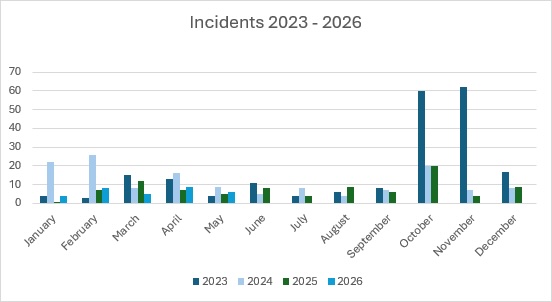
Milner says that at the end of May 2026, the SAJBD ‒ which shares it annual reports with various embassies, universities, and global bodies ‒ had recorded 32 antisemitic incidents across the country, an average of 6.4 per month. “This is the same number of incidents reported at the same point in 2025, and fewer than in 2023 and 2024.
“We note that April witnessed nine incidents, which is an increase on the five witnessed in March, but is in no way out of the expected range, or indicative of a sharp increase or trend,” she says.
According to the SAJBD’s records, “34% of incidents are social media-related, targeted hate mail, or discourse that can be considered hate speech. Verbal insults, threats, and abusive behaviour account for 41% of incidents and intimidation, with provocation and antagonism accounting for a further 13%. To date, there has been only one incident (3%) that can be labelled physical assault.”
Sanders says CSO is also noting a lot more online harassment, which has become more aggressive and threatening. He calls on community members to avoid getting into online debates.
The letter says that CSO continues to work closely with communal organisations, private security providers, law enforcement agencies, and other relevant stakeholders to monitor developments and maintain appropriate security measures across the community.
In the letter, CSO provides detailed advice on what to do if one experiences antisemitic verbal abuse or harassment: remain calm, do not engage or attempt to challenge the individual, and remove yourself from the situation if possible. If it can be done safely, take photos and videos, and record vehicle registrations and descriptions of those involved. Preserve electronic evidence like emails, texts, social media posts, or voice notes.
Report the incident to CSO as soon as possible. If threats have been made or criminal conduct has occurred, report the matter to the police. CSO will assist.
If you are physically attacked or believe an attack is imminent, take reasonable steps to protect and defend yourself and others while escaping the threat. Leave the area and seek safety. Call for assistance from security personnel, members of the public, or nearby businesses. Contact CSO, the police and emergency services immediately. Seek medical attention, even if injuries appear minor. Preserve evidence but avoid discussing the incident on social media until law enforcement and security personnel have completed assessments.
Reporting incidents timeously is one of the most important tools available to the community, as every reported incident, no matter how minor, “contributes to a broader situational picture and assists us in identifying patterns, emerging threats, and repeat offenders”, as stated in CSO’s letter.
It is important to be particularly vigilant when going to shuls, schools, or any communal event or installation, when walking alone, interacting with hostile members of the public, as well as when using public transport or visiting unfamiliar areas.
Be alert to individuals conducting suspicious surveillance, unusual photography or video recording of Jewish institutions or security infrastructure, repeated appearances by the same individuals or vehicles near communal facilities, and behaviour that appears hostile, threatening, or out of place. “If something appears suspicious, trust your instincts and report it,” says CSO.
Milner says that “taken as a whole, the numbers of incidents thus far in 2026 are in line with statistics recorded before 7 October, and are in no way indicative of a spike in aggravated antisemitism or in antisemitism in general.”
Additionally, “it should be noted that our statistics remain exceptionally low when compared with fellow communities around the world”.
For example, in Canada in 2025 there were 6 800 antisemitic acts reported nationwide. “While the majority of these occurred in the digital space, with 6 248 cases of online harassment, the B’nai B’rith survey recorded 10 incidents of violence, 299 cases of vandalism, and 243 incidents of real-world harassment. South Africa, in contrast, remains relatively safe for Jews,” says Milner.
She points out that SAJBD President Zev Krengel uses a “stadium kippah formulation”, which states that the comfort and safety of the Jewish community can be understood by the number of kippot at a stadium event. “In South Africa we certainly continue to be able to wear our kippot in public, with little fear of antagonism or violence.”