


OpEds
Knowing who we aren’t

A friend once told me a story about his father. My friend is observant; his father is a committed, self-proclaimed atheist. One day, after he’d proudly announced his non-belief to a stranger, the man looked at him and asked, “Really? What kind of atheist are you – Orthodox or Reform?”
His father recoiled at the suggestion. “Orthodox! Obviously,” he replied indignantly.
It might be the most South African Jewish answer imaginable.
South African Jews are complicated. We might not believe in G-d, but we are deeply offended by the suggestion that we don’t believe in Him in the correct way.
We might drive to shul on Shabbat, passing three Reform congregations on the way to an Orthodox one. We might eat prawns, but not in the house. We might not keep kosher, but we know immediately when someone has used the wrong knife. We might not attend shul for 11 months of the year, but come Rosh Hashanah, we expect our seat to be exactly where it’s always been.
There’s something wonderfully contradictory about us.
Another friend once told me that during Pesach he would still go to a non-kosher McDonald’s, but would never eat the burger bun. Someone else’s family happily ate a non-kosher steak at Spur, but would never order a milkshake afterwards.
There are rules.
South African Jewry has typically been more traditional than strictly observant. Even those who do very little often remain emotionally attached to an Orthodox framework. They might not follow the rules, but they know that the rules exist – and they would prefer that nobody tampers with them.
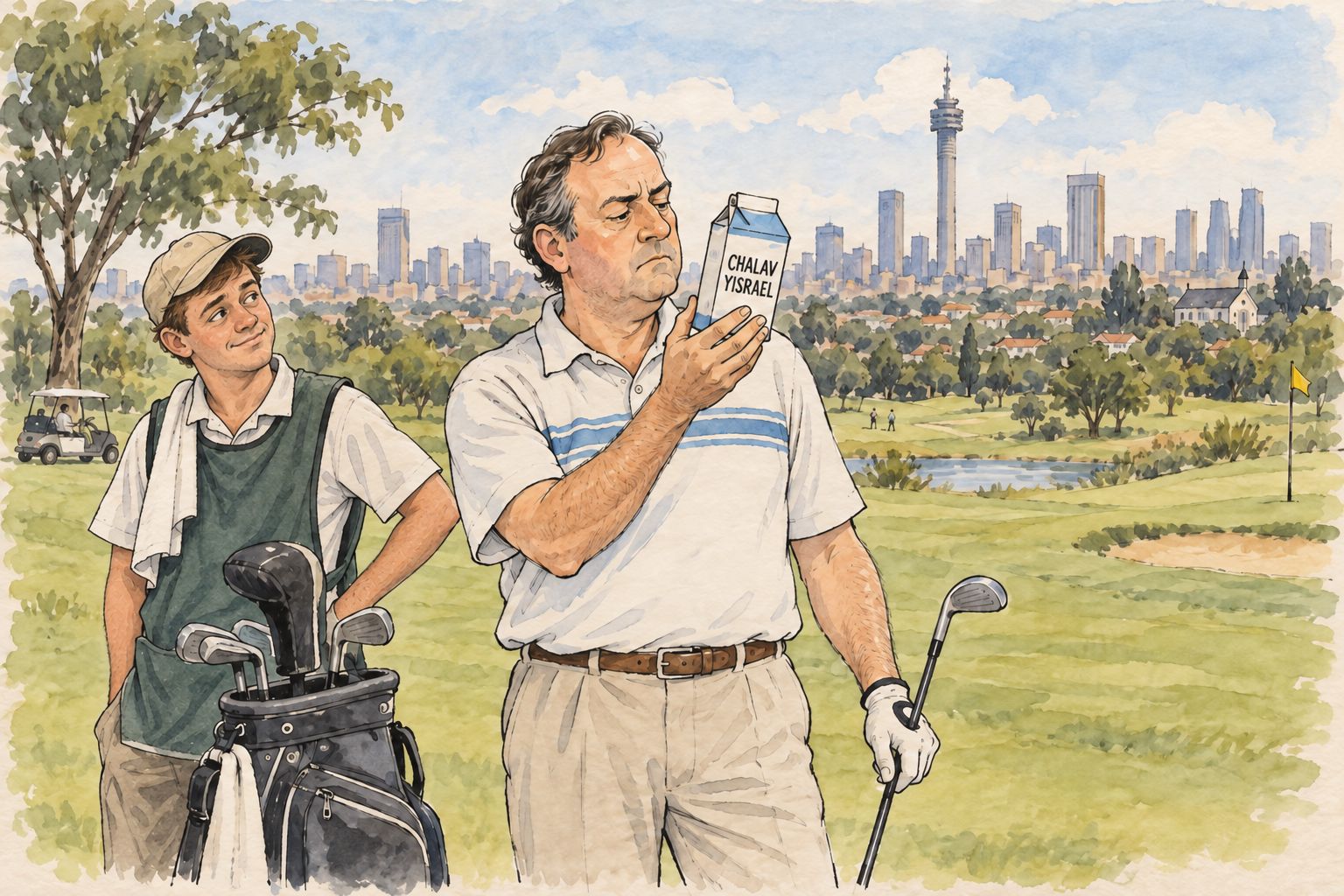
It’s why a South African Jew can spend Saturday morning on the golf course and still feel strongly that the rabbi should keep Chalav Yisrael.
Our Jewish identity has never been confined to religion. It’s built around family, food, schools, shuls, youth movements, charities, Israel, and an extraordinary communal infrastructure. In Jewish Johannesburg, you can be delivered by a doctor who knows your grandparents, attend a Jewish school, play in a Shabbat-observant soccer league, eat in kosher restaurants, call a Jewish security organisation when you’re in trouble, and eventually be buried in a Jewish cemetery.
And throughout that journey, someone will almost certainly ask why you haven’t called your mother.
We’re a small community, which means that everybody is connected. If you meet another South African Jew anywhere in the world, it takes less than three minutes to discover a mutual relative, school friend, former business partner, or person with whom one of you is no longer speaking.
Our size gives us an intimacy that can be comforting and suffocating, sometimes within the same conversation. Privacy is limited. News travels quickly. Good news travels fast; bad news has generally arrived before you have.
But that closeness also creates something remarkable.
When someone is ill, meals appear. When a family is in crisis, networks mobilise. When Israel is attacked, flights are booked, money is raised, and suitcases are packed. When a member of the community dies, people who barely knew them arrive to make a minyan, bring food, and sit with the mourners.
We complain endlessly about communal organisations, but we support them. We criticise our schools, but fight to keep them strong. We argue with our rabbis, but phone them when it matters. We threaten to emigrate, often while attending the farewell party of someone who’s actually doing so.
Perhaps that is what makes South African Jews so distinctive. We aren’t always observant, but we are deeply affiliated. We aren’t always united, but we are profoundly connected. We’re fiercely South African and passionately attached to Israel. We carry the habits of Lithuania, the rhythms of Africa, and the anxieties of Jewish history, all while insisting that nobody has better weather than we do.
And then Rosh Hashanah comes around.
The observant and the less observant, the believers and the sceptics, the regulars and those demanding to know who’s taken the seat they last occupied 12 months ago, all return to the same place.
Perhaps that is the real meaning of our contradictions. Tradition isn’t only about what we do. It is also about where we return, who we return to, and the chain to which we still know we belong.
As we enter a new year, may we hold onto the warmth, generosity, and instinctive sense of responsibility that make this community what it is. May we argue a little less, listen a little more, and continue to show up for one another, when it matters.
Shana tova to the observant, the traditional, the secular, the sceptical, and, of course, to all the Orthodox atheists.
May we all be written and sealed for a year of health, safety, meaning, and peace.
- Howard Feldman writes a regular column for the SA Jewish Report and hosts the Morning Mayhem show on ChaiFM.