





News
Not consulting Jewry renders UCT resolutions ‘unlawful’

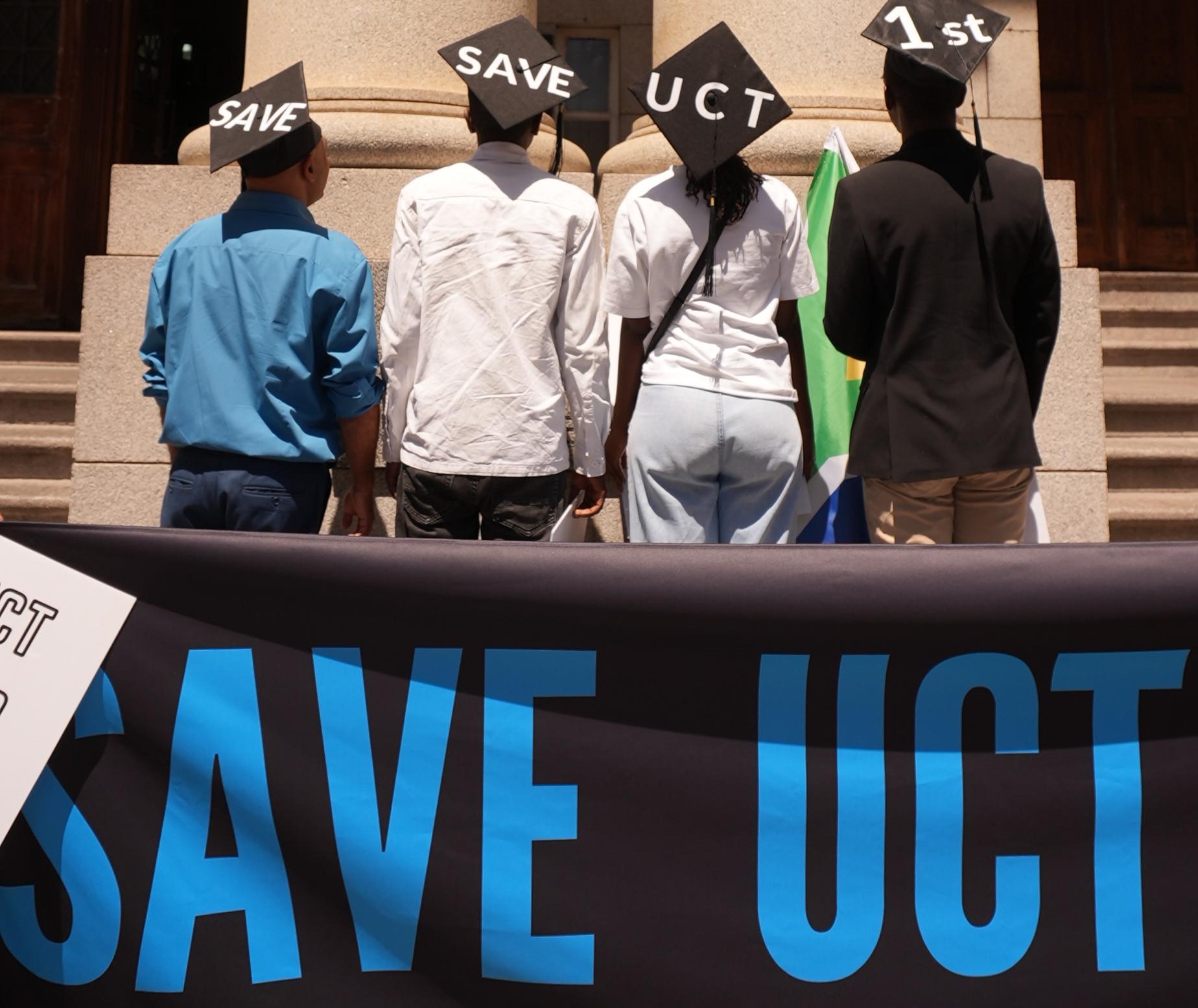
University of Cape Town (UCT) students and alumni demonstrated at the Western Cape High Court on 30 October, calling on UCT’s leadership to “save UCT first” over adopting resolutions that put the future of constituents and the institution in jeopardy.
Professor Adam Mendelsohn, the director of the Kaplan Centre for Jewish Studies at UCT, took his own university to court over two anti-Israel resolutions it adopted in June 2024, and the protest took place before the third and final day of court hearings.
His advocate, Eduard Fagan SC, argued that UCT’s failure to consult stakeholders, including the Jewish community, rendered the resolutions irrational and unlawful. “Not only does rationality impose a need to consult, there was a specific legal duty to consult,” he stated.
Meanwhile, the protesters said that “UCT must ensure financial stability and preserve its academic integrity, free from political influence.” One observer noted that “The irony is that Mendelsohn is on the side of UCT, and UCT isn’t,” lamenting that in court, the lawyer representing the institution “never represented UCT’s interests, only those of its chairperson and executive [Exco].”
In court, Fagan replied to UCT’s arguments, painting a damning picture of how the leading figures and bodies at UCT – its chairperson, executive committee, and Council – breached their fiduciary duties to the institution, acting unlawfully, irrationally, and unconstitutionally.
His descriptions of how the chairperson and Exco “concealed” information from the Council, meaning it adopted the resolutions in an “information vacuum”, led Judge Mark Sher to say that the way the Council adopted the resolutions was “scary”.
Mendelsohn is calling on the court to order UCT to review or set aside the two resolutions. The first “resolves to reject the International Holocaust Remembrance Alliance’s [IHRA] definition of antisemitism”. The second states that “no UCT academic may enter into relations with, or continue relations with, any research group or network whose author affiliations are with the Israel Defense Forces [IDF] or the broader Israeli military establishment”.
Judge Tandazwa Ndita said that after the Donald Gordon Foundation (DGF) stated that UCT was in breach of its contract of donation by rejecting the IHRA definition, there was no need for it to reiterate this. She said UCT was fully aware of what rejecting the definition would mean, including the loss of a teaching hospital from the DGF.
Judge Robert Henney asked Fagan whether his argument is that Council Chairperson Norman Arendse SC and the UCT Exco “knew about the risk of losing donations, but failed to disclose it to the Council”, and that Arendse “lied to this court” about these events.
Fagan argued that the Exco and Arendse had a plethora of information which they consciously chose not to share with the Council, including that the DGF was critical of the Jerusalem Declaration of Antisemitism. However, they allowed Council to choose that definition when adopting the resolutions, therefore “exacerbating the risk”.
While UCT argues that the DGF never explicitly stated that it would withdraw funding, “Exco discussed that they must not be ‘manipulated by donors’,” said Fagan. “This shows that the Exco understood that there was a legitimate threat from the DGF to cancel the agreement.”
Fagan said Advocate Tembeka Ngcukaitobi SC, representing UCT, introduced new arguments in court hearings, and “the extent to which UCT is searching desperately for a viable defence” shows that “the facts in this matter weigh so heavily against it”.
One new defence from UCT was that the “moral imperative” of standing against Israel superseded the need to know the impact on UCT. However, Arendse has admitted previously that the resolutions would have no impact on Gaza.
Another argument was that the Council chose not to rescind the resolutions on two later occasions, with more information at hand, meaning that it undertook due process. However, this doesn’t “cancel out” UCT’s unlawful process when it first adopted them, noted Fagan.
As for Ngcukaitobi’s argument that the Council and Senate represented constituents, Fagan said these representatives were never asked to canvas those they represented, such as staff or students who could face retrenchments or a loss of scholarships if the resolutions were adopted.
South African Zionist Federation spokesperson Rolene Marks says the effects of the resolutions are already being felt, “with a clear chilling of engagement with Israeli academia”. For example, in June, the organisers of the IAMHIST (International Association for Media and History) conference at UCT demanded that Israeli applicants submit sworn statements confirming they had no ties to the IDF.
“No such demand was made of any other nationality, and no such requirement appears in IAMHIST’s or UCT’s policies,” says Marks. “The same UCT department sent its own members, days later, to an international conference where Israeli scholars served on the organising committee and presented papers.”
She says the resolutions were “born of ideology, and are corroding fairness, scholarship, and the university’s moral standing”.
South African Jewish Board of Deputies National Director Wendy Kahn says it was a “privilege” to be in court to hear Fagan detail how “information was deliberately withheld from Council members in determining resolutions that have such consequences”.
She says it’s “imperative that public spaces be welcoming and open for all, including the Jewish community. We must always stand up for these critical principles.”
Journalist William Saunderson-Meyer, who previously described UCT’s refusal to modify the resolutions as “opting for suicide”, told the SA Jewish Report that he expects Mendelsohn to succeed. This is because of UCT “deliberately withholding critical information from its stakeholders; wilfully endangering the financial and reputational future of the institution; and depriving its staff of their constitutional rights to freedom of association and expression.”
But even if Mendelsohn is vindicated judicially, “UCT has been captured by an Islamist clique in much the same way that South Africa’s foreign policy has been captured by a group in the Department of International Relations and Cooperation,” he says.
There’s “no concern” in either of those groupings “of the costs of their actions on UCT or South Africa,” says Saunderson-Meyer. “And there’s no doubt that Jewish UCT staff who don’t toe a radical line will be targeted.”
Political commentator Tim Flack says Mendelsohn’s case is “strong” because it “exposes how the Council blurred the line between governance and activism”.
At a recent event where UCT hosted Francesca Albanese, Arendse publicly praised her and declared that the resolutions would stand, even before the court ruled. This conduct “compromises institutional neutrality, and validates Mendelsohn’s claim that these were political acts dressed up as governance”, Flack says.
Independent practising attorney David Polovin, whose expertise is business law and litigation, says “the legal threshold for reviewability is clearly met: the resolutions are arguably irrational, ultra vires [beyond power], and procedurally flawed”.
He says UCT faces significant risk of losing US federal research grants “unless the chilling effect on academic freedom is reversed. The court must guard the integrity of academic freedom and inter-university partnerships.”
Upholding the resolutions “would risk the university’s funding, reputation, and commitment to constitutional values”, says Polovin. For those reasons, Mendelsohn’s application “should succeed”. The court’s intervention “will not only vindicate the applicant’s rights, but safeguard the public interest in a free, fair and globally engaged university”.
Judgement was reserved, and a written judgement is expected in several months.




Lona
November 7, 2025 at 11:15 am
No alternate points of view, clear examples of Islamophobia, no attempts at distinctions between Zionism and Judaism, no research or explanation on UCT’s decision making or reporting on similar broader international legal decisions regarding Israel and the IDF. ‘Journalism’ for who 😂😂😂