





Question and Answer
Sex for the curious

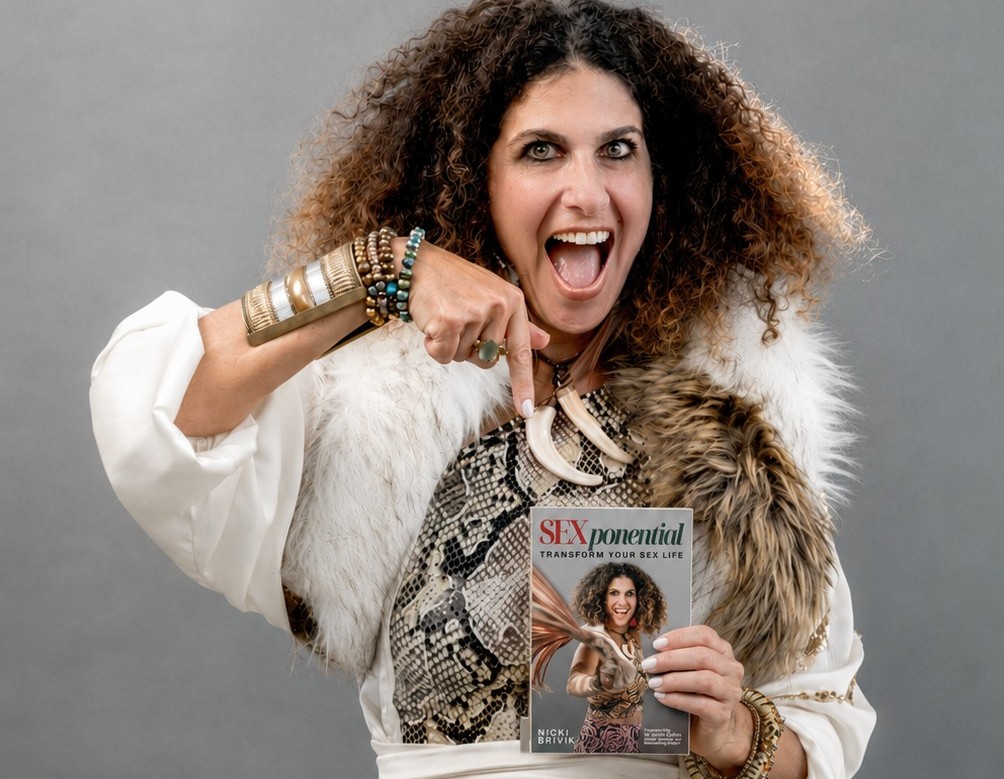
No-holds-barred sex coach Nicki Brivik has launched her first book, SEXponential: Transform Your Sex Life, a practical guide to revving up things in the bedroom. The SA Jewish Report talks to her.
How does a nice South African Jewish girl end up becoming an outspoken sex coach?
I started my career as a personal injury attorney and always saw myself as someone who helped people. But I’ve also always been able to talk about sex very easily, and over time I realised that this was actually quite unusual. Friends, colleagues, and even acquaintances would seek me out to talk about their relationships, their sex lives, and the challenges they were facing. I realised that sex is such an important part of our lives, yet it’s something most of us never really work on. We invest in our careers, our finances, and our health, but somehow expect our sex lives to take care of themselves.
So, I started guiding people through these conversations, first informally and then professionally. What began as curiosity gradually became a calling. In truth, I feel like this work found me at exactly the right time in my life, when I had the experience, confidence, and language to help people navigate this often difficult topic.
Was there a defining moment when you realised this was your calling?
It was more of a gradual dawning that became impossible to ignore. The more people spoke to me about their relationships and sex lives, the more I realised how few places there are where people can safely explore these conversations. So many people carry shame, confusion, and self-doubt around sex, often believing they are the only ones struggling.
Over time, I realised I wanted to be part of changing that. I became passionate about creating a space where people could talk openly, learn, grow, and experience more pleasure and connection in their lives. It wasn’t one moment that convinced me. It was hundreds of conversations that pointed me in the same direction.
You traded legal briefs for bedroom confessions. What was it about sex, relationships, and human intimacy that fascinated you enough to leave law behind?
What fascinated me was that sex is never really just about sex. When people come to see me, they think they’re bringing me a sexual problem. But very often we’re talking about communication, confidence, vulnerability, self-worth, trust. Sex sits at the intersection of so many parts of what makes us human, yet most of us receive very little education about how to navigate it successfully.
You dispense advice one conversation at a time. So why a book, and why now?
There are only so many people I can fit into my office. The reality is that many people seek help only when they feel they’re in crisis, but I’ve always seen myself more as a performance enhancer than a crisis manager. When it comes to sex, small changes can reap enormous relationship dividends. So often people pathologise perfectly normal experiences like differences in desire, changes in arousal, the impact of stress on long-term relationships. Sometimes a single conversation can completely change how someone sees themselves and their relationship. So, I wanted to put those conversations into a book. In many ways, SEXponential is a coaching session in paperback.
What are the biggest lessons, surprises, and uncomfortable truths readers can expect to take away from it?
One of the biggest lessons is that a great sex life is available to almost everyone. The uncomfortable truth is that it doesn’t usually happen by accident. We have this idea that great sex should be effortless and that if the chemistry is right, everything should just fall into place. But like most worthwhile things in life, a good sex life takes intention, practice, and a willingness to learn. You don’t get fit by lying on the couch, and you don’t build a thriving sex life by hoping it will somehow take care of itself.
The couples having the best sex are rarely the luckiest couples. They’re the ones who remain curious about themselves and each other, who are willing to grow, evolve, and adapt as life changes around them.
Perhaps the biggest surprise is that there is nothing wrong with needing to work on your sex life. In fact, that is exactly what the happiest couples are doing.
Are your kids and husband on board with you talking publicly about sex?
Absolutely! My husband and I have always raised our children to understand that sex is a natural and beautiful part of being human, not something to be ashamed of or afraid to talk about. But even more importantly, I have taught them that if you’re willing to work hard, take risks ,and follow your purpose, it is possible to build a meaningful career doing something you’re passionate about. I think that is a lesson that extends far beyond sex.
Any awkward Shabbat-table conversations along the way?
Honestly, there are very few conversations that make me feel awkward. One of the things I’ve realised over the years is that my comfort tends to rub off on the people around me. That’s probably my superpower, making uncomfortable conversations feel comfortable.
Having said that, our Shabbat-table conversations are probably a little more lively and varied than in some households. Let’s just say there aren’t many topics that are considered off-limits, and dinner guests quickly learn that you never quite know where the conversation is going to go next.
In an age of dating apps, pornography, and endless distractions, are people becoming more sexually liberated or more disconnected from genuine intimacy?
I think both things are happening simultaneously. We have more information, more access, and more freedom than previous generations. That’s positive. But we also have more distractions, more comparison, and more unrealistic expectations.
Many people know more about sex than ever before and yet feel less connected. Technology can help us find each other, but it can’t teach us vulnerability. Intimacy still requires presence, communication, and emotional risk. Those things can’t be downloaded from an app.
You’re making a career out of saying the unsayable. What’s the one conversation South Africans are still awkward to have about sex, despite pretending to be far more open-minded than they really are?
The conversations we’re still avoiding, but need to be having, are the ones about desire, pleasure, vulnerability, and what actually makes sex meaningful and satisfying. Those are the conversations that change people’s lives, yet they’re often the hardest ones to have.
The public is getting to know the fearless, flamboyant, no-filter sex coach. Who is the woman behind that persona, and how much of what we see is authentically you?
I think what you see is pretty much what you get. The public version of me isn’t a character I’ve created. I’m outgoing, I care, I love people, I have tons of energy, and I have a great love for life. I have never been particularly good at blending into the background. My children have a theory that my hair is the perfect reflection of my personality. It’s wild and untameable, likes to make a statement, can be slightly outrageous, and you never quite know what you’re going to get.
After listening to what people reveal behind closed doors, what about human beings has surprised you most?
Probably how rarely our struggles are as unique as we think they are. People often arrive convinced that there is something wrong with them or their relationship, only to discover that what they’re experiencing is actually a very normal part of being in a long-term relationship. Differences in desire, changing bodies, periods of disconnection, boredom, these are incredibly common human experiences.
What has also surprised me is that most people aren’t having bad sex. They’re having repetitive, predictable, sometimes slightly dull sex. The good news is that those are very different problems. Most people don’t need fixing; they simply need new tools, new conversations, and a little more curiosity. That’s one of the reasons I’m so optimistic about this work. So often, the gap between where people are and where they want to be is much smaller than they think.
You help people undress emotionally as well as physically. What truth about yourself did writing this book force you to confront?
Writing the book forced me to confront just how deeply I care about this work and how important it is to me to get this message into the world. One of the biggest challenges was finding my author voice instead of my lawyer voice. As a lawyer, I was trained to be precise, analytical, and careful. Writing a book about sex required something very different. It required warmth, vulnerability, and the courage to speak directly to people about some of the most intimate parts of their lives. I realised that my purpose is to help people live with more passion, connection, and pleasure. If I wanted to reach more people, open up conversations around sex, and normalise these discussions, then I had to be willing to do something difficult myself.
For me, that difficult thing was writing the book. It wasn’t always easy, but it reminded me that growth often begins on the other side of discomfort. It’s a lesson I ask my clients to embrace every day, and this book was my opportunity to live it too.







Neha Sharma
July 17, 2026 at 10:29 am
📚💙 A thoughtful interview with practical relationship insights. Thanks for sharing such an honest and engaging conversation! 😊👏