Religion
The shoes

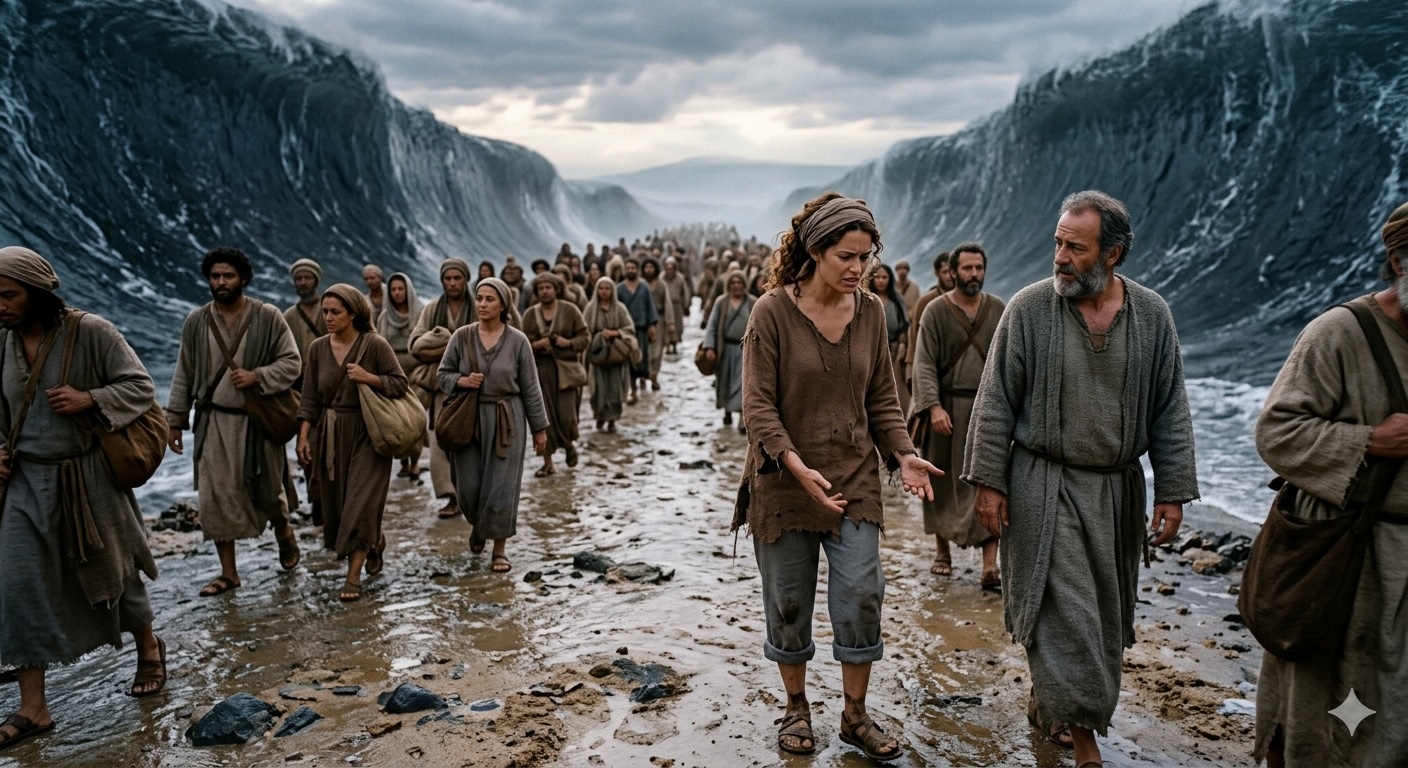
Someone walked through the split sea and complained about their shoes.
The Torah doesn’t record it. Our sages don’t tell us his name. There is no actual source for this image. And yet I am convinced that at one of the most astonishing moments in all of history, there was at least one person still preoccupied with something small and irritating.
The Red Sea had split. Water stood like walls on either side. The Midrash says fruit grew from those walls for the Jewish people as they crossed. The ground beneath them was dry. Dry ground in the middle of a sea. Behind them, Egypt was collapsing. Ahead of them, freedom. And somewhere in the middle of all that, one Jew looked down and thought, “This is not ideal for leather.”
Human beings have a remarkable ability to stand inside something extraordinary and remain emotionally committed to something small. A couple can be under the chuppah, parents crying, grandparents glowing, generations folding into one another, and the father of the bride is still replaying something rude that somebody said to him that morning. A family can be sitting around a hospital bed after a real scare, the kind that rearranges your priorities for at least six minutes, and someone will still find a way to become preoccupied with the parking. A person can be blessed beyond what he prayed for 10 years ago and still spend his day irritated by the one message that wasn’t answered properly. The shoes don’t disappear just because the sea opened.
This matters because Pesach is coming, and Pesach places us right back inside that question. Not whether the sea split. We know the story and we tell it every year. The question is whether we know how to stand inside a moment of liberation without immediately reducing it to logistics.
Of course logistics matter. Pesach without logistics is a fine way to end up with hungry guests and a nervous spouse. The kitchen matters. The cleaning matters. The shopping matters. Anyone who has been in a Moishe’s aisle the week before Pesach understands that the logistics matter very much, to a great many people.
But Jewish life has always carried a risk of its own, namely that we can become very skilled at performing holiness while remaining strangely untouched by its content. We can kasher every surface in the house and leave the heart unchanged. We can remove every crumb of chametz from the cupboard while carrying entire storehouses of old resentment, fear, ego, and spiritual laziness from one yom tov to the next.
That, in truth, is the deeper meaning of Egypt – Mitzrayim.
Egypt isn’t only where our ancestors were trapped. It is every narrow place we continue to live in because it is familiar. The word Mitzrayim shares a root with meitzarim, constraints, the narrow places inside us that we have furnished and made habitable because at least we know the roads there.
There are people living in emotional Egypt for years and calling it personality. Some have been stuck in a marriage dynamic that hasn’t worked for a decade and consider it normal. Others have been telling the same tired story about themselves for so long that it now sounds like humility, but it is really defensiveness with good public relations. We become attached to the shape of our own captivity. Captivity can eventually start to feel almost like home.
Pesach arrives each year and upsets that arrangement by pulling the whole story into our bodies. We taste the bitterness. We taste the bread of affliction. We lean on our left side like free people before we feel free, because the seder understands something the inspirational poster does not: sometimes the body has to go first, and the soul follows. The heart follows the actions.
That is harder than it sounds. Many people arrive at the seder exhausted, mildly irritable, and quietly proud of themselves for having made it through the seating arrangements. Still, it would be a shame to work this hard for a yom tov and then miss the yom tov itself.
The great spiritual waste is rarely open rebellion. It is distraction, pettiness, and busyness. The slow triumph of the trivial. We imagine that if a moment of real liberation ever came near us we would rise nobly to meet it. In reality, many of us would first check whether this was a convenient time, look for somewhere comfortable to sit, and ask what exactly it was doing to our shoes.
So before Pesach begins, before the Haggadahs come off the shelf and the debate starts about which grape juice we are using this year, it is worth sitting quietly with one honest question. The real one. Where am I still living narrowly? What still owns more of me than it should? Where have I become so used to a certain pattern that I now mistake it for who I am?
Pesach isn’t only about what Hashem did then. It is about what He continues to make possible now. There are moments in the Jewish calendar when something opens, when the walls of an old captivity become briefly less solid than usual, and a person gets help leaving what he could not leave alone. This is one of those moments. The sea opens. And even when it does, not everyone notices. Some are too busy with the shoes.
We are living through incredible and historical times. Let’s notice.
Chag Pesach Kasher Vesameach to you and your family.
- Rabbi Levi Avtzon is the rabbi at Linksfield Shul.