Religion

When your child will ask: Pesach, questions, and the peace of our homes

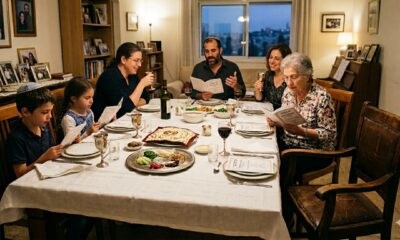
As Pesach approaches each year, Jewish homes begin to transform. Cupboards are emptied. Kitchens are kashered. Shopping lists seem to grow by the day. Families prepare to gather around the seder table.
It is one of the most beautiful times on the Jewish calendar. But if we are honest, it can also be one of the most stressful.
The pressure to clean, cook, host, and prepare can feel overwhelming. Everyone is tired. Expectations run high, and sometimes, in the rush to create the perfect Pesach, tensions can creep into the very homes we are trying so hard to prepare for the festival.
Yet Pesach itself teaches us how to avoid exactly that.
The seder focuses on a simple but powerful idea: questions.
The Torah introduces the Pesach experience with the words “When your child will ask”. The mitzvah of the night is not simply to eat matza or drink four cups of wine. It is to tell the story of the exodus, to pass our history, our faith, and our identity to the next generation.
The entire seder is designed to spark curiosity. We dip vegetables, recline like ancient royalty, hide the afikomen, and change the normal order of the meal. All of it is done so that a child will notice something unusual and ask the famous question, “Why is this night different?”
The Haggadah then introduces one of the most fascinating ideas in all of Jewish education: there are four children.
The wise child, the rebellious child, the simple child, and the one who does not yet know how to ask.
Each of them approaches the seder differently. Each of them asks, or does not ask, in their own way. And the Torah teaches us that each one deserves a different response.
Why does the Haggadah go out of its way to emphasise this?
Because the message is far bigger than education. It is about relationships.
Every family contains these four personalities. And so does every community. There are those who ask thoughtful questions and want to understand every detail. There are those who challenge everything. There are those who speak simply and directly. And there are those who sit quietly, unsure how to begin.
The Torah’s approach is not to silence any of them. Instead, it teaches us to listen.
That is the beginning of shalom bayit. Peace in a home is not created when everyone thinks the same way. It emerges when people feel heard, respected, and valued, even when their perspectives differ from our own.
The Lubavitcher Rebbe teaches us, that there is a powerful insight about the question of the “wise child”. The child does not ask abstract philosophical questions. Instead, the child asks about the details of the mitzvot, the practical actions we perform.
The Rebbe explains that true Jewish wisdom is found not only in lofty spiritual ideas. It is found in the way holiness is brought into the practical world through our daily actions.
In many ways, that insight applies just as much to family life.
A peaceful home is rarely achieved through big speeches about unity. It is built through small acts, patience during a stressful moment, kindness in a conversation, and the willingness to answer a question instead of dismissing it.
Pesach preparation provides countless opportunities to practice exactly that.
Perhaps someone in the family cleans differently than you would. Perhaps a child asks endless questions while you are rushing to finish preparing the kitchen. Perhaps a guest at the seder table expresses an opinion you strongly disagree with.
The instinct might be to shut the conversation down, Pesach suggests the opposite, lean into the question.
The seder celebrates not only freedom from Egypt but the freedom to think, to ask, and to engage. In fact, some commentators note that slaves cannot ask questions. Questioning itself is a sign of freedom.
Every question asked at the seder becomes a small reenactment of redemption.
Of course, remembering this when the house is full, the children are tired, and the soup is getting cold is easier said than done.
Maybe that is why Pesach is filled with such powerful symbols.
Matza, the simplest bread imaginable, reminds us of humility. Maror reminds us of bitterness. Together they tell the story of the Jewish journey, a journey that includes both struggle and redemption.
Families experience the same dynamic. There will always be moments of sweetness and moments of tension. The goal is not to eliminate those differences but to transform them into deeper connection.
A seder table where questions are welcomed becomes a place where relationships grow. I see this every year in our own community seders.
Some guests arrive deeply familiar with every word of the Haggadah. Others are experiencing a traditional seder for the very first time. Some ask thoughtful questions about halacha. Others ask the most disarmingly simple questions imaginable.
And yet those simple questions often become the most powerful moments of the night.
Because when someone feels comfortable enough to ask, it means they feel that they belong at the table.
And that is something uniquely powerful about our South African Jewish community.
We are certainly not the largest community in the world. But we are close-knit. People show up for each other. Families, neighbours, and even relative strangers find their way to each other’s seder tables. There is a natural warmth here, a sense that no-one should be alone on Pesach.
And that works only when people feel they have a place, exactly as they are.
Because unity does not mean uniformity.
Just like the four children at the seder, our communities include different personalities, backgrounds, and journeys in Jewish life. The Haggadah does not remove the rebellious child from the table. Quite the opposite, the conversation happens precisely because that child is present. Community life works the same way.
When we learn to listen to one another, to answer thoughtfully rather than react defensively, and to make space for every kind of question, we create the kind of unity that has sustained the Jewish people for thousands of years. Pesach celebrates the birth of the Jewish nation. But perhaps just as importantly, it celebrates the birth of Jewish conversation. Parents speaking to children, teachers responding to students, families telling their story across generations, and in that process something powerful happens. Questions lead to understanding, understanding leads to empathy, and empathy leads to peace.
So as we rush to prepare for Pesach this year, cleaning the cupboards, setting the seder table, and making sure the matza supply is ready, perhaps we should prepare something else as well. A little extra patience a little extra listening, the willingness to answer a question, even a difficult one, with warmth and respect.
Because sometimes, the path to peace in our homes, and in our uniquely beautiful South African community, begins with the simplest words in the Torah: “When your child will ask …”
- Rabbi Pini Pink is the rabbi at Chabad Greenstone.