Featured Item
Why peace isn’t a zero-sum game

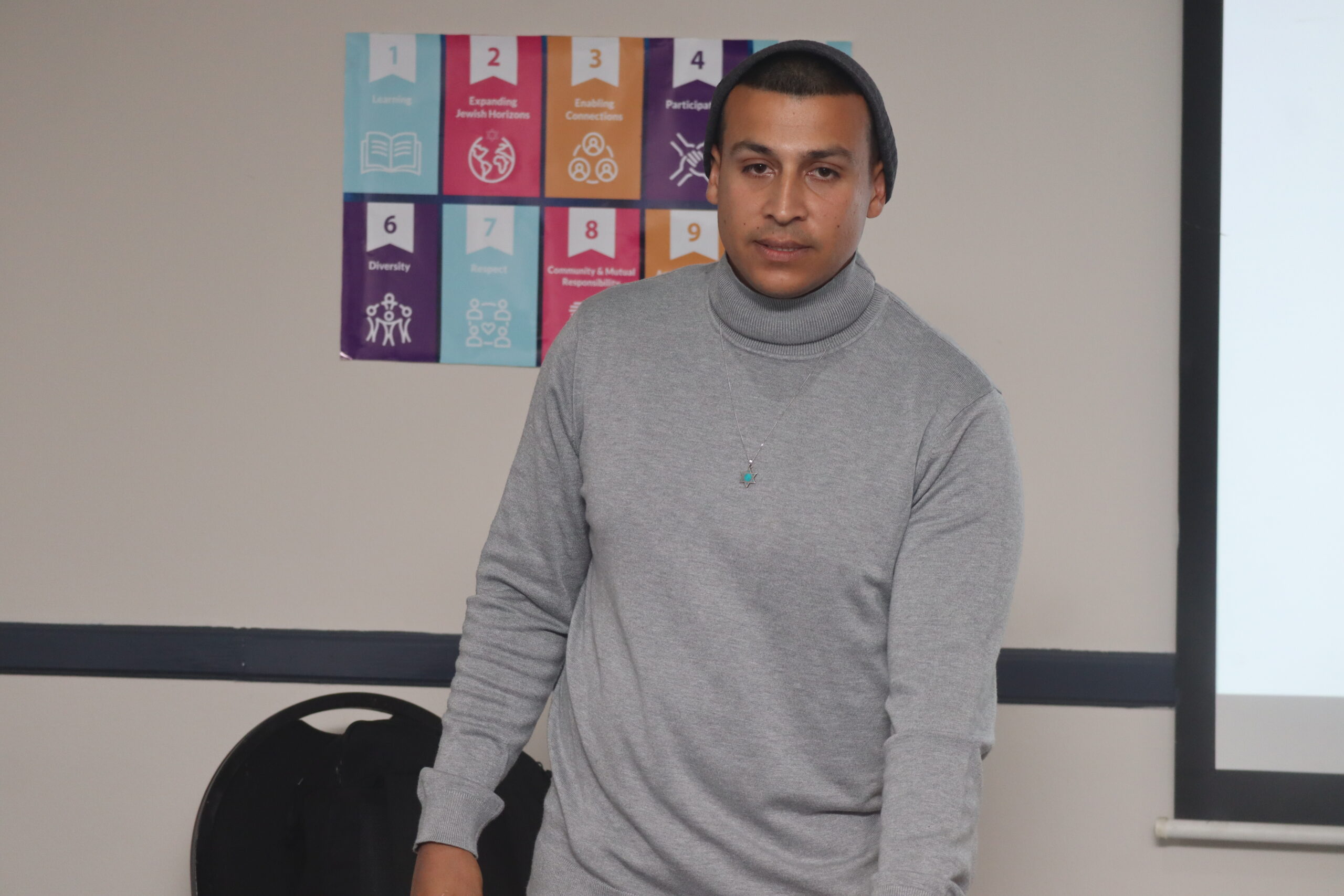
Educator and social media content creator Yirmiyahu Danzig told Limmud Johannesburg on 16 August that though many believe reconciliation between Israelis and Palestinians has become impossible, it’s simply not the case.
“Various chapters of this conflict, certainly the most recent, have indicated to Israelis and Palestinians that it’s not an issue of the material conditions,” he said. “It’s not about disputes over potential borders, or certain resources. Essentially, there’s something about our identity that is a zero-sum game, that the one identity negates the existence of the other identity.”
Danzig said that without having some sort of humanisation, or empathy for the other side, there would never be any semblance of peace in Israel. And he said empathising with the Palestinians doesn’t take away any of our Jewishness or our connection to Israel, especially in the wake of 7 October 2023.
“I have friends in Gaza. I have friends in Ramallah, and in Hebron, and in Shechem. And they’re sending me messages after 7 October to see if I’m okay. So, I’m not going to send them a message, three, four, five months into the war to find out what’s going on, how they’re dealing with getting food? Of course I am. It doesn’t make me any less of a proud Jew.”
Danzig’s upbringing was full of the contradictions that plague the Middle East today. He had an Israeli father whose family lived in the land of Israel, specifically the Jewish quarter of the Old City of Jerusalem, for at least nine generations, and would spend time in Arab spaces.
“It was normal for me to hear my grandfather growing up speaking not only Hebrew fluently as a mother tongue, but also Palestinian Arabic, which he heard his father speak,” he said, “Whenever I spent time with my grandfather, he almost exclusively took me to Arab restaurants, Arab cultural spaces.”
Danzig said he felt like he had to navigate between different identities. However, he was able to realise that two things which are very uncomfortable can be fundamentally true at the same time.
“I had to hold two fundamental truths. Number one, I was a Jew, I was an Israeli, deeply connected somehow to Palestinians, to Arabs, to Muslims. But on the other hand, one of my earliest memories as a child was watching my father break down crying when he found out that his pregnant cousin was murdered by a Palestinian terrorist.”
Danzig also draws on the stories of his grandfather and great-grandfather, who lived in the Old City of Jerusalem under Ottoman occupation, when people say that Jews and Arabs got on well before the establishment of Israel.
People either say that everything was peaceful, or everything was horrible, he said. The reality is that it was a little more complicated.
“There were horrible stories of oppression, and I share these with Palestinians,” he said. “They tell me that they cannot deny the fact that my great-grandfather was jailed because he tried to resist a regime that sexually abused his sister and wanted to let them get away with it because she was Jewish. And yet there were so many stories of brotherly love, compassion, and support for each other.”
Danzig also said the only way to have a constructive conversation about the founding of Israel is to acknowledge the hurt that came as a result for many Palestinian families.
“How can I ignore the story of a Palestinian grandma in 1948? Who had never left her village in her life. Hadn’t met the Grand Mufti of Jerusalem, had never heard him speak. And then all of a sudden, an army comes up and says, ‘You need to leave,’” he said. “Regardless of who is to blame and the fact that there was war, and war is brutal and it’s complicated, that’s still a tragedy. For the family, for the grandchild of that person, as a Jew with my tragedies, I cannot turn a blind eye to that experience.”
Danzig posed the question of how to commit to your story without apology. He said the way discussion is going is that you have the most intensely proud members of the Jewish people invite some Palestinians who completely reject their story and identity to come and join them; and on the other, extremely proud, unapologetic Palestinians that condemn anything the Jews and Israel stands for invite token Jews to join them on their side. However, real change comes when you stand on your own.
“Be unapologetically Jewish. Be unapologetic about your relationship to Israel. A relationship can be defined by intense criticism, but it’s a relationship. And in my experience, that has been one of the most empowering ways to actually break the cycle, because I found that my counterparts on the Palestinian side tend to have a lot more respect when you stand on your own.”