



Lifestyle/Community
Jewish pride rising even as teens navigate antisemitism

King David High School pupils are increasingly proud of being Jewish and feel emotionally connected to Israel, according to the latest research conducted by the South African Board of Jewish Education.
However, pupils reported different experiences of antisemitism, with some having become more anxious about identifying publicly as Jewish.
Josh Sevitz, head of Jewish education at King David Schools, said the findings continued a positive trend seen since the research began in 2014.
“What I’ll say for all the studies, which is quite remarkable from the 2014 trajectory through to now, is that there’s been this upward trajectory of pride in being Jewish and association to being Jewish, and comfort with being Jewish,” he said.
The survey examines Jewish identity, attitudes towards Israel, perceptions of antisemitism, and pupils’ experiences of their school. It is conducted every four years to track pupils from when they begin high school until their final year.
The 2026 research surveyed 161 Grade 8 pupils and 180 in Grade 12. Among the matrics, 110 had also been surveyed as Grade 8 pupils in 2022, allowing researchers to examine attitude changes as they’ve grown older.
Sevitz told the SA Jewish Report that the research helped the school identify areas requiring attention rather than simply measuring whether attitudes had improved or declined. Earlier studies had highlighted the importance of nuanced Israel education, experiential learning, and parental involvement. The latest findings have prompted further reflection on how the school teaches formal Jewish studies.
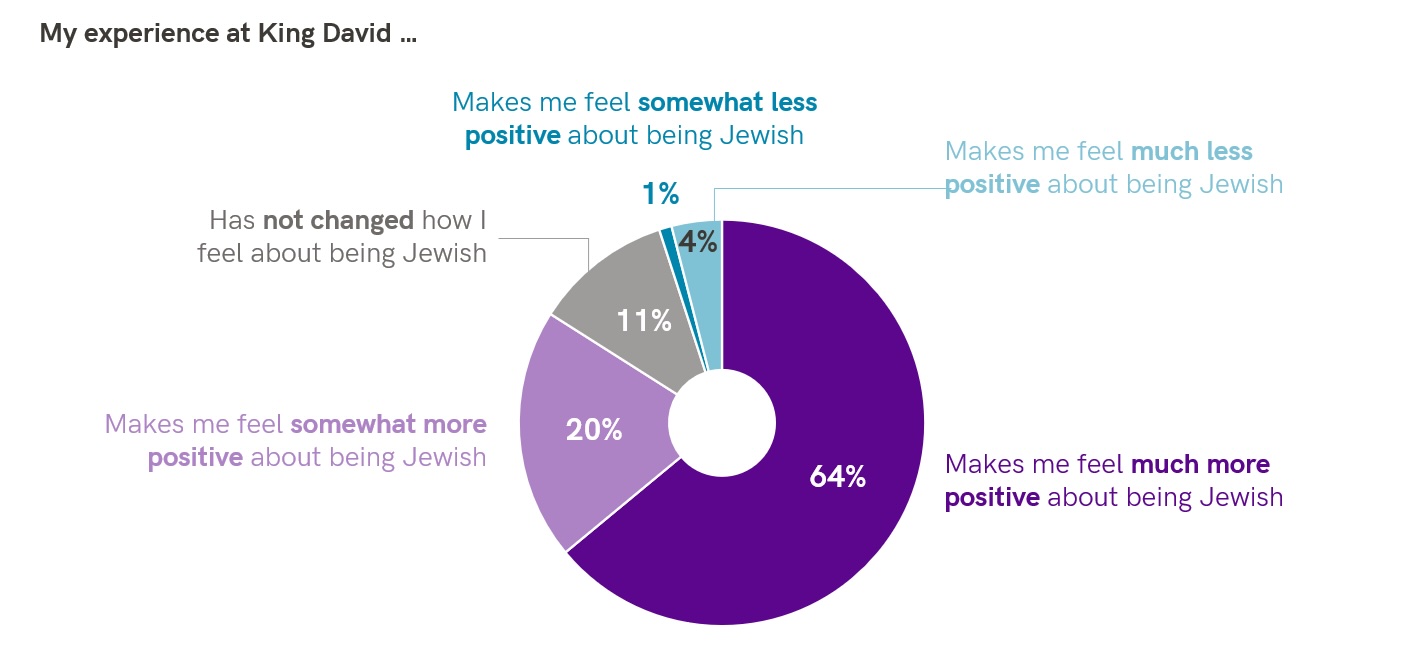
One of the strongest findings concerned the effect of the school itself on Jewish identity. Asked how their experience at King David had influenced their feelings about being Jewish, 64% said it made them feel much more positive. Another 20% said it made them feel somewhat more positive.
Eleven percent said their experience had made no difference. The remaining 5% reported feeling less positive, including 4% who felt much less positive and 1% who felt somewhat less positive. Sevitz said the result was particularly encouraging because it showed the influence pupils believed their school had on their identity.
“How can we further uplift formal Jewish studies?” he said, describing this as a key focus for the school. He explained that Jewish studies must function both as an academic subject and as an opportunity for youngsters to find personal meaning.
The findings also point to strong Jewish pride among older pupils, with 87% of Grade 12 respondents agreeing or strongly agreeing that they feel proud when people knew they are Jewish. Among Grade 8s, the figure was 80%.
Pride in the Jewish people was similarly high, with 85% of matrics and 82% of Grade 8s expressing pride. Both figures reflect a substantial increase from earlier surveys.
The research also found a stronger connection to Jews living in Israel. Among Grade 8 pupils, 68% reported a strong connection, compared with 46% in 2022. Among matrics, the figure rose to 64%, from 38% four years earlier.
Sevitz said the post-7 October period appeared to have strengthened pupils’ emotional attachment to Israelis and their pride in Israel. “There was this major affinity to the people of Israel that jumped up,” he said, describing one of the clearest changes in the latest findings.
However, the survey also suggests that older teens are developing more nuanced attitudes towards Israel. Among the pupils followed from Grade 8 in 2022 to Grade 12 in 2026, agreement that Jews should stand up for Israel “no matter what” declined from 85% to 67%.
The proportion of pupils who said they felt upset when Jews criticised Israel also fell, from 74% to 62%. These results suggest that a strong connection to Israel can coexist with greater openness to criticism as pupils mature.
The study examined how pupils view antisemitism, both internationally and in South Africa. Thirty-seven percent said they had personally experienced some form of antisemitism in the previous year, either in person or online. Another 29% were unsure, while 34% said they had not experienced it.
Respondents viewed antisemitism as a more serious problem elsewhere in the world than locally. Seventy-seven percent considered it a very serious problem internationally, compared with 32% who said the same about South Africa.
The survey identified experiences in everyday environments, including schools, sporting events, public spaces, and online platforms. Reported incidents included verbal harassment, antisemitic slurs, online abuse, and hostility linked to Israel that blurred the distinction between Jewish identity and political views.
Visible Jewish identity was another focus. Since 7 October, 41% of respondents said they had become more inclined to wear, carry, or display items that could identify them as Jewish. Thirty-six percent reported no change, while 23% had become less inclined.
Online expression produced a different picture. Twenty-eight percent said they were more inclined to post content identifying them as Jewish or expressing their views on Jewish issues. Forty-two percent reported no change, while 31% were less inclined.
The findings suggest that greater pride doesn’t necessarily remove concerns about public identification. Students may feel more connected to their community while remaining cautious about expressing that identity in certain settings.
The study also examined the impact of two incidents on pupils’ feelings about displaying their Jewish identity. In 2022, anti-Israel protests in Glenhazel had left 31% of respondents feeling anxious about publicly identifying as Jewish.
In the latest survey, students were asked how an episode involving Roedean School had affected their willingness to wear their King David uniform outside school. Roedean tennis players refused to play King David girls. Thirty-two percent said it had made them feel very proud to wear their uniform, while 18% felt somewhat proud. Thirty-six percent reported no change, while approximately 13% said they felt anxious.
Sevitz said the response to the Roedean episode had been markedly different from the reaction to the Glenhazel protests. He attributed this partly to how the school had responded, with pupils reporting increased pride in their association with King David.
He also pointed to the role of school leadership, experiential learning, and parental involvement in building Jewish identity. The school’s Division of Informal Jewish Education runs programmes including Shabbatonim, immersive Grade 10 and Grade 11 experiences, and additional learning opportunities.
The survey, Sevitz said, offered an opportunity to build on positive findings while identifying where further work was needed. For King David, the challenge is to sustain students’ connection to Jewish life and Israel while ensuring that Jewish education remains meaningful as they grow older. The findings indicate that pride is strong, but pupils’ experiences of antisemitism and their comfort with public Jewish identity remain varied.