


World
Fifty years on, Entebbe still captures Jewish hearts

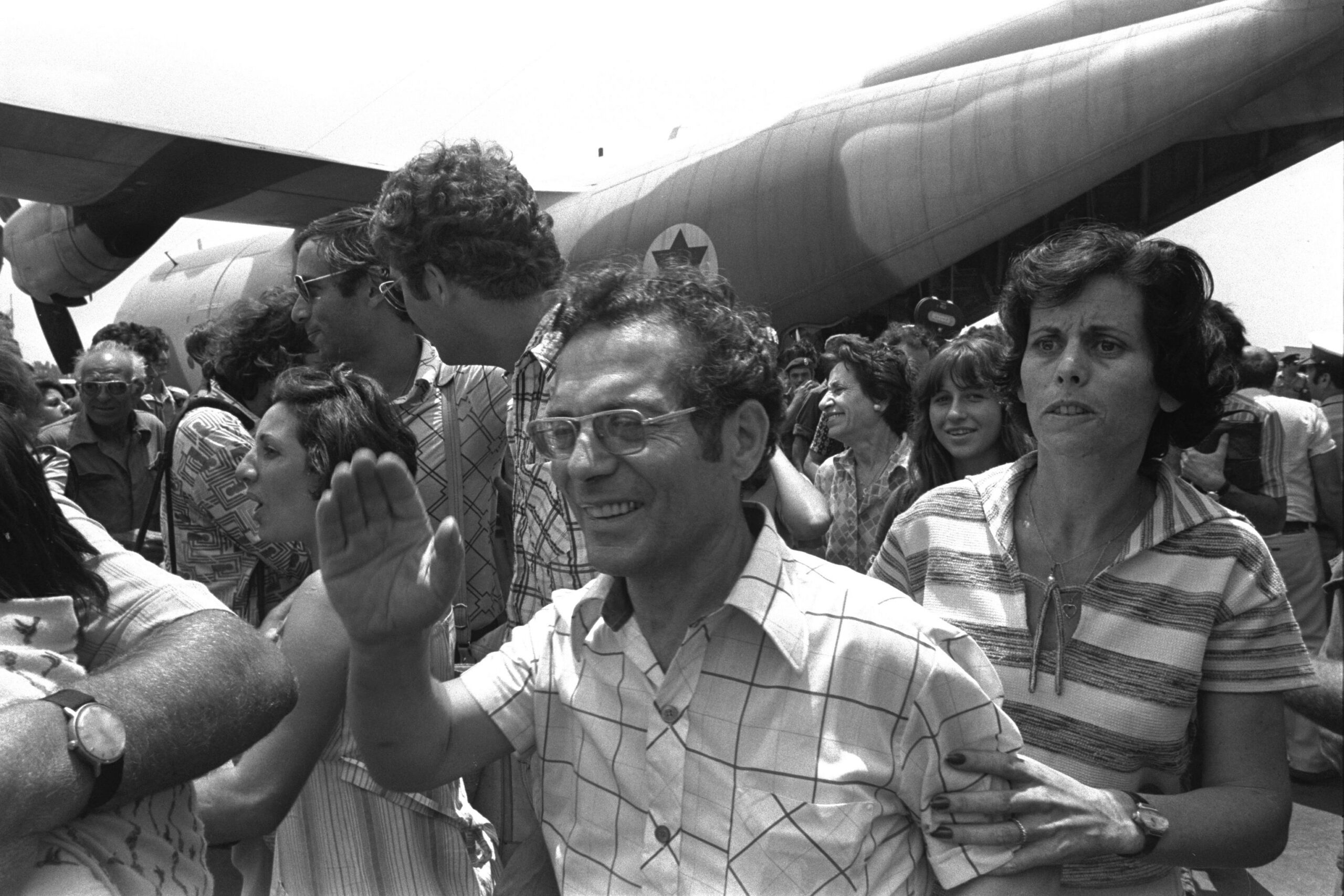
As Israel marks 50 years since the Entebbe rescue, newly declassified government documents have shed fresh light on one of the most daring hostage rescue missions in military history. For many South African Jews, however, the operation has remained vivid thanks to a six-minute film produced by Johannesburg’s Sydenham Shul a decade ago.
Released to commemorate the 40th anniversary of the rescue, Miracle at Entebbe has since attracted more than a million views on YouTube.
The film recounts how in 1976 Israeli soldiers rescued more than 100 hostages held by terrorists who had hijacked an Air France flight en route from Tel Aviv to Paris and diverted it to Entebbe Airport in Uganda.
For the shul’s Life Rabbi Emeritus Yossy Goldman, it was important that the remarkable story not be forgotten. “It was our production,” he said. “I was the rabbi and I was also the producer of the film, and very proud of it.”
The idea emerged while Sydenham Shul was organising a concert featuring American Jewish singer Benny Friedman. “Because it was around the time of the 40th anniversary, we decided to do something to link it,” Goldman said.
Although several documentaries and feature films had already been made about the rescue, Goldman wanted something concise that audiences could watch before the concert. “We wanted to keep it short,” he said. “We were quite ruthless in editing it down to six-and-a-half minutes, which was no easy feat.”
Goldman enlisted filmmaker and historian David Fleminger to help tell the story. “Rabbi Goldman is very passionate about Entebbe,” Fleminger said. “He wanted the community to be reminded about what an amazing event Entebbe was, what a miracle it was that the audacious plan actually was executed correctly.”
Goldman prepared the initial script before Fleminger transformed it into a visual narrative using archival footage from documentaries, feature films, and historical recordings. “He commissioned me to write an overview script,” Fleminger said. “I used existing footage that I found online from various documentaries, movies, and various other sources, and edited together essentially a new retelling of Entebbe.”
Although Fleminger’s career has focused largely on corporate productions, the project appealed to his lifelong interest in history. “It’s always nice to take a story and retell it so that it’s accessible,” he said. There was never an intention to offer a new interpretation of the operation. “This wasn’t an academic history,” he said. “It was a retelling of the story in the most engaging way that we could.”
For Fleminger, storytelling is essential to keeping history alive. “History shouldn’t just be about dates and facts,” he said. “It should be a narrative that engages us and inspires us. History isn’t something that happened in the past. History is something we live with every day. The more we understand, the more we appreciate our history, and the better prepared we are for the future.”
For Goldman, Operation Entebbe grabbed his imagination from the start. “I lived through it, I did a lot of reading about it, and I researched it before we did the film.”
He credits his assistant, Ingrid Seeff, for her invaluable work in helping the film project come to fruition.
He believes the rescue represented far more than military excellence. “First of all, is that G-d is watching over us,” Goldman said. “As much as we admire the bravery, the courage, the grit, the chutzpah, the brains of Israel and the military strategists, and the commandos, they themselves are the first to acknowledge that there was somebody up there guiding us.”
He recalled one story in particular that resonated with him. One of the Israeli pilots described stopping his aircraft earlier than planned for no apparent reason. Afterwards, the crew discovered a large crater further along the runway. “He has no explanation for what put that idea into his mind,” Goldman said. “His words were, ‘Somebody up there was watching over us.’”
Goldman also said the operation demonstrated the courage of Israel’s political leaders, who were deeply divided before the mission. “There were fiery debates in the Cabinet room,” he said. “Some said, ‘Let’s go for it.’ Some said, ‘You’re crazy. It’s reckless and suicidal.’” Despite those concerns, the Cabinet unanimously approved the rescue mission.
“I would say the Entebbe rescue was Israel’s finest moment,” Goldman said. “The whole Jewish world was proud and the whole non-Jewish world was absolutely in awe.”
The film’s reach has exceeded anything its creators expected.
After it was released, Goldman asked Israel’s ambassador to South Africa to forward it to Israeli Prime Minister Benjamin Netanyahu, whose brother, Yonatan, led the mission and was the only Israeli soldier killed. “A few weeks later, I got the most beautiful personal letter on gold-embossed prime minister stationery thanking us for doing this,” Goldman said. “He watched it and was emotional watching it.”
The Entebbe mission has subsequently been renamed Operation Yonatan.
Today, as renewed attention is paid to the mission on its 50th anniversary, Goldman believes it continues to speak to Jews everywhere. “I don’t think it’s anything unique to South African Jews,” he said. “I think it’s all of us, wherever we are, in Israel or in the diaspora.” Its enduring message, he believes, is simple. “With faith and fearlessness, we can achieve the impossible.”