OpEds
Green shoots sprouting

I have been thinking a lot lately about green shoots.
Not because I’ve suddenly become blind to what’s wrong with South Africa. Quite the opposite. But I wonder whether we have become so practised at identifying everything that’s going wrong that we sometimes fail to notice what’s going right.
And lately, when I look around Johannesburg, I see green shoots everywhere.
Not one big miracle. Lots of smaller things, in different places, driven by different people.
Start close to home.
A year or so ago, it felt as though you could choose almost any house you wanted in Glenhazel. Today, family homes are increasingly difficult to find and rentals even harder. That’s hardly a scientific demographic study, but something has shifted. People are choosing to live here.
Then look at what is happening more broadly within Jewish Johannesburg.
The Chassidic community has built a magnificent new campus. Pine Street Shul, which not long ago was discussing downsizing or amalgamating, has experienced a remarkable rebirth in Orchards. The Kollel and Chabad of Norwood have undergone major upgrades. Torah Academy has invested heavily in a beautiful new Girls High School campus. Ma’ayan Chai, a new Chabad seminary and the first in South Africa, has opened with its first group of young women.
Think about the psychology behind that. Communities that believe they have no future don’t normally build campuses, refurbish institutions, open seminaries, and invest heavily in education. They retreat. This doesn’t feel like retreat.
Even painful consolidation can be a sign of strength.
I was a proud Victory Parker, and it was deeply sad to see King David Victory Park close after more than six decades. But strong communities cannot preserve every institution indefinitely because they are afraid to change. Sometimes sustainability requires difficult decisions, consolidation, and redeployment of scarce resources so that what remains becomes stronger.
At the same time, the Academy of Jewish Thought and Learning in Houghton is creating a new generation of Jewish Studies teachers because the traditional university pipeline had effectively dried up. Again, somebody saw a problem and said, “Let’s build a solution.”
Our welfare infrastructure tells the same story.
The Chevrah Kadisha now serves close to 10 000 people across an extraordinary range of needs, which keep expanding its services – recently with Rimon Health, a structured primary healthcare programme for uninsured community members who cannot afford medical aid. Another example is Yad Aharon & Michael, which provides weekly food assistance to around 750 Jewish families, and has now rebuilt its Soup for the Soul facility, which feels like a warm café, not an institutional soup kitchen.
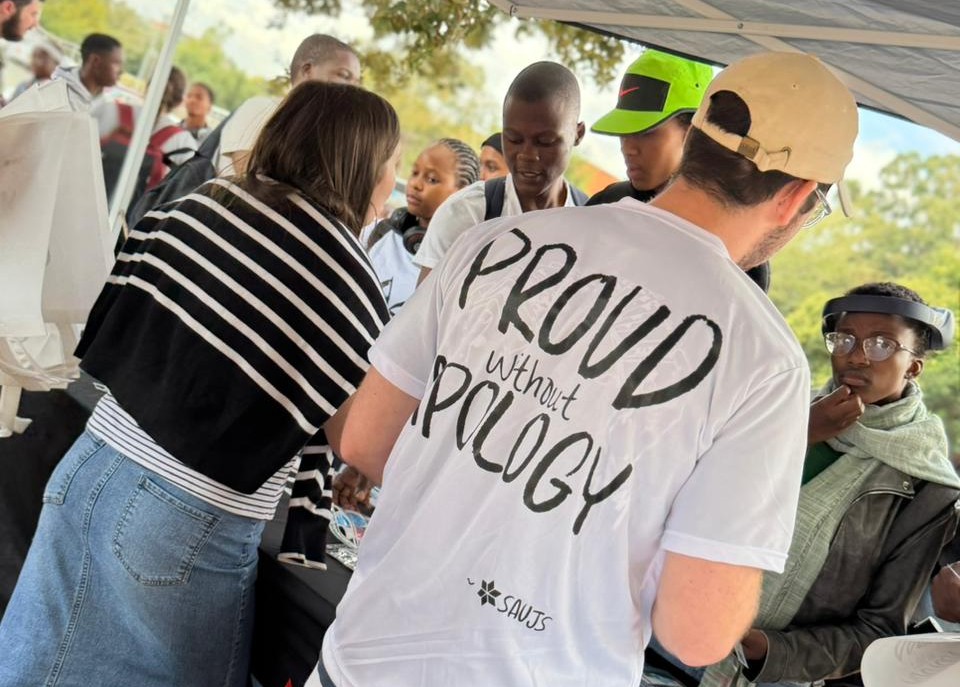
There is another green shoot that I find deeply encouraging. After 7 October, it would have been very easy for South African Jews to become smaller, quieter, and more fearful. Yet, the South African Jewish Board of Deputies, together with the South African Union of Jewish Students, student leadership, and university administrations, made campuses a strategic priority. This year, Jewish students turned Israeli Apartheid Week on its head. They created a campaign called “Pride Without Apology”. One of the invitations was wonderfully simple, “I’m a proud Zionist, come ask me what that means.” Conversation replaced intimidation and Jewish identity became visible rather than apologetic.
This is not to say the problem is solved but compare the psychology. From fear to confidence, from hiding to engaging, from being acted upon to becoming actors in our own story. That is a green shoot.
Outside the Jewish community, I see the same instinct emerging: people are no longer waiting for somebody else to fix Johannesburg and are picking up a piece of it themselves.
CAP Green transformed Galliot Park in Glenhazel from a tired, dusty public space into a beautiful, safe, and popular family park. The point is not simply the landscaping. Families came back. Children came back. A piece of Johannesburg was reclaimed.
CAP Green isn’t simply planting grass. It’s restoring belief.
The same is happening in education.
Businessman Rob Katzen helped rebuild Jeppe High School for Boys, after years of serious decline, into a five-star campus. Out of that experience came EduSafe, which is now working with other government schools.
Its philosophy is wonderfully practical: security must work, bathrooms must work, buildings must be maintained, finances must be controlled, and management must be accountable. A school is more than a place where children learn maths and English. It tells thousands of children, teachers, and parents what “normal” looks like.
Fix one park and you change a neighbourhood. Fix one school and you potentially alter the trajectory of thousands of children over decades.
Then go downtown.
Jozi My Jozi, co-founded by businessmen Robbie Brozin and Adam Craker, has brought business, civil society, communities, and the city together around a simple proposition: Johannesburg cannot be restored by government alone, nor by business standing on the sidelines complaining.
Main Street is beginning to change. Former mining headquarters are being repurposed around education, entrepreneurship, culture, and technology.
Co-founder of the Maharishi Invincibility Institute Dr Taddy Blecher is expanding its extraordinary work of moving young people from education into employment. Jozi My Jozi has helped install solar streetlights, reclaim public spaces, and bring ordinary Johannesburg residents back into parts of the city they had stopped experiencing as their own.
A city begins dying when its citizens stop using it, believing in it, and feeling that it belongs to them. That psychology can also be reversed.
Perhaps the most important green shoot of all is the increasingly serious partnership between business and government.
The Government-Business Partnership, led by Discovery founder Adrian Gore, began around electricity, logistics, and crime.
Ports and rail are beginning to reform too, with private operators entering parts of the freight network.
And now Johannesburg itself is increasingly becoming a focus of that partnership.
What excites me most is that the top-down and bottom-up movements are beginning to happen at the same time.
CAP Green is reclaiming parks. EduSafe is reclaiming schools. Jozi My Jozi is reclaiming streets, buildings, and public spaces. Maharishi is creating pathways into employment. And business and government are beginning to tackle the machinery of the city itself.
If those forces begin meeting in the middle, Johannesburg could become something we haven’t spoken about for a very long time. Not merely a problem to be managed, but a model of how a badly broken city begins rebuilding itself.
I am not saying South Africa has turned the corner. Unemployment remains catastrophic. Municipalities are struggling. Crime is serious. Corruption has done enormous damage. Our Jewish community faces real demographic challenges.
But perhaps that is precisely why green shoots matter. A green shoot does not mean the forest is healthy. It means something living is pushing through.
And perhaps, as Jews, we should understand that better than most. We have never confused a difficult present with a hopeless future.
We build before certainty. We educate before certainty. We plant before certainty. We have children before certainty.
Look around Johannesburg. A shul builds. A seminary opens. A CBD building fills with young people learning skills. Loadshedding almost disappears. Students walk onto campus proudly and visibly Jewish.
None of these things individually proves very much. But together? I think they tell a story.
I am increasingly convinced that there are green shoots all around us.
And our job is not merely to notice them. Our job is to water them.
- Paul Bacher is a social entrepreneur and community builder, with a passion for fostering meaningful connections and creating spaces for personal and collective growth.