



OpEds
The menu costs of global antisemitism

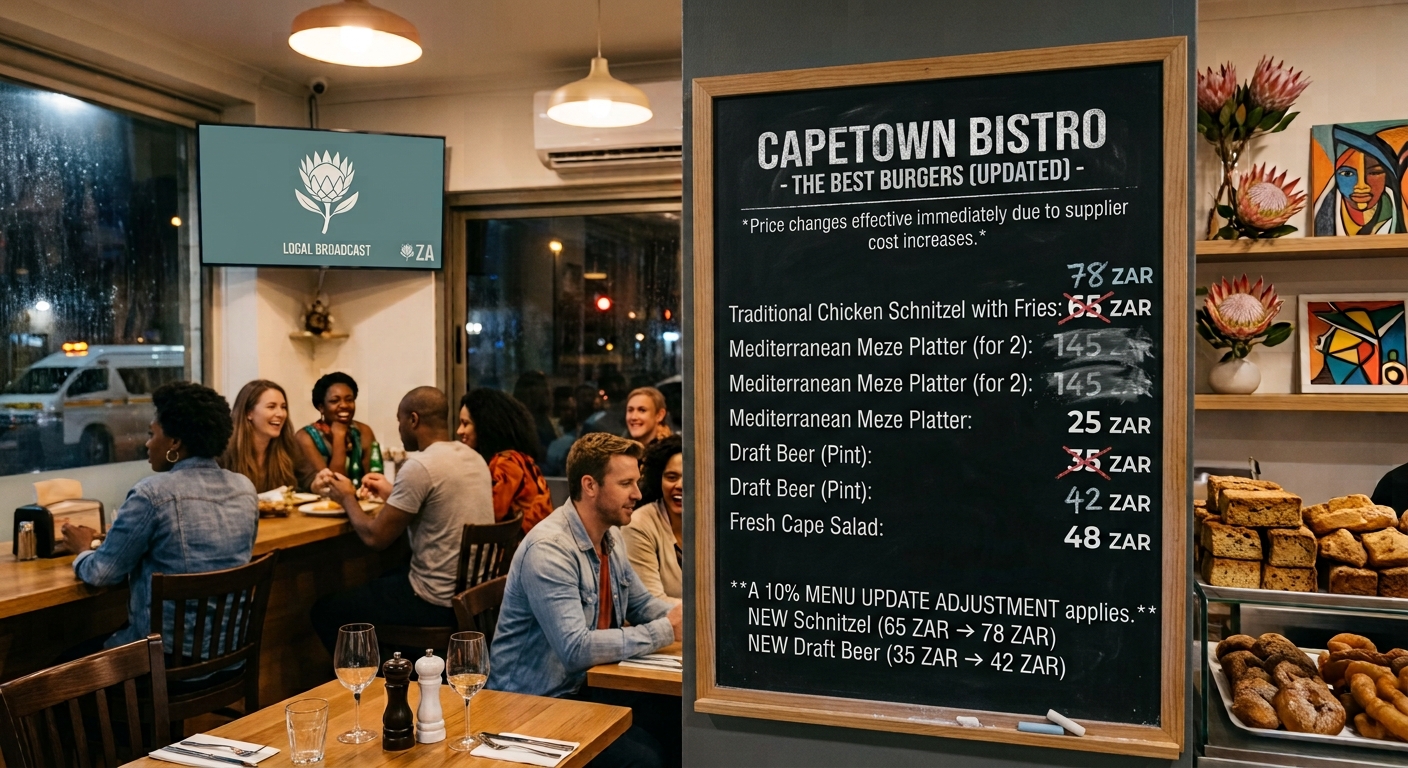
Savvy consumers among SA Jewish Report readers will no doubt be familiar with a phenomenon that occurs during periods of higher prices and inflation. Your local restaurant may take some time before raising the prices on your favourite burger. However, once inflation subsides, restaurateurs don’t always bring those prices down again quite so quickly.
This behaviour is what economists call “menu costs”. The term refers metaphorically to the printing, design, and other costs that a theoretical restaurant incurs when changing the prices on its menu. Because changing prices itself carries a cost, the restaurant may wait before raising them during inflation and then wait again before lowering them once inflation subsides. In the actual economy, menu costs refer to the costs and difficulties associated with adjusting systems, prices, and supply chains to changing economic conditions.
For the past quarter of a century, world Jewry has endured a creeping rise in global “antisemitic inflation”. Every bout of hostilities since the Second Lebanon War has driven it higher, sustained by the ongoing efforts of groups such as the Boycott, Divestment, Sanctions movement.
Work by organised Jewish communities and their allies, diplomatic successes by Israel such as the Abraham Accords, and external events such as the Arab Spring helped slow things down. After 7 October, however, the world entered a period of antisemitic hyperinflation that has yet to return to pre-7 October levels. We are now beginning to see the resulting menu costs take hold.
Take a relatively trivial example: the attempted boycott of Israel at Eurovision. When Israel won the competition in 2018, calls were immediately made to pressure European broadcasters and governments to boycott the following year’s event, including an appeal signed by around 140 artists. There were numerous protests, but ultimately the initiative failed.
Several years later, however, Ireland withdrew from the contest over Israel’s participation, followed by several other countries, including Spain and the Netherlands. While no further countries may withdraw, the likelihood of those that have left returning quickly is also small. Eurovision continues to face anti-Israel initiatives.
Eurovision now has a new menu cost when it comes to Israel.
The same principle applies to almost any institution, whether it’s a book club, the University of Cape Town, or even a supranational organisation like the United Nations (UN). Once an institution has shifted its position, reversing that change requires another expenditure of political, social, or reputational capital.
The biggest and potentially most important increase in these antisemitic menu costs, however, may be occurring in the United States’s Democratic Party. The primary process in the run-up to this year’s midterm elections has produced a plethora of candidates associated with the Democratic Socialists of America, both for Congress and the Senate, inspired by Zohran Mamdani’s successful campaign for mayor of New York.
Many of these candidates have expressed views that are implacably anti-Israel, sympathetic towards Iran, hostile towards traditional American foreign policy, and, in some cases, downright anti-Jewish. Depending on how the elections unfold in November, American Jews may find themselves dealing with a new menu cost embedded within the country’s political structures.
In South Africa, meanwhile, we face perhaps the ultimate menu cost: the application to the International Court of Justice (ICJ). The case has become a major obstacle in relations between Israel and South Africa, while simultaneously giving antisemites who wish to exclude Jews from social spaces an excuse to claim that they are merely following government policy.
The “genocide” narrative has come under considerable pressure from new information concerning the involvement of Hamas members in international news organisations and the UN Relief and Works Agency for Palestine Refugees, new food data challenging allegations of famine, and a range of other disputed data points. As a result, countries involved in the case, such as Ireland, have even begun to argue for a lower threshold in determining genocidal intent in the case against Israel. The proceedings are moving so slowly that the case is likely to be resolved only sometime in the 2030s. Even if the factual basis of the case weakens, the political composition and legal approach of the ICJ mean that an adverse judgment remains possible.
Such an outcome could become the modern equivalent of the UN’s infamous 1975 “Zionism is racism” resolution, which helped provide the intellectual and political basis for many of the racism accusations Israel still faces today. That resolution was eventually, and unusually, repealed.
A genocide judgment would be far more difficult to undo. It would tarnish Israel’s image internationally and could damage its relationships with partners in parts of Europe and potentially North America. Unlike a political resolution, a judgment of the world’s highest international court cannot simply be repealed by another vote.
The menu cost could therefore be global and effectively permanent.
So what can be done about menu costs?
Returning to our restaurant analogy, once prices have risen, they generally come down only when the conditions that produced the inflation have receded. The retailer has limited control over those external conditions. Yet even when inflation falls, there remains an incentive to keep prices where they are. What eventually forces them down is pressure from customers and the threat that those customers will go elsewhere.
The political equivalent requires two things. Pro-Israel forces need to be organised, properly resourced, and willing to challenge institutions that have been affected by the anti-Israel agenda. They also need to be able to take advantage of the broader political environment to move in their favour.
South Africa is currently in an unusual position because some of the major drivers of our “antisemitic inflation” may be beginning to recede.
For the moment, the fighting in the Middle East has subsided, keeping the issue away from the front pages and reducing the number of protesters on the streets. More importantly domestically, the African National Congress (ANC) is likely to suffer at least some losses in the November local elections. Although these elections are municipal, a sufficiently poor result could further weaken the party and potentially accelerate its decline ahead of the 2029 national election.
The ANC isn’t the only source of antisemitism in South Africa, nor necessarily the largest source of antisemitic ideas. But it has been the country’s most important political vehicle for legitimising and spreading them. There is therefore a relationship between the ANC’s ability to wield state power and the institutional reach of anti-Israel politics.
This creates an opportunity.
If the ANC emerges from the elections weakened and increasingly dependent on coalition partners, opposition parties will possess greater bargaining power. Withdrawal from South Africa’s ICJ case could become part of their negotiating package in future coalition agreements.
If South Africa’s participation in the case were withdrawn, the country’s involvement could increasingly come to be understood for what its critics have always argued it is: a political project rather than an unavoidable requirement of international law.
The inflationary pressure has begun to fall. The next task is to bring down the menu costs.
- Benji Shulman is the director of the Middle East Africa Research Institute.