





SA
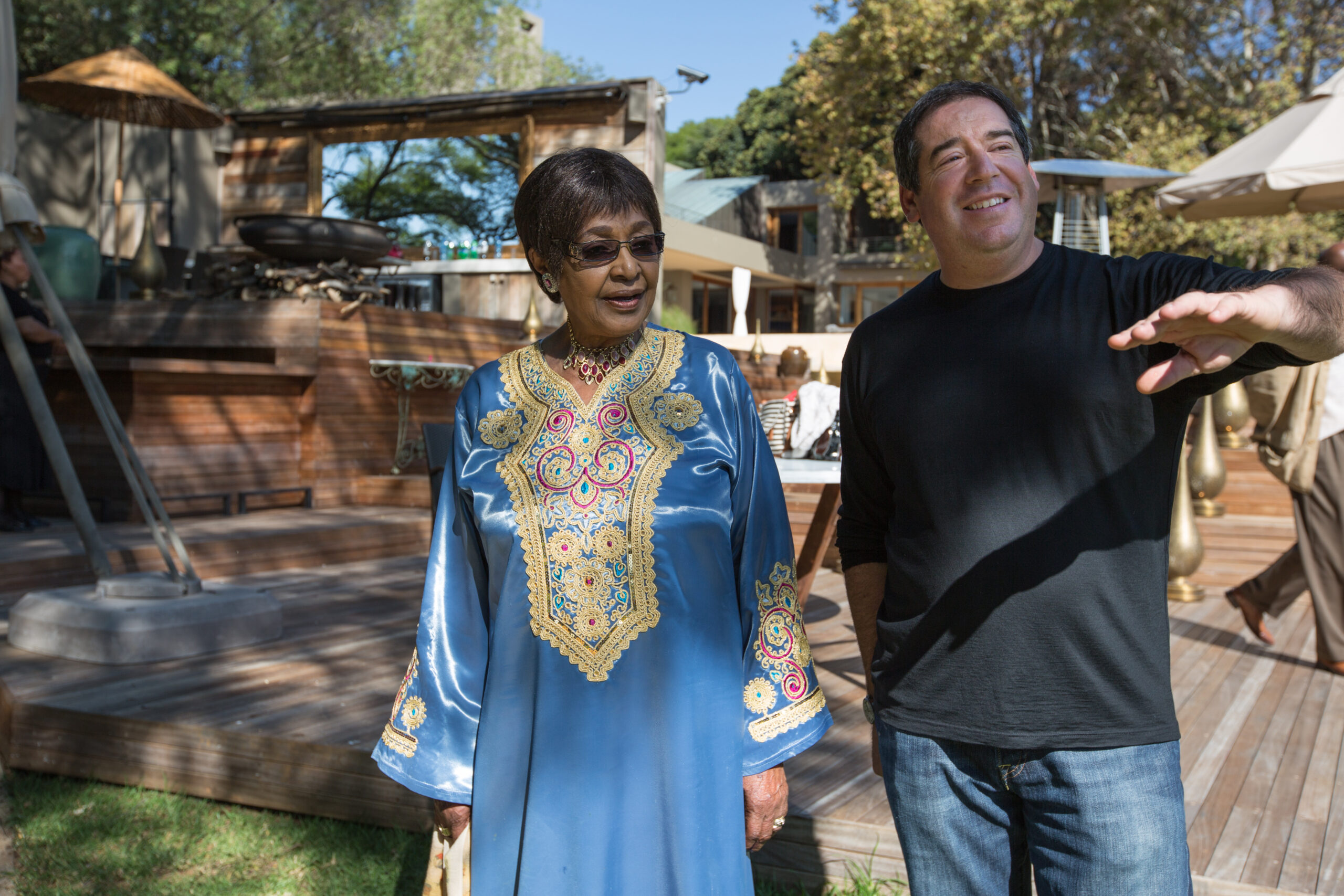
Documentary brings Winnie alive for future generations

Few figures in South African history elicit as much admiration as well as unease as Winnie Madikizela-Mandela. Because of this, business mogul and philanthropist Ivor Ichikowitz wanted to tell her story and the story of South Africa through her eyes.
“Winnie Mandela was a very complex individual and she had an incredibly important role to play in the South African story, says Ichikowitz, the executive producer of Netflix’s The Trials of Winnie Mandela, which premiered on 23 April.
“I was privileged to have had Winnie’s trust and been allowed to tell Winnie’s story in her own words. And this is the first time that that’s ever happened.”
In the documentary series, Madikizela-Mandela’s life isn’t presented as a closed chapter but as something that challenged the way history sees powerful women versus powerful men.
Ichikowitz was inspired to tell South African stories, like Madikizela-Mandela’s, by the work Steven Spielberg has done in keeping alive the memory of Holocaust survivors, in the USC Shoah Foundation, though. Spielberg understood that there would come a moment when the voices of Holocaust survivors would fall silent, leaving future generations to piece together history without those who had lived it, says Ichikowitz. He saw a similar urgency in South Africa.
Ichikowitz worked with two-time Emmy Award-winning Jewish South African director Mandy Jacobson as series director.
“I realised that South Africa had come through one of the most tumultuous revolutions in history. And that story would need to be told,” he says. “And if future generations didn’t get to know and understand people and their personalities, and what made them unique, there would never be an understanding of that history.”
He recognised that Madikizela-Mandela was one of the many people involved in the liberation struggle whose story had not been told in the context of her life, not just in the context of time.
In that context, The Trials of Winnie Mandela becomes something more intimate than a historical documentary. Threaded through the series are intimate conversations between Madikizela-Mandela and her granddaughters HRH Princess Zaziwe Manaway and HRH Princess Swati Mandela-Dlamini, who also serve as producers of the series.
One of the granddaughters says in an episode, “How do you ask your grandmother, are you a murderer? Or if she cheated on your grandfather?”
Ichikowitz speaks of working on the documentary as a “genuine journey for these remarkable young women”. It was also, he says, “a metaphor for the current generation of young South Africans who didn’t live through apartheid, who didn’t witness Winnie in action, and who frankly have completely forgotten where we came from, have completely forgotten the complexity of our struggle”.
The work began more than 11 years ago and had Madikizela-Mandela’s full support. “I think that this whole process was cathartic for Winnie because it made her confront elements of her past,” he says.
While in post-production in 2024, Jacobson passed away following an illness. This prompted Ichikowitz to work even harder to get the project finished in order to dedicate it to Jacobson.
Similarly, when Madikizela-Mandela had passed away in 2018, the team had felt even more compelled to tell the story of this very complicated woman, the good, the bad, and the ugly.
“People always assume that Winnie determined what we could talk about and what we couldn’t. Winnie didn’t prevent us from going anywhere,” says Ichikowitz. “She wanted the controversy discussed as much as she wanted the positive stuff discussed. And, therefore, we had literally hundreds of small stories that we had accumulated.
“Winnie was a woman of incredible energy, and she was doing 10 things at a time, and 10 stories were unfolding literally at the same time. So, we really did have a tough time. Largely, Mandy, who was a very disciplined filmmaker, was quite careful in keeping to relevant stuff. And I was pushing her constantly to record the subplots and the substories, and we kind of got a good balance of the two. In the finished product, we cover the major issues, and a lot of issues that flesh out her personality.”
Ichikowitz says Madikizela-Mandela’s story is about the complexity of the time. It’s about her resilience and the fact that she feared nothing but at the same time was extremely caring. He explained that although he got to know Madikizela-Mandela pretty well, there were still some unexpected discoveries.
“Like most people in South Africa, nobody really knew Winnie well. Firstly, she didn’t trust many people, and for very good reason. Secondly, behind that very strong, tough exterior was this very human, very remarkable woman who truly did change history. I didn’t go into this knowing what to expect. I didn’t know whether we were going to find the ultimate saint or the ultimate sinner. And I think that many of the stories that came out of this were a surprise to me.
“The disconnect between appearance and reality was probably the biggest surprise for me. The extent to which the apartheid propaganda system succeeded in turning Winnie into the ultimate villain was a huge surprise to me. And what was really a surprise were the admissions that were made by the apartheid-era spies on what they did and how they villainised Winnie.
“I was also really surprised at how scared they were of her. I could understand that they were using her and manipulating her, but I never got my head around how scared they were of her, because they realised that she herself was the tinderbox that could have set off a revolution that could have completely overthrown the government.”
For Ichikowitz, the most important part of the series is that it sparks debate and starts conversations.
“We are at a critical moment in South Africa’s history, and in the world, where a new generation must step into leadership in an increasingly divided society. To do that, we need a clear understanding of where we come from: what worked, what failed, and what it cost. Yet many young South Africans are losing faith in the very democracy that was fought for less than 40 years ago ‒ the belief that one voice matters. Challenging that disillusionment is essential.
“This is about showing that individual voices still count, while reminding a new generation what the struggle demanded and what was sacrificed. It is also about confronting the full, complicated truth ‒ beyond media narratives, misinformation, or labels ‒ and allowing people to make up their own minds,” he says.

Mp
May 1, 2026 at 4:41 pm
You do know Winnie killed her own people was involved in the killing of children soweto suffered under her she was no hero. And to make her out as one is a insult to her victims bet you would not feel the same if it was some nazi very disappointed Jewish report
Jeffrey Meents
May 4, 2026 at 6:20 pm
She was part of the ANC that hated and turned totally against Isreal she was a dishonest business woman and for me I would stay a million miles away from this terrorist organization the ANC
Suliman Vally
May 2, 2026 at 5:45 pm
Kudos 👏 to our local Jewish community.
Schalk Van Schalkwyk
May 6, 2026 at 10:44 pm
Back in the 90’s the ANC promised everyone houses, cars, JOBS, running water, electricity, blah blah blah…. The houses were not provided, instead they want to take the old houses from white people (not racist), the fancy cars are provided in abundance to the gov officials only, unemployment is at it’s worst ever, the running water we had is being controlled by mafias everywhere, Eskom…. well…. blow me