





Featured Item

Ella Blumenthal portrait turns ‘heartache into art’

When artist Adele Sanders first heard Holocaust survivor Ella Blumenthal speak at the Holocaust Centre in Cape Town six years ago, she immediately felt compelled to capture her likeness in art.
Now, that portrait, titled I Am Ella – 48632 – Survivor, by Sanders, is a part of the PORTRAIT 100, an exhibition of artwork that was selected in the run-up to the 2025 Rust en Vrede Portrait Award, one of South Africa’s most respected national art prizes.
While Sanders may not have won the prize, she is thrilled that this particular work was chosen for this prestigious exhibition displayed until 29 October at HUB Gallery in Cape Town.
Sanders said she was entranced by Blumenthal at the talk, and recognised that she was in the presence of someone extraordinary and felt the need to paint her portrait. At the time, Blumenthal was 98 years old, standing for two hours without notes as she shared the weight of her story. That alone was remarkable, but even more so was her warmth, clarity, and refusal to be defined by bitterness, according to Sanders.
Though Blumenthal’s life has been documented by Joanne Jowell in I am Ella and in the documentary I Am Here by Jordy Sank and Gabriella Blumberg, this is Sanders’ contribution to documenting her life.
Sanders worked on the portrait over the course of six months and finishing it early this year. She said she did what she could to do justice to what she saw as Blumenthal’s strength, resilience, and legacy.
The Rust en Vrede award is judged anonymously by an invited panel of experts, and the award is often compared to the prestigious Herbert Smith Freehills Portrait Award in the United Kingdom. Sanders said that for her, the recognition was humbling and deeply personal.
Her work on the portrait began the night she first encountered Blumenthal. “The photographs I took of her as she stepped off the podium became the basis for the work,” she said. Sanders acquired permission from Blumenthal via her daughter, Evelyn Kaplan, to create the portrait. At first, she considered whether it would be better to render the piece in oils or graphite, and ultimately chose graphite.
“Portraiture is a profoundly humbling art form,” Sanders says. “It requires hours of stillness, study, and empathy – an intimate process of reaching for the subject’s essence. With Ella, every line and nuance of her face spoke of her history: the anguish of the camps; the torment of loss; but also the unshakeable courage, resilience, iron will, and faith that sustained her.”
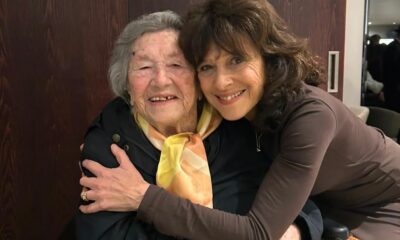
Getting to know Ella in person was a privilege that Sanders treasures. “The times with Ella were memorable moments,” she reflected. “She exceeded every expectation of what a centenarian might be – articulate, expressive, with a brilliant sense of humour, a twinkle in her eye, and always ready to sing a song or share her varied language skills. She touched my heart immediately and deeply.”
When the completed portrait was unveiled, Blumenthal’s reaction was overwhelming, said Sanders. “She kept touching her face and saying, ‘Look, you’ve got my face!’”
Sanders said she found the process not only artistic, but transformative. “Ella taught me life-changing lessons,” she says. “She embodies a lack of anger, envy, hate, or self-pity. Her focus is on celebrating life. These ‘Mandela moments’, as I call them, are deeply etched in my mind.”
Today, at 104, Ella continues to live joyfully with her daughter Evelyn, Evelyn’s husband, Paul, and their family, surrounded by love and care. Her story is one of triumph over tragedy, and her attitude serves as a reminder that resilience and joy can coexist with memory and loss.
Though Sanders’ portrait has been recognised by the art world, it’s also an act of personal remembrance. “Ella’s story resonates deeply with me as a Jewish woman. My late mother survived the pogroms in Poland, and her memories gave me a visceral connection to Ella’s testimony. Creating this work has been my way of turning ‘heARTache’ into art,” she said.
As Sanders reflects on her journey, she shares her guiding principle that, “Good art should comfort the disturbed and make the uncomfortable comfortable.” Through her portrait of Ella Blumenthal, she believes she has done just that, ensuring that one woman’s extraordinary resilience continues to inspire generations to come.




Ingrid Gaertner
September 22, 2025 at 1:14 pm
Art Works into heARTwork sums you up Adele.
Such a wonderful story with a brilliant portrait.
Kol ha’kavod
Adele
September 24, 2025 at 2:05 pm
Hi Ingrid, your heARTwarming comments are appreciated. Thank you. Adele
Sherlene
December 3, 2025 at 12:10 pm
A beautiful soul❣️ Thank you for your art.