Lifestyle/Community

Holocaust education criticised for downplaying antisemitism

“Never Again” has become one of the most recognisable phrases associated with Holocaust education. But what does it mean when antisemitism continues to evolve?
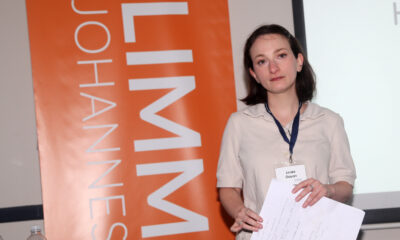
This is what Dr Shay Pilnik, founding director of the Emil A and Jenny Fish Center for Holocaust and Genocide Studies at New York’s Yeshiva University, explored at Limmud Johannesburg recently. He challenged some of the fundamental assumptions behind how the Holocaust is taught and whether current approaches are doing enough to protect Jewish communities today, particularly in the United States.
Pilnik, the grandchild of Holocaust survivors, explained that Holocaust education is an American invention from the 1960s.
“It started in America, although there were grassroots efforts by individual Holocaust survivors in many countries who began going into schools and sharing their experiences. In America, this started as early as the 1960s,” he said.
“The first two decades after the Holocaust have often been described as decades of silence. Most Holocaust survivors were busy recovering from the war and rebuilding their lives. The stereotypical experience of my grandparents in Israel was that nobody wanted to talk to them about it, nobody wanted to listen, and nobody really bothered.”
Pilnik said the word “Holocaust” itself is an Anglo-American term that first gained currency in the English-speaking world. In Russia, for instance, there was no real reference to the Holocaust as a distinct phenomenon, he said. The term “Holocaust” wasn’t widely used in the Soviet Union until perestroika and glasnost in the 1980s, with the Nazi genocide largely viewed as part of the broader Soviet experience of World War II.
In Hebrew, Shoah is used instead, meaning a natural disaster, while “Holocaust” comes from the Greek holokaustos, referring to a sacrifice consumed by fire. Pilnik noted that this terminology carries theological implications that don’t accurately describe the Holocaust, which was a crime committed by human beings. In America, however, the term “Holocaust” gained traction as early as 1942, when a group of rabbis used it in a pamphlet.
However, as Holocaust education started to grow, there were many critics. The main critiques focus on the fact that Holocaust education is generalised and doesn’t necessarily address the main reason that the Holocaust happened, antisemitism.
“One critic, [academic] Ruth Wisse, explained that Holocaust education in America has taken the very specific experience of the Jewish people and turned it into an experience of humanity. And she, in a way, foreshadowed that in the future, this experience of Nazi versus Jew, villain versus victim, this paradigm in Holocaust education will turn around like a boomerang on the Jewish people,” he said.
“In another critique, [scholars] Casey Babb and Naya Lekht explain that in Holocaust education there is no link whatsoever between, for example, violence against Chassidim on the streets of Brooklyn today with what happened in Nazi Germany.
Furthermore, Pilnik quoted author Dara Horn as saying that “using the Holocaust as a morality play is exactly its appeal. It flatters everyone. We can all congratulate ourselves for not committing mass murder.” Then, any action short of murdering six million Jews doesn’t acknowledge the danger of antisemitism, she says.
Pilnik said, “If we teach that the Holocaust happened because people weren’t nice enough, that they failed to appreciate that humans are all the same, for instance, or to build a just society, we create this self-congratulatory space where antisemitism grows. So, first of all, the same idea: fighting on behalf of the dead Jews and leaving aside the living ones,” he said. “Very little of Holocaust deprecation concerns living ones because, let’s say, when you go to the Illinois Holocaust Museum, they do have some general exhibits about genocide. But to be fair, when you go to the exhibit, it’s a very serious exhibit. And yes, it tells the story of the Jewish people in Europe in a way not much different from the United States Holocaust Memorial Museum.”