Lifestyle/Community

Hyrox has everyone pushing and pumping

For most people, spending a Saturday or Sunday running, rowing, sled-pushing, and lunging their way through a fitness competition seems daunting. Yet for a growing number of South Africans, Hyrox has become the ultimate challenge, drawing everyone from seasoned athletes to first-timers.
Some are chasing personal bests; others are celebrating weight-loss journeys or milestones in recovery. At the same time, many simply want to prove to themselves that they are capable of more than they ever imagined. What unites them is a willingness to embrace discomfort in pursuit of a goal.
Hyrox follows a fixed format: eight 1km runs, each separated by a functional workout station, including the ski erg machine, rowing machine, sled push, sled pull, burpee, broad jumps, farmer’s carry, wall balls, and sandbag lunges.
“People who train for a Hyrox event gain ‘hybrid fitness’, which combines cardiovascular endurance with functional muscular strength. Unlike traditional weightlifting, which builds muscle mass, or long-distance running, which focuses purely on aerobic stamina, Hyrox teaches the body to produce force under severe cardiovascular fatigue repeatedly,” says Ilisa Waksman, a Hyrox competitor and trainer.
After foot operations, she thought she wouldn’t be able to run again. She decided to try a Hyrox class at Urbanlight Gym and found she could manage a two-minute treadmill run. She then tried the Deadly Dozen race, which is 12 x 400m runs instead of the 8 x 1km, at Hyrox in May last year. Two Hyrox races followed, with Waksman and her partner missing second place by four seconds, coming third in the 40-49 age group in May.
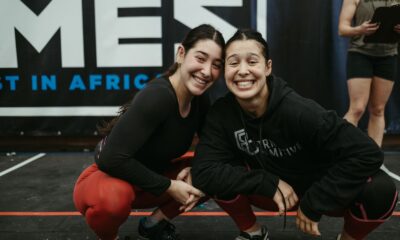
“Hyrox was the ultimate challenge for me to try. I have done two so far, in November 2025 and May 2026. I compete in doubles with my bestie Meagan Dos Santos, who is 10 years younger than me. The beauty of Hyrox is that people can do it at any age, with any partner, male or female, individually or as a relay race. It has gained popularity among couples, who compete in the mixed event,” she says.
Samantha Fanaroff and Andy Sostak decided to compete in the Hyrox competition on 31 May after meeting on a tour to Poland in 2024.
“Something shifted there. Standing in places where so much life had been taken, Andy and I discussed that the greatest tribute we can pay to those who no longer have a voice is to live loudly and fully on their behalf, to spread light where there was darkness, and to say yes to life. Somewhere along the way, Hyrox became another opportunity to do just that,” says Fanaroff.
Sostak, who is wheelchair-bound, took this on as an additional challenge after completing the New York Marathon in November 2025.
“I wasn’t the athlete competing. I was one small part of the team lucky enough to be alongside her. We got to witness the discipline, determination, and sheer stubbornness it took to prepare for something so far outside our comfort zone. We also got to witness a lot of laughter,” says Fanaroff.
The duo spent only four months training and finished the adaptive Hyrox in just under 59 minutes, coming in first place for the Hyrox adaptive women’s group. They found a training home at Urbanlight, where Waksman and Jordan Naidu welcomed them with open arms. “They understood that this wasn’t simply about preparing for a race. It was about possibility,” says Fanaroff.
“The finish line was extraordinary, but it was never really the point,” says Sostak. “The real victory was discovering that it’s never too late to surprise yourself, that reinvention doesn’t come with an expiry date, and that impossible things become a little more possible when people believe in you and stand beside you.”
Fanaroff says, “There were afternoons when I’d arrive tired, distracted by life, only to remember that Andy had already fitted in a session before work and was back for more. Faced with challenges that would give most people a perfectly acceptable excuse to opt out, she kept choosing to lean in.”
Shona Kuming, Sostak’s lifelong friend, was there through it all. Every session. Every setback. Every small victory. “Her loyalty and love became part of the foundation that held this whole experience together,” says Sostak.
Once a week, Gila Ash, the duo’s rebbetzin, trained with Sostak too. “There was something beautiful about that partnership, tending not only to physical strength, but to spiritual strength as well,” says Fanaroff.
Lance Kier, who has been doing CrossFit for about 13 years, explained that when Hyrox came onto the fitness scene about two years ago, he was immediately interested. He has since competed in five events, coming third in the 40-44 age group for doubles pro men at the most recent competition in Johannesburg on 30 and 31 May.
“While training varies depending on an athlete’s goals, the race itself is always the same. That consistency sets it apart from CrossFit, where workouts constantly change and often involve more technical, skill-based movements such as gymnastics, alongside rowing, swimming, and cycling,” he says. “While anyone can take part in CrossFit, its complexity can be intimidating for newcomers. Hyrox, by contrast, was designed to be accessible and inclusive. Its straightforward format allows people of all fitness levels to participate, which is a major reason for its rapid growth in recent years.”
Waksman says Hyrox training often begins as one or two training sessions, but quickly turns into a goal to compete.
“The actual competition is tough, but it is manageable with some training. It has no strict cutoff time, making it accessible to all fitness levels. While top athletes are driven by time, so many competitors race at a more comfortable pace, happy to be able to compete and just be a part of the wonderful experience.”