Voices
Not protest, but desecration

This past week began, once again, with news that no community should have to absorb as routine. The firebombing of Kenton United Synagogue in northwest London, the third suspected arson attack on a Jewish site in the British capital within three days, following earlier incidents in Finchley and Hendon/Golders Green.
Let me be unambiguous: a synagogue is a house of worship. It is a place of prayer, of community, of children’s laughter on a Shabbat morning. It is not a military installation. It is not a proxy for any government’s foreign policy. No geopolitical framing, however elaborately constructed, constitutes a defence for firebombing it. Any attempt to provide such “context” is moral evasion, and we must refuse to accept it as anything else.
What we’re witnessing with increasing frequency and little apology is one of antisemitism’s most insidious modern forms: the collective punishment of Jews everywhere for the actions of the Israeli State.
This is not political critique. It is a libel with a very long history, dressed in the language of human rights and activism. But the logic is ancient and recognisable: Jews are uniquely evil. Jewish grief is suspicious. Jewish fear is performance. Jewish self-defence is criminal or aggressive.
The refusal by so many institutions, politicians, universities, and cultural figures to name this is a failure of moral clarity, and it carries consequences.
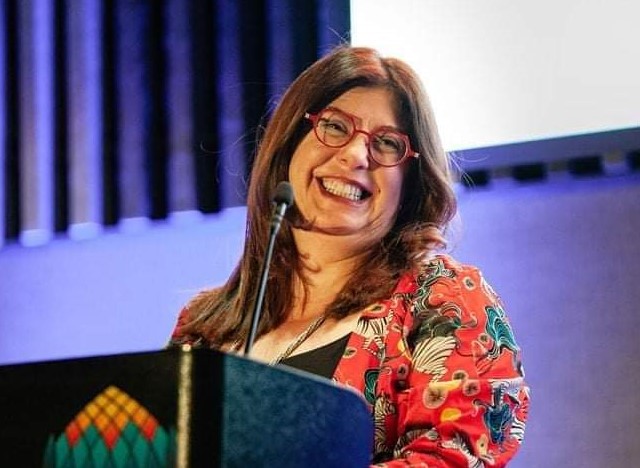
This is the same intellectual and moral corruption that underpins the Holocaust inversion trope, the conflation of Jews with the very perpetrators of the genocide against them. At last week’s Yom HaShoah commemoration in Johannesburg, SA Jewish Board of Deputies (SAJBD) Gauteng Chairperson Danny Mofsowitz addressed this directly and with remarkable force. Her words deserve to be heard widely:
“Yom HaShoah demands clarity. And clarity, in our current moment, has become an act of resistance.
Something dangerous is happening across the world and in our country … We are witnessing the deliberate distortion of one of humanity’s darkest chapters. Not to honour the dead. But to weaponise them against their very descendants.”
Danny spoke of protesters gathering outside Holocaust centres in Johannesburg, Durban, and Cape Town, and of placards equating the Star of David with the swastika. She was right to call this what it is: not protest, but desecration.
Danny went on to conclude that there must be a moment when a society can say, “This is not negotiable.” I could not agree more forcefully. That moment is not approaching, it is here, and it is demanded of us by the fires still smouldering in London.
A section of Danny’s speech is available on the Board’s social media platforms. I encourage every member of our community to watch it and to share it as broadly as possible.
This week also brought the full emotional arc of our communal calendar into sharp relief. On Monday night, we commemorated Yom Hazikaron with the solemnity and grief it demands. If Yom HaShoah teaches us about the catastrophic cost of powerlessness, of a people left entirely at the mercy of others, then Yom Hazikaron teaches us the cost of the state we were compelled to build. Both days carry a weight that does not lift easily. But they are balanced by Yom Ha’atzmaut, the celebration of our resilience and our declaration, renewed each year, that we are here, that we endure, that we will never again be powerless.
I wish to congratulate the South African Zionist Federation for its hosting of both Yom Hazikaron and Yom Ha’atzmaut this week. The events were moving, well-attended, and exactly what they needed to be, robust demonstrations of communal unity and pride.
In this spirit of fortitude, the SAJBD remains fully committed to confronting all forms of antisemitism in South Africa. If you witness or experience an antisemitic incident, I urge you to contact our reporting hotline at 078 259 4147. Our team is ready to provide swift support and response.