





OpEds
Big move in a small town: recognition, reconciliation, and restitution

Ra’anana in central Israel is my home today. It wasn’t always. I hail from the Strand, a beautiful False Bay town that is part of the area described as the “Fairest Cape”, bracketed by the majestic Hottentots-Holland mountains, Somerset West, and the turquoise blue of the Atlantic Ocean. Today, this town is making news and it involves my family. Of this I am proud, proud of the past and proud of how we are forging a favourable future.
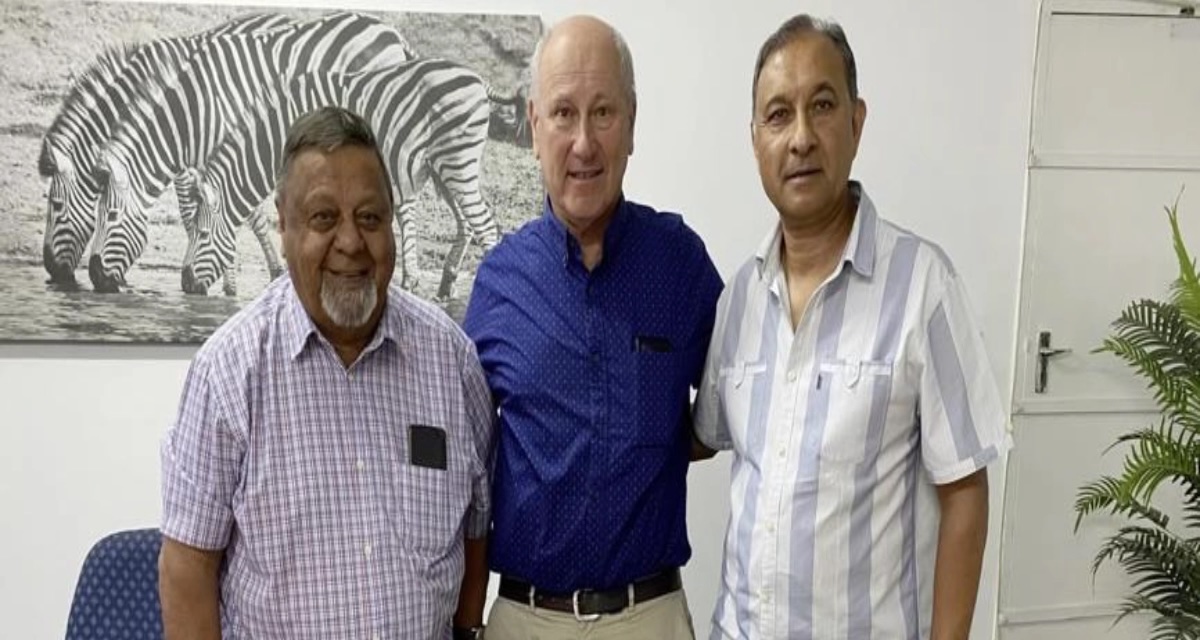
In a historic gesture of recognition and reconciliation, our family has approved the renaming of Ben Friedman Plein, honouring my grandfather and family founder in South Africa, to Strand Muslim Square.
When local Muslim leader Ebrahim Rhoda approached my brother, Barry, about renaming the square to finally redress the wrongs of the past and to honour the Muslim contribution to the town, Barry expressed enthusiasm. But he said he would need to discuss it with other family members. He knew their only concern would be that the family history would not be erased. With full understanding and sensitivity, Rhoda suggested that if the renaming was approved, the traffic circle in front of our family store could be renamed Ben Friedman Circle. This our family considered fair and agreed to the renaming of the town square subject to council approval.
The process took a few years and now the renaming will proceed, but not without an ugly backlash resulting from the usual culprit, misinformation.
There are those who’ve tried to frame it as a roughshod attempt to erase the “white” history of the Strand, or to view it in terms of Muslim/Judeo-Christian conflict. It is neither. It is simply the long overdue acknowledgement of the Muslim community’s enduring history and contribution to the town. I am sure that my late friend Oesman Wentzel, who owned a classic diesel-powered fishing boat that I spent many happy hours on in my youth catching mackerel and snoek, would be very happy with this historic restitution. It reflects the harmony and unique community relations that characterised our lives in the Strand, in spite of the policy of apartheid that tried to disrupt it.
My grandfather, Benjamin Friedman, who arrived in Cape Town around 1903 as a penniless immigrant from Kaunas (Kovno), Lithuania, is the man that the Ben Friedman Plein controversy is all about.
Speaking Yiddish without any knowledge of English or Afrikaans, he started work as a labourer at a salary of two shillings (20 cents) a day at the Cape Town docks.
Once he had acquired some knowledge of English and had enough funds to buy a bicycle, he cycled to Somerset West, where a dynamite factory was opening to supply explosives to the mines. He bought a general dealer’s licence and, with no funds and amazing divine providence, was able to open a line of credit with JW Jagger, a major wholesaler in Cape Town.
He married Anna Cohen and they had five sons, including my father, and two daughters. The business thrived and eventually became a large department store in the Strand that still stands today. Benjamin played a big role in the development of the Strand and was a leader of the Jewish community.
Pioneering and building ingrained in the Friedman family was not only confined to South Africa’s developing coastal town of Strand, but also in the future Jewish state of Israel. Benjamin’s son Solly, my uncle, was a visionary and a Zionist and emigrated to the then British Mandate of Palestine in the 1930s. He settled in Haifa, opening a law office in 1939, and went on to develop one of the biggest law practices in Israel. He specialised in marine law, with the ZIM Shipping Company being one of his major clients. Founded in 1945 by the Jewish Agency, the Israel Maritime League and the Histadrut, ZIM’s main task during its first years was transporting hundreds of thousands of immigrants to the emerging state. Some of the other ships that had been used for clandestine immigration before the establishment of Israel as a state were confiscated by the British Mandate authorities, and later joined the company’s fleet. My uncle would travel abroad to negotiate the purchase of ships that formed the basis of Israel’s merchant marine fleet. In the days of the Mandate, he was constantly active in the courts, defending Haganah men brought up on charges by the British and trying to negotiate the release of impounded refugee ships. Emerging as Israel’s expert in maritime law, it would stand him in good stead as the lawyer for ZIM Shipping Company in the ensuing decades as it developed into one of the world’s top 20 cargo carriers. He relates that when the British left Palestine, most of the ships they had impounded were in Haifa harbour and the new Israeli government simply reclaimed them. How poignant that the biblical word ZIM means “a fleet of ships”. (Number 24:24).
The Cape Malays descended from enslaved and freed Muslims brought to the Cape from Indonesia and Malaysia in the mid-17th century. They were skilled labourers and political exiles, such as Sheik Yusuf, whose Kramat (a sacred shrine or tomb honouring a holy person in Islam) at Macassar Beach near Cape Town is still a place of pilgrimage. This is undertakable as Sheik Yusuf is credited as the founding father of Islam in South Africa, having established the first enduring Muslim community in the region in 1694, during the governorship of Simon van der Stel.
The Cape Malays were among the first settlers in the Strand, which was originally called Mostert’s Bay. They were mainly engaged in fishing in False Bay and settled in the area of the current central business district (CBD) of the Strand, where they had a thriving community of craftsmen, carpenters, builders, small traders, tailors, and fishermen.
However, in the 1950s, when apartheid was being heavily enforced, they were forcibly relocated to an area called Rusthof, located between Strand and Gordons Bay. It was a low-lying area subject to severe flooding in winter.
However, the original mosques in the CBD were maintained and remained, so that their physical link to the area endured.
Benjamin, whose small trading store on the Lourens River, where the dynamite factory had opened manufacturing explosives for the gold mines, grew and flourished. He invested in properties and land, many of which were in the centre of the Strand, and where the original store was moved to. Over time, it developed into the modern Friedman and Cohen Department Store, which is now 110 years old.
The Strand had 25 Jewish families at its peak, but neighbouring Somerset West had 40 Jewish families. Relations between the Jewish and Muslim community were excellent and many from the Muslim community were, and still are, employees of Friedman and Cohen. Many “old-timer” customers would relate stories of how they used to buy on credit at our store, but when the frequent gale-force southeasterly winds used to blow, they were unable to pay their accounts because the fishing boats couldn’t put to sea. My grandfather would tell them to pay when they could, and never placed any pressure on them.
As the town grew, so did the Jewish community, and Benjamin Friedman was instrumental in founding the Strand Shul, where he laid the foundation stone in April 1930. It is interesting to note that the furniture for the new Somerset West Shul was made by Muslim carpenters, again reinforcing the enriching connection of the two communities.
A prime mover in the renaming of the Strand square process is local Muslim community leader Ebrahim Rhoda, a school teacher and historian, who explained to my brother that in spite of his community’s history and contribution to the Strand, there “was not one street name reflecting their heritage”.
Cape Muslim families such as the Rhodas, Gabiers, Wentzels, and Salies were prominent community members, and it is time that their stories and legacies of the Muslim community are honoured.
The proposal to rename Ben Friedman Plein to Strand Muslim Square is rooted in reconciliation and restorative justice, acknowledging a community forcibly removed during the apartheid era, and whose 200-year heritage includes three mosques that still anchor the square today, Nurul Anwar, Market Street, and Nurul Islam. The first place of worship in Strand, the Market Street Mosque, was built on the square itself.
Eddie Andrews, Cape Town’s acting Mayor and Mayoral Committee Member for Spatial Planning and Environment, said on Freedom Day on 27 April, in his address at City Hall, that the proposed renaming adds weight to both history and reconciliation.
“Ben Friedman Square stands in an area shaped by the long-standing presence of the Strand Muslim community, whose heritage stretches back over two centuries. Importantly, this process has been characterised by cooperation, supported by the Muslim community, endorsed by civic and faith-based organisations, and undertaken with the support of the Friedman family themselves,” Andrews said.
The renaming reflects what Andrews called Cape Town’s unique tradition of interfaith coexistence. “Cape Town is a city where Muslim, Christian, Jewish, and other faith and cultural communities do not simply coexist, but have, over generations, built relationships of respect, partnership, and shared belonging. This renaming reflects that reality.”
The proposal has been endorsed by the Strand Muslim Council, Nurul Islam and Aneeqah Congregation, Rusthof Methodist Church, and the Muslim Judicial Council. Business owners bordering the square raised no objections.
The controversy will pass as it should.
However, what must not pass is the good relations between the communities of the Strand. The Muslim and Jewish contributions to the town go back in time and stand to ensure an enriching future.
I look forward to revisiting my hometown to see the renamed Strand Muslim Square and Ben Friedman Circle.
Benjamin Friedman, who began this journey on a bicycle well over a century ago, would be pleased and proud.
- Ben Friedman served on the Western Province Zionist Council and was Vice-Chairperson of The Phyllis Jowell Jewish Day School in Cape Town before emigrating to Israel with his family in 2010. This piece was first published in the Lay of the Land newsletter on 27 May 2026. layoftheland.online






SHAUN
June 2, 2026 at 2:19 pm
Simply outrageous. Shame on you – this is exactly how SA and West is declining. Rusthof Church – what you are you doing ?? May God forgive you.
Jessica
June 3, 2026 at 1:06 pm
Erasing one group’s cultural history, no matter how modest, in favour of another group’s cultural history, is downright discriminatory.
This is exactly what Prof Gad Saad calls “suicidal empathy”.
Gary
June 4, 2026 at 1:23 pm
I don’t experience much harmony myself between Jews and Muslims in Cape Town, they must stop the pro Hamas/anti Israel demonstrations and then we can talk.
Ricardo Owen
June 5, 2026 at 4:30 am
It is strange to know that there were only two foreign communities in the Strand totally forgetting of the indigenous peoples to whom you sold your fish and your clothes to.Thank you again for that historical thought.Now it is time for you to work on a permanent thought to move back where you came from.