SA

Children with fake guns at Al Quds march prompt legal questions

Experts are calling for legal scrutiny of the Al Quds march through the Cape Town city centre where many children carried imitation firearms and there were chants of “One Zionist, one bullet”. Questions have been raised about incitement to violence, the use of minors, and whether laws were contravened.
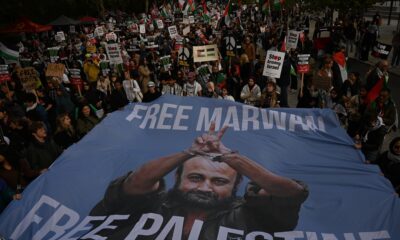
There were between 200 to 300 participants – far fewer than previous years – in the march that moved through the city centre, past Parliament, under police escort.
The large number and visibility of children with realistic-looking weapons struck observers. Images and video footage show children, some appearing to be between 10 and 13 years old, dressed in keffiyehs and military-style clothing, carrying imitation rifles, and positioned upfront in the procession. In several instances, they were placed alongside effigies of international political figures, with adults directing their participation and movement.
This wasn’t the first time children with fake guns were involved, but their number had increased significantly this year.
The South African Zionist Federation national spokesperson, Rolene Marks, said the display crossed a clear line. “Children dressed as militants, handed replica firearms, and paraded through the Cape Town city centre as props in a political spectacle,” said Marks. “This is not protest. It is the deliberate grooming and exploitation of minors to normalise violence.”
Concerns were heightened by protesters chanting “One Zionist, one bullet” during the march. Footage of this is doing the rounds on social media.
Advocate Mark Oppenheimer said such a chant could constitute hate speech under the Promotion of Equality and Prevention of Unfair Discrimination Act.
“Chanting ‘One Zionist, one bullet’ amounts to unprotected hate speech,” he said. “The Act expressly protects groups on the basis of their beliefs, which includes a belief in Zionism. Propagating hatred against such a group, and inciting harm against its members, falls squarely within the prohibition.”
He said this slogan echoed earlier politically charged phrases associated with violence, reinforcing its meaning and intent. Oppenheimer appeared for AfriForum in a case against the Economic Freedom Fighters claiming that “Kill the Boer” and associated slogans like “One settler, one bullet” amounted to hate speech and incitement. While AfriForum lost the case, the judge didn’t make a ruling about the slogan “One settler, one bullet”, which has a clear implication of violence.
Oppenheimer was also critical of the use of children in the protest. “The use of children cosplaying as terrorists reflects extremely poorly on their parents,” he said. “Deploying children to convey a message of hatred and violence is an abuse of those children and should be unequivocally condemned.”
The Cape South African Jewish Board of Deputies (Cape SAJBD) similarly focused on the involvement of minors. “Particularly disturbing was, yet again, the involvement of children carrying replica weapons and dressed in militant-style clothing,” said Daniel Bloch, executive director of the Cape SAJBD.
“Using children in this way not only normalises violence but turns them into instruments of ideological indoctrination. Our children’s rights, including their right to safety, freedom, and protection from exploitation, must always be upheld.”
Bloch said that although attendance at the march appeared to be declining, “the rhetoric and imagery remain troubling”, noting the presence of flags and posters linked to organisations and figures associated with conflict in the Middle East, including that of Hezbollah.
Legal experts say the presence of imitation firearms at a public demonstration raises important legal questions. The Dangerous Weapons Act defines a dangerous weapon as any object capable of causing serious harm if used unlawfully, and prohibits possession under circumstances that may raise a reasonable suspicion of intended unlawful use.
Damian Enslin, a property and firearms law specialist, told the SA Jewish Report that amendments to the Regulation of Gatherings Act make it clear that participants at a gathering or demonstration may not possess “any airgun, firearm, imitation firearm … or any object that resembles a firearm and that is likely to be mistaken for a firearm”. Contravention of this provision can result in a fine or imprisonment of up to three years.
The law places a clear responsibility on both participants and organisers. Convenors and marshals are required to take reasonable steps to ensure compliance with these restrictions, particularly in relation to the display of weapons or objects resembling firearms.
The legislation also requires that intent be assessed in context, including the behaviour of participants, the manner in which objects are displayed, and whether there is any associated intimidation or threat.
Against this backdrop, the images of children carrying imitation rifles in a politically charged protest environment have prompted questions about whether the threshold for legal scrutiny has been met.
Marks said the apparent tolerance of the protest raised broader concerns. “Explicit incitement [was] broadcast openly under police escort, within sight of Parliament,” she said, describing what she called a “glaring double standard” in the enforcement of South Africa’s laws.
Beyond South Africa, Al Quds Day protests have come under increasing scrutiny in other countries. In the United Kingdom, authorities banned the march this year for the first time in more than a decade, citing concerns about public disorder, links to Iranian state activity, and a history of arrests at previous events for offences including support for proscribed organisations and hate crimes.
Al Quds Day, established in Iran in 1979, is marked annually in cities around the world and is typically characterised by strong anti-Israel messaging. While the tone and scale of events varies internationally, controversies have frequently arisen over militant imagery, slogans, and the involvement of children.
In Cape Town, those who attended or monitored the march said the use of children appeared deliberate rather than incidental.
Adults constructed effigies of Israeli Prime Minister Benjamin Netanyahu, United States President Donald Trump, and British Prime Minister Sir Keir Starmer; positioned children alongside them; and placed imitation firearms in their hands before the procession moved through the city centre. The participation of minors was visible throughout the march, and not confined to isolated instances.
“Legal action should be considered against the organisers and participants of the demonstration in order to curb the rise in violent anti-Zionist rhetoric,” said Oppenheimer.
For community organisations, the issue extends beyond legality to broader concerns about the normalisation of violence and the role of children in political activism. “Friday’s march showed exactly what it looks like when children are drawn into political fanaticism and used as props for the extremist agendas of adults,” said Bloch.
As debate continues, this year’s Al Quds Day protest has shifted attention away from turnout and towards the nature of participation, particularly where minors are involved in imagery and messaging that many say raise serious legal and ethical concerns.