Lifestyle/Community
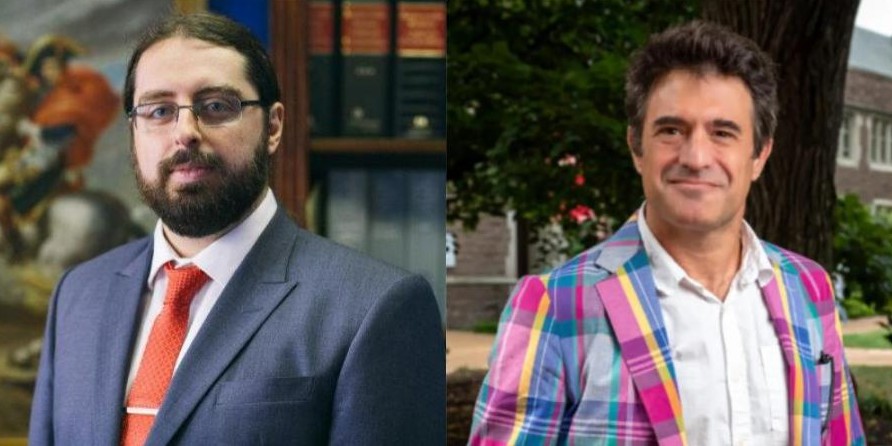
Don’t withdraw in face of antisemitism, experts urge

“I don’t think it’s the job of Jews to cure antisemitism. Antisemitism is an unfortunate sickness that afflicts antisemites. It’s our job to be good Jews and good humans.”
So said American journalist, author, and podcaster, Mark Oppenheimer, speaking to South African lawyer and hate-speech expert of the same name, Advocate Mark Oppenheimer. They were in a webinar conversation hosted by the Jewish National Fund South Africa, the South African Zionist Federation (SAZF), and the SAZF Cape Council on 17 February.
The American Oppenheimer explained that Jews shouldn’t be afraid of antisemitism and shouldn’t withdraw from places because of its threat.
“We shouldn’t withdraw from spaces we want to be in. If you want to go to Harvard because it has the laboratory you want to work in or it has a crew you want to row on, you shouldn’t not go because there are antisemites,” he said.
The South African Oppenheimer said that though the Jewish community must build its own spaces, he has witnessed, particularly as a member of the University of Cape Town Council, that if we want Jews to continue to play a pivotal role in the societies in which we live, we cannot allow ourselves to surrender the spaces we occupy.
“As Mark says, if Jews are American citizens, then Jews in South Africa are South African citizens. We need to explain our history to people and how we continue to be inspiring people who punch above their weight, and also, get your muscles ready, because you have to have some fights,” Oppenheimer said.
He said that what he found interesting when looking at the situation in which Roedean School refused to play a tennis match against King David two weeks ago was the idea of downplaying the Jewishness of the school and inflating the “Israeliness” of the school to justify Roedean’s reason for not wanting to take part.
Said American Oppenheimer, “I was struck reading about the controversy in South Africa, especially as a tennis player and father of teenage girls. If even girls’ high school tennis cannot remain depoliticised, what can? What stood out was the clear dissembling: private remarks referring to Jews, later reframed publicly as being about Israel. Similarly, there was the Swiss broadcaster who, instead of simply critiquing the Israeli bobsled team’s performance, felt compelled to label them ‘Zionists’ and ‘genociders’. For some, the terms have become interchangeable. This is a shift that speaks volumes.”
He said he knew people who were sincerely anti-Zionist. “They have no problem with Jews; they just have a problem with Israel,” he said. “Then, there are people who have to stop themselves and say ‘Zionist’ when they really mean ‘Jew’, and those in between.
“I know people across the spectrum on this issue. At one end are those I believe to be sincere anti-Zionists who genuinely don’t harbour hostility toward Jews. Some are Jewish, some are not, and many have demonstrated consistency over decades,” he said. “They hold all countries to the same moral standards – speaking out about atrocities in Sudan; China’s treatment of the Uyghurs; or the persecution of LGBTQ people in parts of the Muslim world. There’s integrity there, but they are a small minority.
“At the other extreme are those who clearly mean ‘Jew’ but consciously substitute ‘Zionist’ or ‘Israeli’. The distinction is cosmetic; the hostility isn’t. In between are many others, where the slippage between ‘Jew’ and ‘Zionist’ may be unconscious, careless, or at times deliberate. That ambiguity leaves Jews constantly trying to discern intent: who genuinely disagrees with Israeli policy? Who harbours animus? Who is being dishonest?”
He said that in terms of American universities, there are two different scenarios: those universities that allow for encampments to continue on their campus, even though it clearly breaks the rules of the university; and those like Washington University, where he teaches, which cleared out the encampments but still allowed students to hold placards and demonstrate.
“Protests are legitimate. Encampments aren’t because campuses are shared spaces for all students. That’s especially true when encampments barred ‘Zionists’ or journalists from entering. As a journalist, I found the hostility toward the press striking. Journalism is essential to the free-speech ecosystem for the left as much as the right, yet many protesters treated any reporter as an adversary,” he said.
Campus journalists, in many cases, failed as well, he said. They often colluded with protesters, avoiding photographs, withholding names, and declining to investigate funding sources. Important stories went uncovered because student papers were either sympathetic to the cause or accepted claims that identifying participants would harm their future careers.
“Campuses clearly struggled,” Oppenheimer said. “Administrators, in many cases, have since reconsidered their approach, particularly the practice of issuing institutional statements. Many are returning to the Chicago neutrality principles: universities don’t take official positions on political issues; faculty and students are free to speak for themselves.”
Both Oppenheimers agreed that though antisemitism has become vicious and it’s important to shut hate speech down, it’s also important to uphold the right to free speech and freedom of expression.
“So long as people aren’t harming others or harassing them to the point where they really can’t go about their daily lives, they should kind of get to say what they want, and society has to make space for that,” said the American Oppenheimer.
South Africa’s Oppenheimer said that South Africa has strong protections for free speech, and that though we should “be able to swing to the edge of someone’s nose and no further”, we should also learn from hate speech as it can give valuable information and a warning.
“One argument for allowing offensive speech is that it provides information. Before the Bondi Beach attack, there were clear warning signs: antisemitic graffiti, synagogue vandalism, and open hostility. The instinct is to silence that speech. But if you drive it underground, you lose the early warning system,” he said.
Instead, he said, hateful speech should alert us that there’s a serious problem that needs to be confronted through counter-speech, community response, and, where necessary, monitoring groups that may move from rhetoric to action. Suppressing speech entirely can mean missing signals that could help prevent violence.
“That said, there are circumstances where speech can incite imminent harm. And it’s crucial to distinguish between speech and conduct,” he said. “A student expressing extreme views on campus is one thing. Setting up encampments that block Jewish students from accessing public spaces isn’t speech, it’s action. Too often, universities conflate the two. Protecting harassment, property invasion, or shouting down speakers under the banner of ‘free speech’ misunderstands the principle. Suppressing someone else’s speech isn’t an exercise of free speech; it’s the opposite.”