


Lifestyle/Community
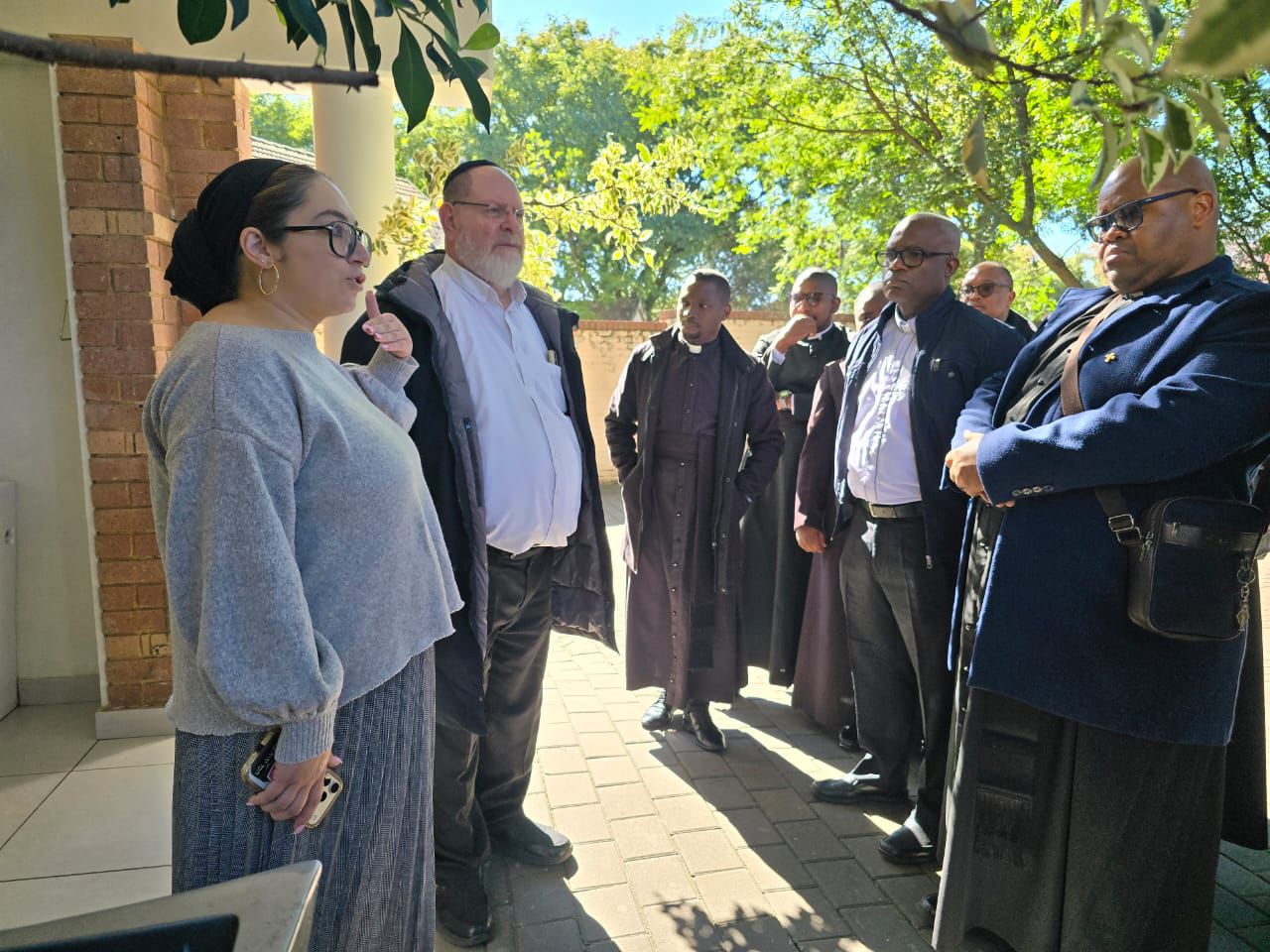
Catholic students learn about Judaism at Sandton Shul

Sandton Shul recently opened its doors to a group of final-year Catholic seminary students eager to learn more about Judaism and the Jewish community.
In partnership with the South African Jewish Board of Deputies (SAJBD), the aim was to bridge faiths through conversation and understanding.
Rabbi David Shaw, rabbi of Sandton Shul and SAJBD member; Wendy Kahn, the SAJBD National Director; and Gabi Farber Cohen, the SAJBD Youth and Politics Advisor, hosted the visit by students of St John Vianney Seminary in Waterkloof, Pretoria.
“These are individuals who will one day help shape one of South Africa’s largest faith communities, and it was encouraging to witness such a sincere commitment to dialogue and understanding,” said Farber Cohen.
“Meetings like this matter because intolerance so often grows in the absence of human connection. Distance allows stereotypes to flourish. It becomes easy to reduce people to headlines, assumptions, or political narratives when one has never actually sat across from them, spoken to them, or shared space with them,” she said. “The moment people meet one another genuinely and directly, complexity returns. Humanity returns. In South Africa, particularly, a society as diverse, layered, and historically fractured as our own, building relationships across communal and religious lines is not optional; it is essential.”
The Southern African Catholic Bishops’ Conference (SACBC) represents bishops from South Africa, Botswana, and Eswatini. As part of the eight-year training to become bishops, participants complete a semester in their final year focused specifically on interreligious dialogue, not only studying other faiths academically, but engaging with them directly and meaningfully.
The SACBC reached out to the Jewish community seeking an opportunity for seminarians to visit a synagogue, meet members of the community, and gain a deeper understanding of Jewish life, traditions, beliefs, and values.
Father Bonaventure Mashata, Secretary of the SACBC Department of Interreligoius Dialogue, facilitated the visit, after Bishop Thomas Graham Rose of the Diocese of Dundee reconnected with Rabbi Gideon Pogrund, with whom he had worked several years ago. Pogrund subsequently put Rose in contact with Shaw to coordinate the visit.
“What was particularly striking was the sincerity behind the request,” said Farber Cohen. “At a time when communities across the world are becoming increasingly insular and disconnected from one another, there was something profoundly encouraging about a group of future Catholic leaders actively seeking engagement, understanding, and relationship with the Jewish community.”
The seminary students who visited the shul on 13 May discussed Jewish communal life in South Africa, with Shaw, Kahn, and Farber Cohen. They were taken on a tour of the synagogue, its mikveh, the tashlich pond, youth facilities, and entertainment spaces.
“At each point, we explained not only the practical use of the spaces but also the traditions, Torah sources, and values connected to them,” said Farber Cohen.
“At one point, Father Bonaventure asked how the Jewish community understood the need for interreligious dialogue,” said Rose. “Gabi explained that it was perceived as important, as it was founded on the Book of Genesis’s understanding that we were all created in the image of G-d and so shared a fundamental human dignity.”
Rose also referred to Pope John Paul II’s visit to the synagogue in Rome, where he described the Jewish community as their “elder brothers in faith”.
“Rabbi David [Shaw] explained the central significance of the Torah scrolls in the synagogue,” he said.
Sandton Shul was chosen as the venue for this interaction because Shaw serves both as a member of the SAJBD and the rabbi of the congregation.
“Beyond that, Rabbi Shaw was the right person to facilitate the engagement. He has exceptional ability and experience in connecting with people from diverse backgrounds in a way that feels both genuine and deeply personal. His warmth, humour, and openness helped create an atmosphere that allowed the engagement to move beyond formality and become something far more authentic and meaningful,” said Farber Cohen.
She said this would not be a one-off visit but rather the first step in an ongoing relationship between the Catholic and Jewish communities. Farber Cohen explained that she had left the encounter deeply inspired. “There was something profoundly moving about seeing a group of future religious leaders approach interfaith engagement with such humility, curiosity, and openness,” she said.
“Due to the hostility our community has faced, naturally we are retreating further into ourselves. But in fact, we have to do the exact opposite, as hard as it may be. We need to be creating more opportunities for engagement, not fewer. Our rabbis, communal leaders, and particularly our younger generation must understand not only the importance of engaging beyond our own communal spaces, but also that we develop the confidence and skills to do so meaningfully,” she said.
Farber Cohen said that in his inaugural lecture, University of Cape Town Professor Adam Mendelsohn had said that as the South African Jewish community continues to shrink demographically, many South Africans may never personally meet a Jewish person. Increasingly, perceptions of Jews are shaped by media narratives and political discourse rather than genuine interaction.
“That is why interfaith engagement matters so deeply. It is not simply symbolic; it creates relationships before moments of tension arise,” said Farber Cohen.
Just days after this engagement, a Catholic church in Braamfontein was desecrated.
“Because relationships had already been established with the Catholic community, the SAJBD was able to reach out to Bishop Rose, who connected us with Father Pollitt of the affected church so that we could express the Jewish community’s solidarity and support. Father Pollitt later shared our message with his traumatised congregants during Sunday service following the attack. It was a powerful reminder that interfaith relationships built in moments of dialogue become invaluable in moments of crisis,” she said.