Youth
Physics whizzes compete against world’s best

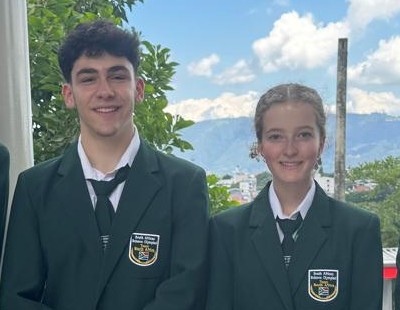
When the world’s brightest young physicists gathered in Bucaramanga, Colombia, for the 56th International Physics Olympiad this week, two Jews stood proudly in green South African blazers.
Gabriella Berger and Matt Kaplan, both students from Redhill School, are among just four pupils selected to represent the country at what is widely regarded as the most prestigious physics competition for secondary school pupils. Bringing together competitors from more than 90 countries, the Olympiad is as much an opportunity for cultural exchange, international collaboration, and the forming of lifelong friendships as it is a celebration of scientific excellence.
For Berger’s family, the significance of the achievement only truly sank in when they watched the opening ceremony from Johannesburg.
“It was amazing watching these two Jewish children standing there in their South African blazers representing the country,” said Berger’s mother, Sarah Levy. “There are only four South Africans there this year, and two of them are Jewish. It’s really, really incredible.”
The road to Colombia was anything but easy. Only the highest-performing scholars earned places on the national team.
“They did the qualifying round through their school and then, because they’d done well, they were invited to write the second round, which is much harder,” Levy said. “They both made the South African team.”
According to her official selection letter, Berger has spent months preparing for the Olympiad through weekly online training with the University of KwaZulu-Natal, completing first-year university physics while still at school. She also attended an intensive practical training camp in Durban, where she received her South African blazer, before departing for Colombia. As one of the team’s female representatives, her participation is also being recognised by the International Physics Olympiad’s international board.
“They’ve been preparing for the past six months,” Levy said.
The International Physics Olympiad has been held annually since 1967, with a different country hosting the competition each year. While its centrepiece is two notoriously difficult examinations ‒ one experimental and one theoretical – the event offers much more than an academic challenge. Throughout the week, pupils attend scientific lectures, take part in organised cultural excursions and sightseeing, and spend time with fellow competitors from around the globe. This encourages collaboration between the next generation of scientists while giving them a taste of the host country’s culture.
“It’s not just about the exams,” Levy said. “It’s about education and science, giving these young people the opportunity to meet each other and realise what they’re going to achieve.”
The competition itself is conducted under exceptionally strict conditions. Competitors surrender their mobile phones until the exams have been completed, limiting communication with their families.
“They took their phones away as soon as they arrived,” Levy said. “They’re not allowed to have any kind of access to anyone. I think it’s obviously because they have to monitor cheating.”
Instead, parents receive updates from official guides assigned to each country’s delegation. “The person assigned to us has been giving us updates,” Levy said. “He lets us know where the team is and what they’re doing. That’s the only contact we have while they’re competing.”
Like many parents, Levy initially found the arrangement difficult. “At first I wanted to go with her, to be honest,” she laughed. “I’m not too happy about not speaking to her, but I feel much happier because Matt Kaplan is a good friend of hers, so that makes it easier.”
For the Berger family, the Olympiad has opened the door to a new world. “We actually didn’t know about it; we’ve now been exposed to something we had no idea about. It’s really been fascinating.”
Watching the opening ceremony reinforced just how prestigious the competition is. “My older daughter started looking things up and told us that when it was held in Paris last year, six French Nobel Prize winners attended the opening ceremony,” Levy said. “That’s when you realise how seriously these countries take it.”
For Berger and Kaplan, the next few days will be filled with practical and theoretical examinations, scientific activities, and cultural experiences, before the Olympiad concludes with a closing ceremony and awards presentation.
For their families back home, however, the medals are only part of the story. “They’re representing South Africa alongside some of the brightest young scientific minds in the world,” Levy said. “That’s something to be incredibly proud of.”