Youth

The battle lines for today’s youth

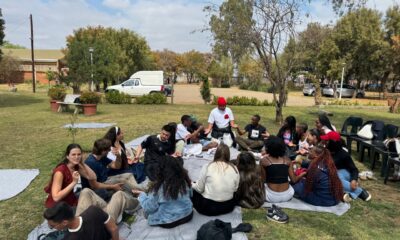
Fifty years after the 1976 Soweto Uprising, the SA Jewish Report asked Jewish youth what young people today are fighting for. Here are the responses from three King David High School pupils.
In 1976 it was Afrikaans, now it’s truth
Misha Lee Freinkel (Grade 9)
While the pupils of 1976 were fighting for educational equality, today’s youth are perhaps fighting for truth.
I remember hearing as a little girl that there are always three sides to every story: his side, her side, and the truth. But surely his side is true to him, and her side is true to her. So where does that leave the truth?
Today, social media dominates almost every part of my life. It has become my news source, my search engine, my classroom, and sometimes even my judge. It tells me what is happening in Iran, Turkey, Canada, Ukraine, and everywhere else. But I keep asking myself: Am I seeing what is really happening, or only what someone wants me to see? I don’t want a version of reality shaped by a government, a media company, an influencer, or a political agenda. I want to know what is true.
George Orwell said, “In a time of deceit, telling the truth is a revolutionary act.”
At first, I didn’t understand this. Why should truth be revolutionary? Why should something so basic have to be fought for?
But maybe that is exactly the point.
When lies are repeated loudly enough, when opinions are dressed up as facts, when images can be edited, voices can be faked, and stories can be manipulated, truth becomes dangerous. Not because truth is weak, but because truth threatens those who benefit from confusion.
The pupils of 1976 fought against being told what language they should learn in and, ultimately, how they should think. They fought to be educated in a way that respected their dignity and their right to determine their own futures.
Today, we face a different challenge, yet we still have to ask the same question: Who decides what we know? Our fight is not against a language policy, but against misinformation, manipulation, and the distortion of truth.
We must fight to think clearly, question bravely, and resist being manipulated. We must fight for the right to ask: Who is telling this story? What are they leaving out? Who benefits if I believe it? And what evidence proves it?
Because truth isn’t always the loudest voice. It isn’t always the most shared post. It isn’t always the story that makes us angriest.
Truth requires courage, patience, and humility.
And perhaps today, in a world overflowing with information, the most revolutionary act is not simply to speak. It is to search honestly for what is real.
A legacy of standing up for our beliefs
Ella Passman (Grade 11)
One of the things that stands out to me about the youth of 1976 is how many of them were around our age when they had the courage to stand up for what they believed in and fight for a better future.
If the pupils of 1976 were fighting for educational equality, I think many young people today are fighting for equal opportunities. Although education is more accessible than it was then, not everyone has the same opportunities outside of the classroom. Access to technology, universities, jobs, and other resources can still depend a lot on where you come from.
I also think mental health is something many young people are passionate about today. More teenagers are speaking about the pressures they face and the importance of getting support when they need it.
Activism has also changed a lot since 1976. Social media gives young people a platform to share their opinions and create awareness about issues they care about. Information can spread much faster than it could in the past. At the same time, I don’t think social media can ever replace the bravery of the students who marched in 1976. Posting online is important, but real change still needs people to take action beyond the screen and stand up for what they believe in.
I do think young people’s voices are taken more seriously today than they were in the past, but not always. We have more opportunities to express our views, but we are sometimes told that we’re too young to understand certain issues. I don’t think being young means our opinions matter less. In many cases, we’re the ones who will be most affected by the decisions being made today.
The legacy of the pupils of 1976 is that young people can make a difference. Their courage shows that you don’t have to be an adult for your voice to matter, and I think that’s a lesson that is still just as important today.
Activists have social media now
Shoshana Krasner (Grade 11)
In 1976, pupils were fighting against an unequal education system and political oppression. Many of the difficulties facing the youth today are still rooted in the desire for fairness and opportunity. Issues such as access to quality education, mental health awareness, gender equality, climate change, and social media safety are major challenges many young people are concerned about. In a world that is constantly adapting and changing, today’s youth is urging digital inclusion because a lot of pupils don’t have access to social media. The youth is also fighting against stereotypes, like “men aren’t emotional” and “girls aren’t as smart as men”. These beliefs create an unsafe and negative atmosphere, and cause unfair treatment of pupils.
Social media has dramatically changed activism. In 1976, the youth relied on face to face communication and physical protests to attempt to change society. They risked their safety trying to make their voices heard. Today, social media allows information to spread instantly, helping young people raise awareness and start campaigns that reach a global audience in minutes. However, while online activism can be powerful and convenient, it also has the potential to encourage the youth to support causes without actually taking meaningful action. The activists of 1976 demonstrated their dedication through direct action and personal sacrifice. That is something the youth of today definitely lack.
I believe that young people’s voices are heard more easily today because of social media and access to online platforms. The youth are constantly sharing their personal opinions with large audiences, but being heard doesn’t always mean that we are taken seriously. Many young people still feel that their concerns are being dismissed by others in positions of power, like the government. This alone is something the youth is still trying to fight. Nevertheless, our history has shown us that young people are capable of making real change in our society. The students of 1976 are proof that the voices of the youth can influence a nation, which still remains true today.