Youth
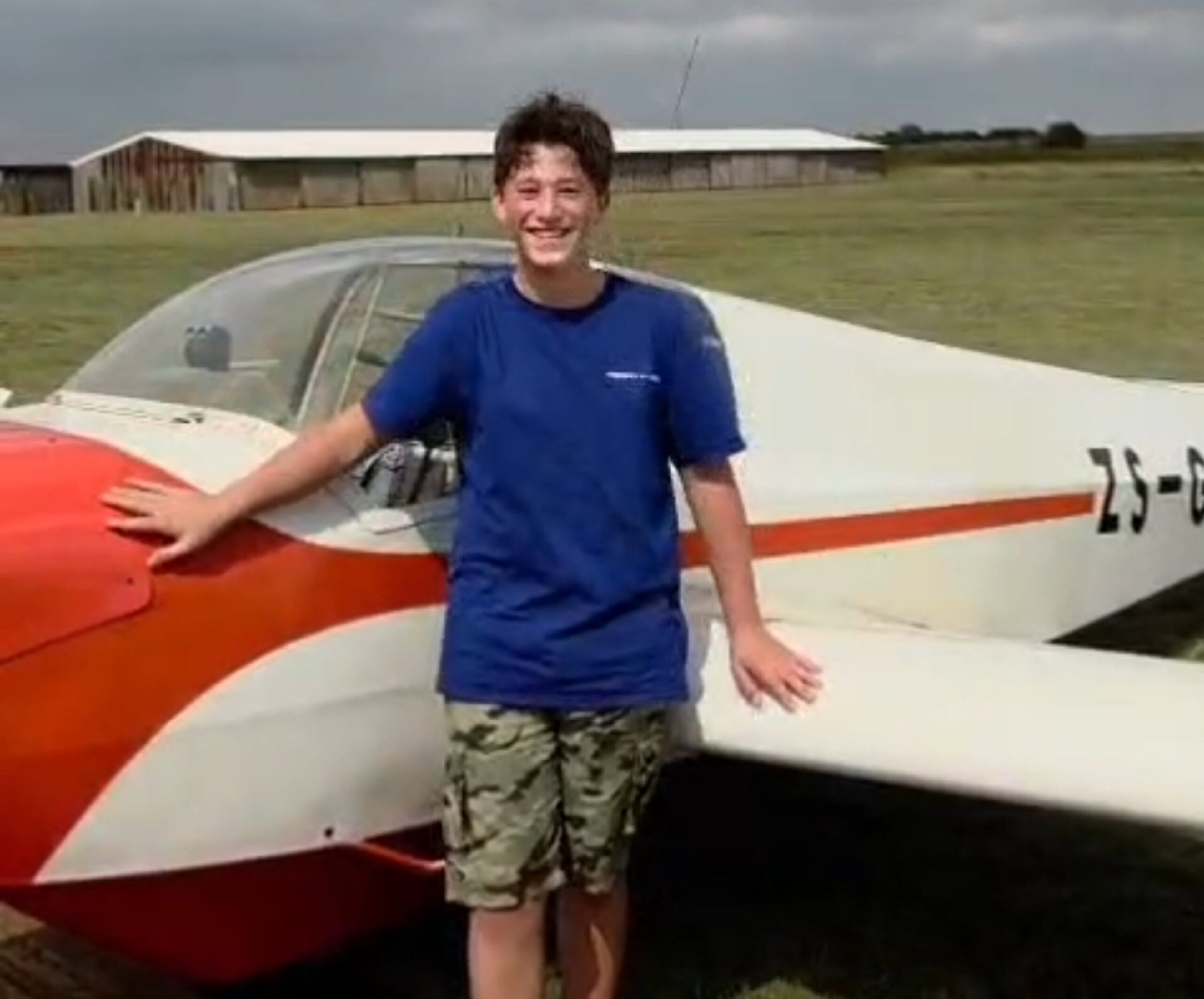
Flying solo at 14

Most Grade 8 boys spend their weekends gaming or watching sport. Fourteen-year-old King David scholar Jesse Abro, however, spends his in the skies above Johannesburg.
Three weeks ago, Abro made his first solo flight, in a two-seater Scheibe SF-25 Motorfalke, a small aircraft that is part plane and part glider. That experience gave him a sense of “insane freedom”.
“I’ve always been interested in flying,” says Abro. “Since I was a little child, I’ve always loved going on commercial planes. I remember always wanting to fly on Mango Airlines when I was younger.”
His interest turned into a passion when his grandfather Ronald Woolf booked an introductory flight for him at a flight school as a Barmitzvah present.
“I got the feel of flight training and what it was like to actually fly a plane,” Abro says. “That was all the encouragement I needed.”
But getting from there to the point of being able to fly solo needed far more than passion.
“I had to read up a lot,” he says. “There are about seven subjects to master and seven different books to learn to do the exam for your licence. It’s difficult, but at some point, it all seemed to click into place for me.” In addition to written exams, he completed a medical assessment and trained under experienced instructors before being cleared to fly alone.
He trained through the Magalies Gliding Club, becoming one of its youngest members. His progress was steady. “We could only go once a week, sometimes once every two weeks because of the weather,” he says. “So I’d been flying for six months by the time I went solo, but I had already done about 17 or 18 hours flying.”
Within that structure, Abro chose a more challenging path. “I fly a taildragger, which is a more sophisticated aircraft,” he says. “They’re more difficult to fly.”
The aircraft Abro pilots has an engine, so it can take off on its own like a normal plane, but once in the air, the engine can be switched off so it can glide quietly using air currents. What makes the Motorfalke more challenging is that it is also a taildragger, meaning it has a small wheel at the back instead of the front. This makes it harder to control on the ground, especially during take-off and landing, and requires more precision from the pilot.
“It’s a lot harder to manoeuvre,” he says, explaining that even small mistakes can throw the plane off balance, making control more demanding than in a standard training aircraft. Most training planes have three wheels arranged like a tricycle, with one wheel at the front and two at the back. This makes them more stable and easier to control, especially on the ground.
While unusual at his age, Abro’s solo flight was possible because a glider pilot’s licence allows students to fly solo from the age of 14, provided they meet strict training, testing, and safety requirements under instructor supervision.
Outside of the formal training, Abro found additional ways to improve. “I bought a flying simulator,” he says. “That was really the biggest help, other than flight training itself.”
Even before that, his interest in flying was clear. “On my Xbox, I played Flight Simulator. It kept me on par with flying in real life.”
By the time he was ready to fly solo, fear was no longer a factor. “I was nervous initially,” Abro admits. “But when I lined up for my first solo, I wasn’t nervous at all.” Instead, the moment was defined by something else entirely. “Freedom and a lot of excitement. And a big sense of reward.”
That confidence, he says, is built over time. “You build it in the cockpit,” he says. “Everyone realises at a point that you have to take it upon yourself to work towards this dream. And if your instructor agrees you can do it, and you agree with yourself, then you must do it.”
“My mom says she loves it,” he says, “but when I was going solo, they were very nervous.”
Balancing school and aviation remains an important part of the journey. Abro trains primarily over weekends, working his flying schedule around school commitments.
He is also aware of how unusual his achievement is. “I’m very young,” he says. “There’s maybe a 20% chance there’s someone else my age who has gone solo.”
His ambitions, however, stretch far beyond this milestone. “I want to continue gliding – you’re flying with no engine, you’re with the birds, it’s insane freedom,” he says. “But I also want to progress to other aircraft, learn how to fly everything.”
“I’ll never stop,” he says. “Until I become the best. No matter what.”