





OpEds
Similarities between Venezuela and SA

Venezuela’s Jewish community was known as one of the most vibrant and cohesive in all of Latin America. Numbering 25 000 at its peak in the 1990s, the community descends mostly from immigrants who arrived from Europe after World War II, as well as from Morocco after the 1976 Six-Day War in Israel.
The community was roughly half Ashkenazi and half Sephardic, but unlike other Jewish communities in Latin America ‒ such as Mexico and Panama, where the two groups are quite distinct ‒ Ashkenazi and Sephardic Jews married each other, went to school together, and shared the Hebraica campus, a sprawling Jewish country club offering Olympic-grade sporting facilities, Jewish schools, kosher restaurants, and sporting activities.
Since the 1998 election of Hugo Chávez as president, 80% of the community has emigrated. The economy collapsed, the government adopted an increasingly anti-Israel stance, cutting diplomatic relations with Israel and expelling the Israeli ambassador in 2009, and kidnappings in broad daylight became common. Caracas subsequently became one of the most dangerous cities in the world, with a per-capita homicide rate comparable to those of major South African cities.
Most members of the Venezuelan Jewish community emigrated to Miami in the United States, Panama, Mexico, and Israel. Like many fellow Latin American Jews in Miami, they have sought to recreate the Jewish way of life they left behind ‒ much as South African Jews have done in Australia ‒ settling among a large Spanish-speaking Jewish population only a three-and-a-half-hour flight from Caracas.
As in South Africa, almost everyone in the Venezuelan Jewish community has a child, sibling, or other close relative living abroad. In many cases, the parents are the last family members in the country, while their children and grandchildren are scattered across the world.
The mass emigration has forced those who remain to make difficult decisions about Jewish infrastructure that was built for a much larger community. During my visit, I saw both an Ashkenazi and a Sephardic synagogue that had been closed within the past year because the community had shrunk so dramatically. As in South Africa, some synagogues have closed altogether, while others struggle to make a minyan.
The main Ashkenazi synagogue seats 1 200, and its ballroom can accommodate 500 guests. Today, it is open only for high holy day services. I was told that in the 1990s, the synagogues were full and the ballrooms were constantly in use, sometimes hosting several weddings a week. Today, a synagogue is fortunate if it hosts four weddings in an entire year.
So why did the 20% of the Jewish community who remained choose to stay? Reasons vary, but some include having elderly parents in the country whom they feel responsible for, running a successful family business, or working in a licensed profession, such as medicine or law, that cannot easily be relicensed elsewhere.
The number of community members who now need financial assistance has increased dramatically, and a feeding organisation now provides monthly food packages to 300 family units.
I attended a Shabbat dinner at the home of a Chabad rabbi in his late 20s who had arrived in Venezuela several years earlier. My fellow dinner guests were all under the age of 35, which is unusual in a community where relatively few young adults remain. Almost all of their peers now live in Miami, although many had left Venezuela themselves to attend university in the United States.
Because white-collar salaries in Venezuela remain extremely low, a legacy of years of hyperinflation and economic instability, many young professionals who return do so either to work in family businesses or to be closer to loved ones while earning foreign-currency incomes through remote work for overseas companies. This allows them to maintain a standard of living largely insulated from the realities of the Venezuelan economy.
Like South Africa, mass emigration has reduced the number of key donors in the community, many of whom are feeling squeezed. The community is having to decide what to prioritise: maintaining synagogues or expanding social services. The stand-alone pre-school at Hebraica was recently closed and relocated to the main school because there were too few children. One young man I met told me that his graduating class at the Jewish school had numbered 140 students. Today, the average class size is down to around 20.
Hatzalah can no longer afford to help pay for needy community members to take out private medical aid, and instead sends doctors to their homes to see whether it is possible to treat them there instead of sending them to dilapidated state hospitals.
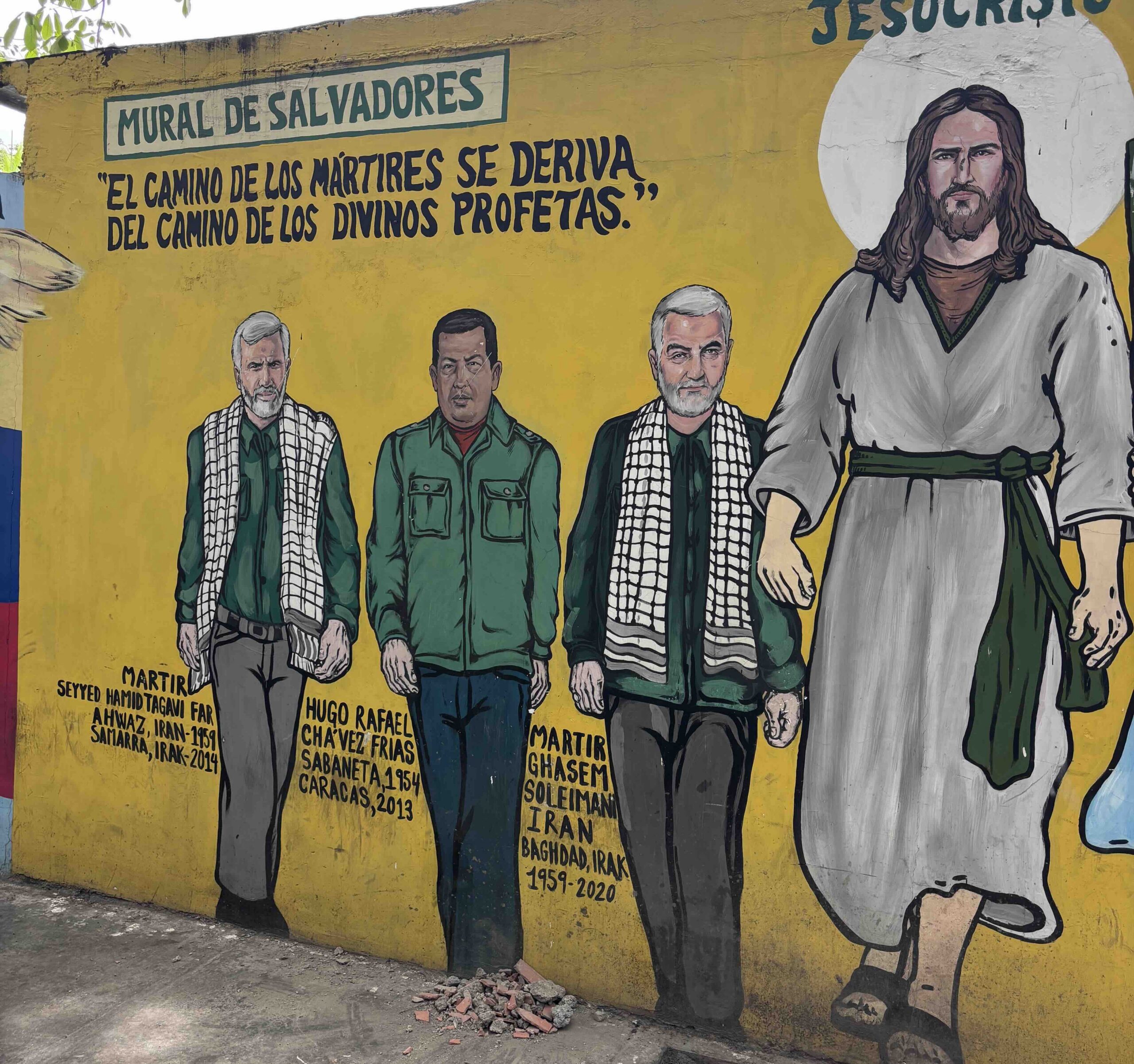
Like South Africa, Venezuela’s government has maintained a very pro-Palestinian position, most visible at Chávez’s mausoleum, which features the Venezuelan and Palestinian flags side by side next to his coffin. However, members of the Jewish community were emphatic that they don’t face day-to-day antisemitism from the general population.
There are definitely parallels between the exodus of the Jewish communities of Venezuela and South Africa, which have respectively shrunk by 80% and 60%. Both experienced mass emigration in the 1990s and 2000s, although this began decades earlier in South Africa.
This has forced two incredibly organised and resilient communities to balance maintaining buildings, keeping Jewish schools running with fewer pupils, meeting increased demand for social services amid the deterioration of public services, while at the same time experiencing very little inbound migration.
If either community were to disappear, it would be a tragedy, as they are both among the most organised Jewish communities in the Spanish- and English-speaking worlds. Both have also grappled with being strongly Zionist communities, while living under governments adversarial towards Israel, yet neither community experiences the day-to-day antisemitism that one increasingly encounters in North America, Western Europe, and Australia. Those who remain in both communities tend to be more religious, and Venezuela’s community is now majority-Sephardic, as a higher percentage of its Ashkenazi members have emigrated.
As the Western countries to which so many community members emigrated grapple with rising antisemitism, it raises a broader question: do the destinations that South African and Venezuelan Jews once viewed as safe havens still offer the security and stability they sought when they left their homelands? Or will future generations find themselves searching for new homes once again?
- Dan Brotman is a journalist and world traveller, currently based in Montreal, Canada. He is currently working on a documentary about shrinking Jewish communities around the world. You can follow his travels on Instagram at @danbrotman.







DUMISANI NKOSI
July 10, 2026 at 9:24 am
I am an indigenous South African.As a Democrat,I stumbled on JR this morning.I read a few articles with an open mind and felt like much. as I don’t agree with most views,especially on Xenophobia in SA,especially from people who have never set foot in Townships and poorer Rural Ares. JR should try have alternative voices seeking to redirect misplaced anger and misunderstandings otherwise, we will be talking abt Jews migrating to US,Australia,or Israel.Remember, knowledge is abt ACTION and not Knowledge itself.I see where most people see and come from.Hiweber,there is another side.Lets put or heads together to stop negative perceptions abt SA Jews and their relationship with israel.however,my biggest and urgent concerns is to RESCUE MZANSI from further decline and decay.