Question and Answer
Komorowsky’s heart, soul, and DNA in ‘Sarajevo’

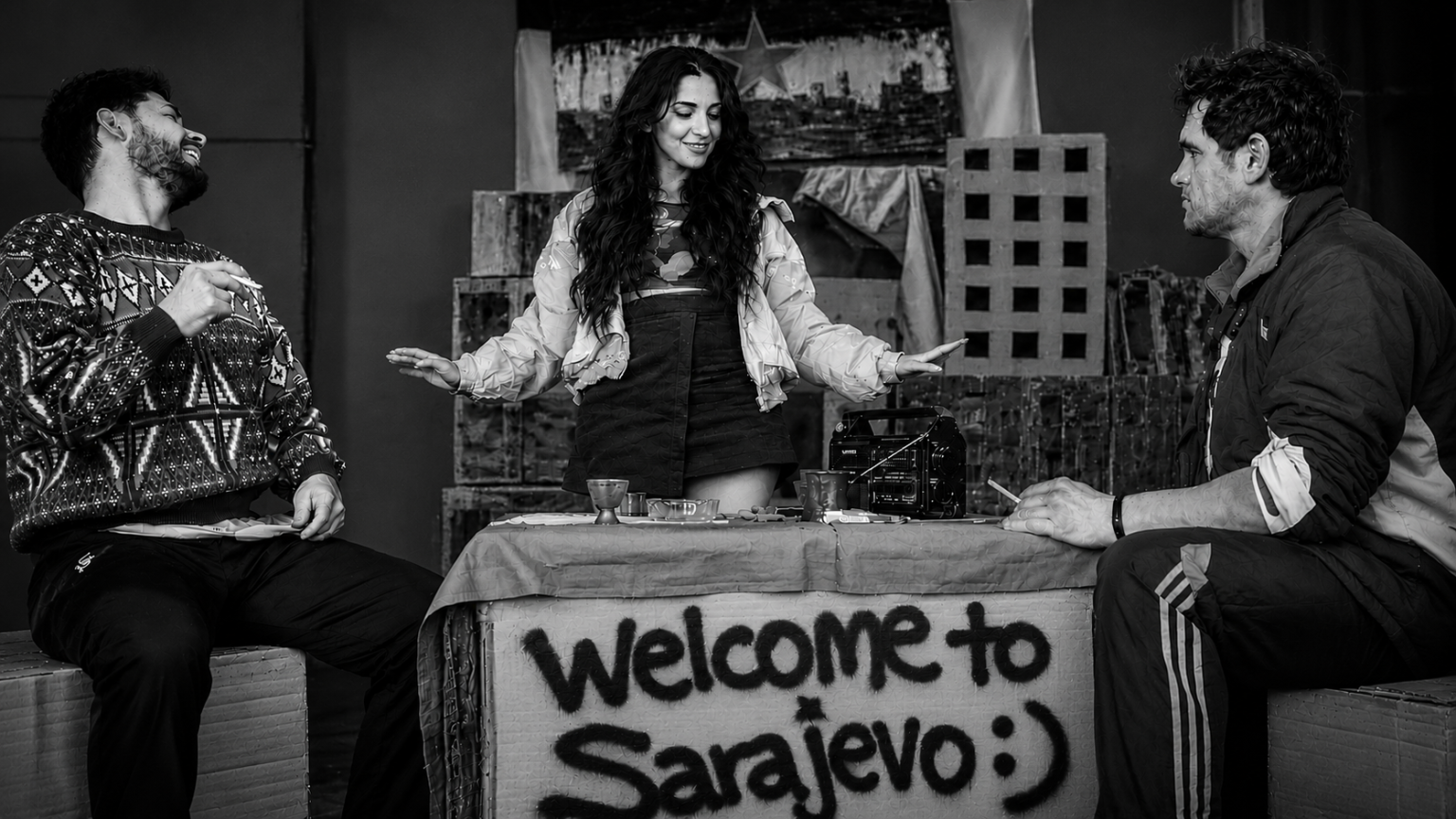
Aimee Mica Komorowsky wrote and stars in Sarajevo, the theatrical production that won four Naledi Awards and is on show once again at Theatre on the Square. The SA Jewish Report caught up with her between performances.
Who and what inspired you to write Sarajevo, and when did you do it?
I started writing Sarajevo in 2014. The original version was actually called Cheers to Sarajevo, and I co-wrote it with a Croatian woman. When she left the project, I went back to the script and almost completely dismantled it. And I think that was when I actually discovered what the play was supposed to be.
I stopped being interested in writing about sides and became interested in people. What happens to ordinary human beings when the world around them starts demanding that they choose a side? What happens when the person you are suddenly supposed to hate is the person you grew up with?
I didn’t want to write about heroes and villains. I wanted to write about human beings who make choices. Sometimes courageous choices, sometimes terrible ones. Because the men who commit atrocities don’t arrive from another planet. They are somebody’s friend, somebody’s uncle, somebody’s brother, somebody’s father, somebody’s son.
My connection to the former Yugoslavia goes back much further. When I won the South African Karate Championships, the World Cup was held in Yugoslavia, and travelling there exposed me to a place where the consequences of the wars of the 1990s were still very present. I also experienced something deeply personal and traumatic there that was connected, indirectly, to the legacy of the Bosnian conflict. I think that experience stayed somewhere inside me for years.
Eventually, writing became the way I tried to understand it.
Does the script relate to your life at all? If so, in what way?
Very much so. There are parts of my own trauma woven into the emotional DNA of the play, particularly experiences connected to my time in the former Yugoslavia. But there is another layer that is perhaps even deeper: my own inherited memory as the descendant of Holocaust survivors.
I grew up understanding that history doesn’t necessarily end when the event ends. Trauma has this extraordinary ability to travel through families. You inherit stories, silences, fears, and memories of things you never physically experienced yourself.
So although Sarajevo is about Bosnia, I recognise something incredibly familiar in it – the moment when neighbours become enemies, when identity suddenly becomes dangerous, when people are reduced to labels rather than human beings.
I think that’s why I’ve never really been able to leave this play alone. Somewhere underneath it, I’m constantly asking the same question: how does an ordinary society reach the point where ordinary people become capable of extraordinary cruelty and what would I have done?
You have both a theatre and writing background. Tell us more about it.
Before Sarajevo, I had never actually written for theatre. My writing background was primarily film and television. So naturally, I decided that my first play should be an intimate psychological drama set during the Bosnian War. Very sensible!
And because I came from screenwriting, I wrote the original script almost like a film. It was incredibly visual. I thought in cuts, close-ups, silences, changes of focus, and cinematic rhythm – and then had to discover how to translate that language onto a stage where you can’t simply yell “cut” and move the camera. But I think that accident ultimately became part of the play’s identity. Sarajevo still has something very cinematic about it. The audience almost becomes the camera. Their attention moves from one person to another; they witness moments they perhaps shouldn’t be witnessing.
In this case, you also star in Sarajevo. Why?
Well, the glamorous answer would be that it was an enormous artistic calling.
The less glamorous answer is that I was an actress in a culturally deprived city waiting for somebody to give me work and eventually I thought, “Well, this is ridiculous. I’ll make my own.”
And Mirela became a character I couldn’t simply hand over and walk away from. I had lived with her for too long. I knew her contradictions, her humour, her fear, her sexuality, her rage, and her silences. Writing her and then stepping inside her are two completely different experiences. Sometimes the actress in me is furious with the writer in me! But that’s also part of what keeps the role alive.
How has this show grown or changed since you first performed it?
Almost beyond recognition. The original Cheers to Sarajevo was much more political and much more interested in sides. Over the years, I stripped that away and allowed the human relationships to become the politics of the play.
And that is one of the things I love most about theatre: it is never really finished. A film is captured and preserved. Theatre breathes. It responds to different actors, different directors, different audiences, and even to the world outside the theatre.
Every new company discovers something I didn’t know was there. A character suddenly becomes more sympathetic. A silence becomes more important than a page of dialogue. A scene I thought I understood 10 years ago suddenly means something completely different.
What did winning four Naledi Theatre Awards mean to you?
Honestly, the recognition meant everything.
You spend years carrying a piece of work that people don’t necessarily understand. You rewrite it, defend it, finance it, rehearse it, doubt it, and occasionally wonder why on earth you are still doing this to yourself.
Then suddenly your peers say, “We see it.”
That was incredibly emotional.
And what made the four awards particularly meaningful was that Sarajevo has always been a collective endeavour. Theatre is never one person. There are actors, directors, designers, technicians, producers, and people working invisibly behind the scenes to make those two hours possible.
What is the significance of Sarajevo being performed again during Women’s Month?
It’s incredibly significant because women’s bodies have so often become battlefields in war.
During the Bosnian War, sexual violence was used systematically against women. Rape camps and detention sites became part of a deliberate campaign of terror, humiliation, and displacement, and the international prosecutions that followed helped establish an important legal recognition of sexual violence as a war crime and crime against humanity.
But when we talk about those women, I don’t want us to talk about them only as victims.
Women survive. Women rebuild families. They testify. They remember. They raise children. They carry communities after the men with guns have gone. There is an extraordinary strength in that.
And Women’s Month gives us an opportunity to talk about women’s agency, survival, and the enormous courage required to speak after somebody has tried to silence you.
What are you working on now?
I’m working on a novel that I intend eventually to adapt for the stage, and developing a series called A Horse Named Hitler, which draws from my great grandparents’ and grandparents’ history and their journey to South Africa.
But before any of that, I still have unfinished business with Sarajevo.
The dream now is Edinburgh and Toronto. And ultimately, Sarajevo itself.
Taking this play to Sarajevo has always been the destination for me. After all these years of carrying this city in a script, researching it, imagining it, questioning it, and performing it thousands of kilometres away, I want to bring the story back to the place whose name it carries.
Only then will some part of the journey feel complete.