





SA

Cape Union Mart judgment – ‘a win for all South Africans’

The South African Jewish community is celebrating the Western Cape High Court judgment in favour of Cape Union Mart. They see it as a victory against a tirade of antizionist and antisemitic hate that has escalated in recent years.
In the landmark judgment on Friday, 4 September, Judge Judith Cloete stopped the Palestine Solidarity Campaign (PSC) and its supporters from defaming, targeting, and harassing Cape Union Mart, its brands, and its executive chairperson, Philip Krawitz.
The executive director of the Cape South African Jewish Board of Deputies (Cape SAJBD), Daniel Bloch, says the judgment provides an important measure of reassurance.
It’s reassurance that Jews “have the same rights as all other South Africans to participate fully in society, to own and operate businesses and organisations, and to maintain their Jewish identity, beliefs, and legitimate connections to Israel without being subjected to targeted harassment, intimidation, or defamatory conduct”.
Criticism of any government, including Israel’s, is a legitimate part of democratic discourse, says Bloch. “What isn’t legitimate is the targeting of Jewish individuals or Jewish-owned businesses through serious, damaging allegations that are unsupported by evidence.”
Independent practising attorney David Polovin agrees that the judgment is “an important legal victory and a deeply encouraging moment for South African Jews who identify proudly with Israel. It upholds the principle that attachment to Israel doesn’t diminish anyone’s entitlement to dignity, reputation, and the protection of the law.”
He says that Krawitz’s determination to defend those rights deserves recognition. His victory offers “reassurance and encouragement to others who share his convictions”, says Polovin. “The judgment demonstrates that the courts can provide meaningful protection when political hostility crosses into defamation and unlawful conduct.”
Bloch adds that protest campaigns “must be grounded in fact and conducted within the bounds of the law”. The campaign against Cape Union Mart “has highlighted the broader dangers that arise when political activism is accompanied by misinformation or unsubstantiated claims”, he says.
The court interdicted the PSC and its supporters from making any claim that Krawitz, Cape Union Mart, and its brands are funding “genocide”, the Israeli army, or the conflict in Gaza, and claiming that they are killing children or are complicit in the killing of children.
They are also restrained from publishing defamatory statements saying that Krawitz, Cape Union Mart, and its brands “support a genocide in Gaza” or describing them as “Killers Way”, instead of the brand K-Way.
They also may not claim that Cape Union Mart is associated with the State of Israel in any way.
They aren’t allowed to prevent access to Cape Union Mart stores and must comply with the Regulations of Gathering Act when protesting.
“Krawitz became a ‘lightning rod’ for a campaign whose symbolic target extends far beyond one individual or business,” says Polovin. “His successful stand therefore has a wider resonance: Jewish supporters of Israel need not accept that their convictions make them fair game for unfounded accusations of ‘funding genocide’ or ‘killing children.’”
Shimron Shapiro, the lead attorney at S Shapiro Attorneys, says this is an extremely important judgment, not just for the Jewish community, but for South Africans at large.
It reminds us that “the right to freedom of expression, while important in a democracy, isn’t limitless, and that one cannot defame a business or an individual by making serious allegations based on unsubstantiated hearsay”.
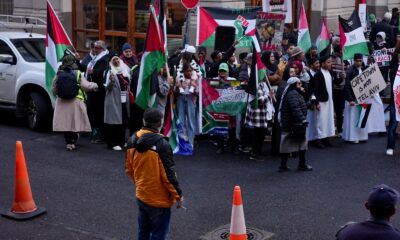
The PSC says it will continue to protest outside Cape Union Mart stores, but from his very first affidavit, Krawitz said he didn’t want to curtail anyone’s right to protest. All he asked was that protests were conducted lawfully, and that they don’t defame him and Cape Union Mart.
“The applicants are in no way attempting to prevent the respondents from exercising their right to freedom of expression and freedom to assemble. The relief sought doesn’t curtail those rights,” he said in June 2025, when he filed the case.
“This judgment takes nothing away from anybody’s right to protest, to boycott, or to criticise Israel,” says Joshua Schewitz, executive director of the South African Zionist Federation Cape Council. “What the court has confirmed is that when you accuse a named individual of funding mass killing, the onus is on you to prove it. Unverified claims circulated online don’t meet that standard.”
Schewitz notes that protest action resumed outside Cape Union Mart stores on Saturday, 5 September, within a day of the ruling.
“‘Funding’ was the reason given to the public for two years of protests outside those stores. That reason has now been tested on oath, and it failed,” says Schewitz. “Once the funding allegation falls away, and a court has now removed it, we are entitled to ask what is left: a retailer that has never donated outside of Southern Africa, and a Jewish businessman who supports Jewish charities.”
If there is an explanation for continuing this campaign “other than the fact that Krawitz is Jewish”, the PSC should place it on record, says Schewitz.
He says the judgment carries wider significance for the business community.
“Jewish business owners now have clarity. A person’s faith and charitable giving aren’t evidence of wrongdoing, and no business should have to prove its innocence against allegations built on nothing. This doesn’t seem to stop the PSC from protesting, and that is a concern.”
Bloch says the Cape SAJBD is currently involved in several legal matters, including cases concerning alleged defamation. “Each matter will, of course, be determined on its own facts and legal merits. Nevertheless, the principles affirmed in the Cape Union Mart judgment are significant, and may provide important guidance and precedent in our ongoing efforts to protect individuals and organisations where political campaigning crosses the line into unlawful conduct.”
He emphasises that this isn’t solely a Jewish community issue. The judgment “reinforces an important principle of South Africa’s constitutional democracy: the right to political expression and protest doesn’t provide a licence to unlawfully damage another person’s reputation, livelihood, safety or fundamental rights”.
The Cape SAJBD encourages members of the community who encounter protests to remain calm and avoid confrontation. “Where conduct becomes threatening, intimidating, violent, or otherwise potentially unlawful, community members should prioritise their safety, document events where it’s safe and appropriate to do so, and report the matter to the Cape SAJBD and the relevant authorities.”
Spokesperson for South African Friends of Israel, Bafana Modise, says “this is a victory for thousands of South Africans who work for Cape Union Mart, safeguarding their jobs. It’s a victory for the Jewish people, to know that South Africa remains a safe place for business and for their families.”
It’s also a victory “for our economy, and for the business community in this country to know that business will be protected against foreign agendas”.
Pastor Thom Thamaga from Simunye Israel, who has written extensively about the case, says the judgment “draws an important line between the constitutional right to protest and the supposed ‘right’ to destroy another person’s reputation through allegations that cannot be substantiated”.
He says South Africans must remain free to protest, criticise Israel, support Palestinians, organise boycotts, and express political views with which others may strongly disagree. “But freedom of expression cannot mean freedom from accountability.
“Persistent targeting of a business with no proven connection to the wrongdoing alleged against it risks ceasing to look like legitimate political protest and beginning to look like harassment”, says Thamaga.
The judgment “reminds all of us that political passion doesn’t transform an unproven allegation into a fact. South Africa desperately needs that principle right now.”
He asks if Cape Union Mart would have been targeted in this manner if its owners weren’t Jewish.
“We would rightly reject the targeting of a Muslim-owned South African business because of terrorism committed elsewhere by people claiming to act in the name of Islam. We would call that collective blame and prejudice. The same principle must apply to Jewish South Africans.”





Marius Joubert
September 11, 2026 at 8:39 am
As a Christian, I fully support Israel and GOD’S chosen people, the Jews and would like to extend blessings and Shalom to them all. Antizionist and antisemitic hate should not be tolerated in any way, it is unbiblical and would be to the detriment of those instigating and supporting such behavior. I do support Cape Union Mart and all Jewish businesses for that matter and will continue doing so. I am very happy with this court ruling and pray for success with others that may follow.
Raymond
September 12, 2026 at 10:07 am
Great news for All South Africans,especially for all those employed by a great company like Cape Union Mart,just keep on going Philip,those standing with placards trying to discredit you will soon get tired and try to do something more constructive with their lives.