





SA News
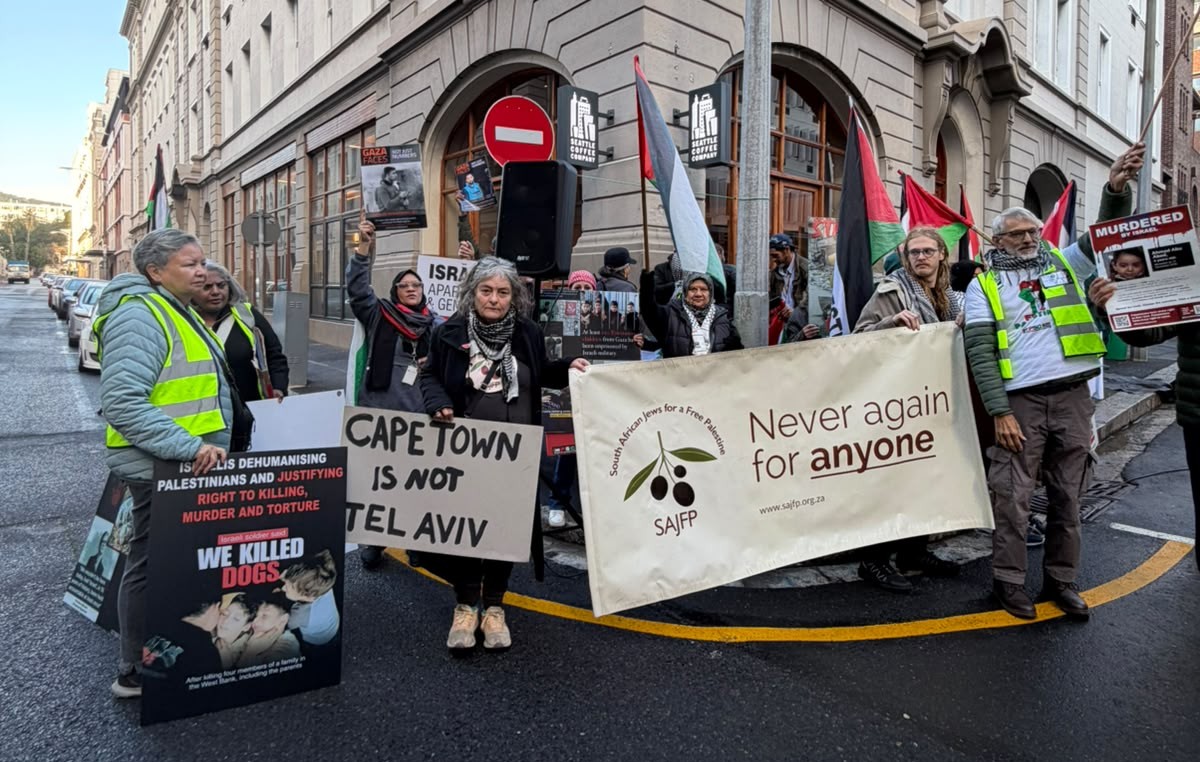
Choritz defends slurs against Mendelsohn

Antizionist agitator Megan Choritz argues that she has a right to denigrate Professor Adam Mendelsohn – the director of the Kaplan Centre for Jewish Studies at UCT – because he is “a self-confessed Zionist” who supports the “apartheid settler colony in Israel”.
She makes the claim in her defendant’s plea, submitted to the Western Cape High Court on 7 August. And she claims that Mendelsohn “defends, justifies, or associates himself with Israel’s actions in Gaza”, which she calls “a genocide”.
Mendelsohn, however, has never officially stated that he is a Zionist nor said that he supports Israel’s actions in Gaza.
Choritz argues that she can call Mendelsohn an “Islamophobe” because he expressed concerns about the University of Cape Town (UCT) awarding an honorary doctorate to Dr Imtiaz Sooliman, who happens to be Muslim. Yet, she called Mendelsohn an “Islamophobe” before he even expressed these concerns, which in no way targeted Sooliman because of his religion, but rather addressed his antisemitic rhetoric.
Choritz, represented by Ashmodien Attorneys, made the assertions in response to Mendelsohn suing her for defamation. She denies causing him damage, that her statements are defamatory, and that Mendelsohn is entitled to an apology or an award of costs. She is asking the court to dismiss Mendelsohn’s claims, with punitive costs.
But Cape South African Jewish Board of Deputies (Cape SAJBD) Executive Director Daniel Bloch says, “Professor Mendelsohn has every right to defend his professional and personal reputation, and the Cape SAJBD supports his decision to do so.”
Bloch says the idea that “being a Zionist somehow makes a person fair game for professional targeting and personal vilification” is both “dangerous and intellectually dishonest”.
He says people are entitled to express political views and criticise public figures, institutions, and political ideologies. “But political disagreement does not remove an individual’s right to dignity and reputation, nor does it provide a licence to make serious and damaging allegations against them. Branding an individual an ‘Islamophobe’ or accusing him of ‘supporting genocide’ goes well beyond legitimate political criticism.”
Choritz says her comments were in the public interest because Zionism is “an apartheid policy, and a crime against humanity”.
The summons refers to two instances in which Choritz allegedly defamed Mendelsohn in response to his inaugural lecture at UCT in April.
In the first, she alleged in a TikTok video that Mendelsohn is “a supporter of Israel’s genocide” and “an Islamophobe” and asked why he is “allowed a voice” and is not “criticised, stopped, and deplatformed”.
In the second incident, Choritz wrote on the blogging platform Substack that “there is no word for what Mendelsohn and his friends are … these Zionists do not fear Muslims, they hate them. Their hatred looks and sounds exactly like antisemitism.”
She wrote that “letting his [inaugural] lecture happen without protest gives him and his hateful, racist views legitimacy”, and that “Mendelsohn’s Zionist paranoia, fragile feelings, and bad faith slurring of antizionists needs to be challenged at every opportunity.”
The summons states that Mendelsohn has suffered damages in the amount of R500 000. He is claiming R250 000 per claim, and interest on these amounts from the date of judgment to date of payment at the prescribed rate of 10.25% per year. He is also asking the court to order Choritz to make an unconditional apology. Further or alternative relief would be legal costs.
In her defendant’s plea, Choritz argues that her TikTok video was published “in the context of robust public debate”. She says her statements are justified as “fair comment” because Mendelsohn “supports and defends Israel, including its war waged in Gaza since 7 October 2023, notwithstanding that the war is a genocide against the Palestinian people”.
Israel was not waging war in Gaza on 7 October 2023. Mendelsohn has not expressed his political views about Israel, and the war in Gaza has not been defined as a “genocide”.
She argues that her statements, including “he is a supporter of Israel’s genocide”, should not be taken to mean that he literally supports “genocide” or has committed a crime. She also says her accusation that Mendelsohn is an “Islamophobe” should not be taken literally. Her comments are not “a literal assertion of fact”, she says.
Her comments are in the public interest because Mendelsohn has defended “a Jewish connection to Israel” and expressed that factually, Israel has not occupied “Palestinian land” since 1948.
Choritz says her comments are justified because Mendelsohn took UCT to court over its Gaza resolutions. In that case, Mendelsohn argued that UCT did not follow its own processes when adopting them.
She says her comments should also be allowed because Mendelsohn argued that South Africa’s case against Israel at the International Court of Justice is infused with political bias and antisemitism. She claims that her TikTok video and Substack post were not intended to harm Mendelsohn.
Her Substack article was a “first-person opinion piece written in emotive and rhetorical language” and, Choritz says, the reader would understand that she did not mean her statements literally, but as hyperbole and opinion. She says calling Mendelsohn “racist” and “hateful” were “value judgements” and “political criticism”.
Choritz’s plea refers to several statements Mendelsohn made in his inaugural lecture. However, she admitted on Substack that she had not read or listened to the lecture when she made her comments.
She says Mendelsohn’s lawsuit against her is “an abuse of the judicial process”, brought “with an ulterior motive” to “deter her” from criticising him, Zionism, or Israel. She says the case is “retaliation”, aims to “increase the risks” for people criticising Israel and Zionism, and violates her right to free expression.
Choritz has also entered a special plea, a SLAPP (Strategic Lawsuit Against Public Participation) defence, stating that Mendelsohn’s case has the “designed aim of using litigation as lawfare in pursuit of an improper end”.
Attorney Simon Dippenaar frequently writes and advises on online defamation and digital reputation management in South Africa. He explained to the SA Jewish Report that, in simple terms, “Choritz admits publishing the material but disputes the defamatory meanings alleged.”
She says her words were “forceful political opinion, rhetoric, or hyperbole based on true or publicly known facts; or that any factual sting was substantially true and published in the public interest”.
But Dippenaar says that while “protected comment can include harsh, exaggerated, or prejudiced criticism, it must remain recognisable as opinion, concern a matter of public interest, and rest on true facts that were stated, clearly indicated, or sufficiently notorious”.
He says it will be difficult for Choritz to prove that it was not defamatory to say that Mendelsohn “supports genocidal conduct, hates Muslims, holds racist views, or acts in bad faith”.
This is because “general support for Israel or opposition to an honorary doctorate would not automatically establish those wider conclusions”.
In addition, “if the comments about Sooliman were made only during the inaugural lecture, after the TikTok publication, they cannot retrospectively provide the disclosed factual foundation for the earlier comment,” says Dippenaar.
He says Mendelsohn’s summons is “not self-evidently abusive [of the law]”.
Bloch agrees that calling the litigation abusive does not make it so. “Professor Mendelsohn is entitled to seek legal recourse to protect his reputation.
“What we have seen over a prolonged period is that Jewish individuals, institutions, businesses, and the Jewish community have been subjected to personal attacks and serious allegations, with attempts to shield such conduct by simply labelling it ‘criticism’ or ‘free speech’,” says Bloch.
However, “political activism does not place individuals beyond accountability for what they say about others”, he says. “Those who make such allegations must be prepared to substantiate and defend them when challenged.”
The SA Jewish Report reached out to Choritz for comment, but she didn’t respond.






Colin
August 20, 2026 at 12:52 pm
If Ms Choritz has stated in her affidavit (under oath) that Israel is committing genocide, a claim, pace Cde Pandor and Francesa Albenese, that has not been proved, she has perjured herself.
As a follower of the Israel/Gaza conflict, she should be aware that genuine genocide and urban warfare scholars (e.g. Andrew Fox, Richard Kemp, John Spencer) have refuted the claim.
This needs to be investigated.
Bendeta Gordon
August 20, 2026 at 6:02 pm
Very sad situation.
Sad because Megan Choritz is going to be used by her pro-Palestinian pals.
Sadly a misguided person and amazingly schooled at King David? How does this happen?
Gary Selikow
August 26, 2026 at 2:47 pm
Bendetta these Jewish anti Zionists are filled with hate and bitterness. You just have to look at their faces to see, also note they are never attractive
Gary
August 21, 2026 at 4:38 pm
Wow these Jewish anti-Zionists are nasty pieces of work
Gary Selikow
August 21, 2026 at 4:54 pm
Why is it OK to be racist against Israelis but you should be banned and persecuted if you ”Islamophobic”? Hating someone for their national origin is not OK. You cant be allowed to hate Israelis just because you Jewish. I loathe Jewish anti-Zionists with every fibre of my being. They always look the same and sound the same.
Gary Selikow
August 21, 2026 at 5:09 pm
The anti-Zionists must know (especially the Jewish ones) the same rage and hate they feel for Israel and Zionists my rage and hate for them is stronger!