World
Jewish Australians testify about pervasive hatred

A Jewish mother at an under-12 netball game heard another parent allegedly shout that Jews “should all be eradicated”. A rabbi is being asked by his congregants whether they should leave Australia. A teenage gamer described being told online that “Hitler was right to kill them all”.
These are some of the people who have testified before Australia’s Royal Commission into Antisemitism and Social Cohesion, established after a sharp rise in antisemitic incidents in Australia since 7 October and the war in Gaza.
The most notable of these events is the attack at Bondi Beach during a Chanukah celebration on 14 December 2025, when two men opened fire on members of the Jewish community, killing 15 and wounding others.
The Australian government established the commission on 9 January and public hearings began in February 2026. The commission is due to deliver its final report by 14 December, the first anniversary of the Bondi attack.
The commission is examining the extent of antisemitism in Australia, its impact on Jewish Australians, and what can be done to address it. Witnesses are describing a community living with heightened fear, increased security, social isolation, and anxiety about openly expressing Jewish identity.
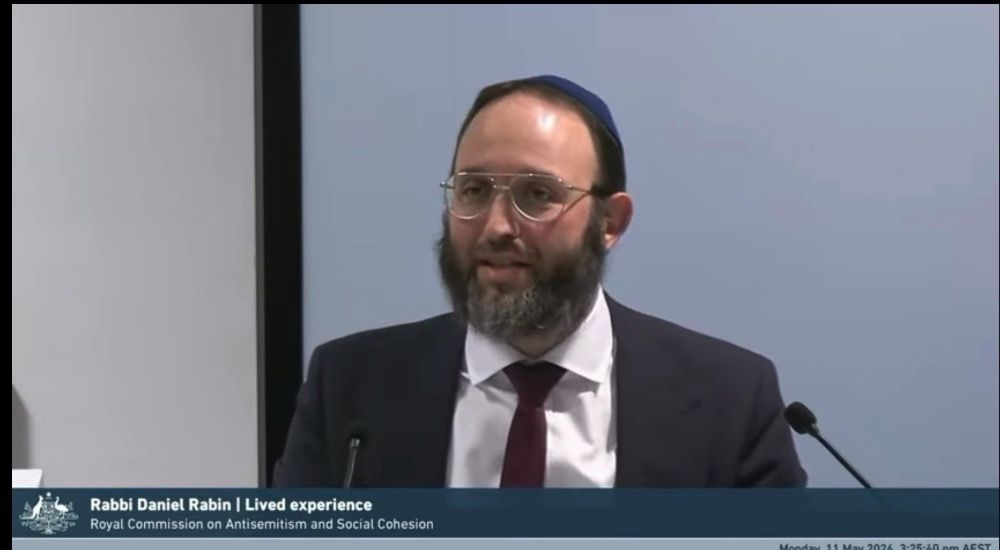
Rabbi Daniel Rabin, a South African who has lived in Australia since 2009, told the commission, “I think the biggest shock to me was people asking me, genuinely, should they leave Australia? Is this the writing on the wall?”
Speaking afterwards to the SA Jewish Report, Rabin said, “I’m thinking about my children. I’m thinking about my community. I’m thinking about the reality for the Jewish community here and its future.”
Rabin, who grew up in Johannesburg and attended Torah Academy, said what disturbed him most was the brazenness of antisemitic rhetoric. He said people were now openly spreading claims that “Jews control the media” and “Jews control the banks”. “This is coming from regular Australians who are just being fed this propaganda. It’s spreading like a virus.”
He spoke of the fear filtering into family life. Rabin recalled walking home from synagogue with his son shortly after 7 October and people in a passing car shouting abuse at them. “My son said, ‘What’s going on? Why do these people hate us?’”
Sydney mother Dina*, who is married to a South African expat, also testified about how daily life had changed. She told the SA Jewish Report that many Jews had once viewed Australia as exceptionally safe. “I’ve heard many people refer to it as the golden age,” she said, referring to Jewish life in Australia before 7 October.
Dina said the anti-Israel protest outside the Sydney Opera House on 9 October 2023 became a turning point for many Jews. “It was a wake-up call for us to understand what was really lurking underneath.”
Jewish leaders had repeatedly warned authorities about rising hatred, she said. “We’ve been pleading for a long time for government and law enforcement to take it more seriously.”
She described appearing before the commission as both emotional and historically significant. “Our grandparents never had an opportunity to stand before a government inquiry and tell the government how bad things were getting,” she said. “The fact that we have this opportunity is very fortunate for us.”
Just days after testifying, Dina experienced direct antisemitic abuse for the first time. She was attending a large community netball fixture in Sydney when another parent allegedly shouted that Jews should be eradicated.
“What was really difficult to swallow was that it was a mother,” she said. “The fact that this came from an Australian mother just like me, standing and watching kids play netball, was deeply confronting.”
She said the incident showed how emboldened some people had become. “There’s social licence now because of how things have gotten here.”
Dina said antisemitism was increasingly affecting ordinary decisions and interactions. She recalled taking her daughter to an emergency room after she broke her nose. The child was wearing her Jewish school uniform. “I sat in that waiting room wishing she wasn’t in her school uniform because I wasn’t sure if she was going to get the right treatment,” she said.
Several witnesses described the impact of antisemitism on children. An anonymous 15-year-old from Perth told the commission he had experienced repeated abuse while playing Minecraft online with classmates. One message described him as a “filthy” Jew and another declared “Hitler was right to kill them all”.
“It made my stomach turn upside down,” the teenager told the commission.
South African expat and former New South Wales Jewish Board of Deputies Chief Executive Dr Vic Alhadeff said antisemitism had become normalised in Australia. “Prior to 7 October 2023, antisemitism was socially unacceptable and confined to the margins,” he told the SA Jewish Report.
“However, since 7 October, it has shifted from the edges of society into mainstream Australia and is now part of the ecosystem.” Alhadeff described hearing a woman at a Sydney Writers Festival event refer casually to the “tentacles” of Australia’s “Israel lobby”, echoing classic antisemitic tropes.
“What alarmed me was that it was thrown out so casually, confidently and unashamedly,” he said. He also described being subjected to antisemitic abuse during a road rage incident while parking at Bondi Beach. “Fucking South African Jew!” another driver allegedly shouted at him.
Alhadeff said the issue extended beyond politics or the war in Gaza. “The issue is not the conflict thousands of kilometres away. The issue is who we are as a nation, respect for diversity, denigration of minorities.”
Joshua Moshe, a Jewish Australian saxophonist, told the commission that he and other members of a private WhatsApp group for Jewish creatives were targeted after screenshots and details from their group were leaked online in 2024.
He said social media users shared his and his wife’s personal accounts and the Instagram page of their Melbourne homewares store, accusing them of being “Zionists” and encouraging harassment. He said police told him that posts attacking him as a “Zionist” did not meet the threshold for antisemitism. Moshe explained to the commission that terms like “Zionist” and “Zio” were increasingly being used as substitutes for “Jew”.
Despite the distressing testimony, many witnesses also expressed hope. Dina said she had received deeply moving support from non-Jewish Australians. “There are a lot of good people out there who just want to live good, happy, supportive lives,” she said.
Rabin said Australia’s leaders and wider society now faced an important test. “One is that I hope this helps leadership in Australia recognise that they have to be part of the solution.” Political, religious, and business leaders needed to challenge falsehoods and hatred directly, he said.
At the same time, Jewish communities also needed to build stronger relationships outside their own circles. Rabin said his synagogue had started initiatives inviting non-Jewish colleagues and neighbours into Jewish spaces. “People realise we’re not what these libels and ancient tropes are saying,” he said.
Alhadeff said the future of social cohesion in Australia depended not only on the commission’s findings, but on whether ordinary Australians are willing to confront the antisemitism, bigotry, and hatred openly. “The question that cries out to be answered applies to everyone else,” he said. “Will we speak out?”
*She asked that her surname not be used for security.