SA
Joburg protest amplifies Iranians’ cry for freedom

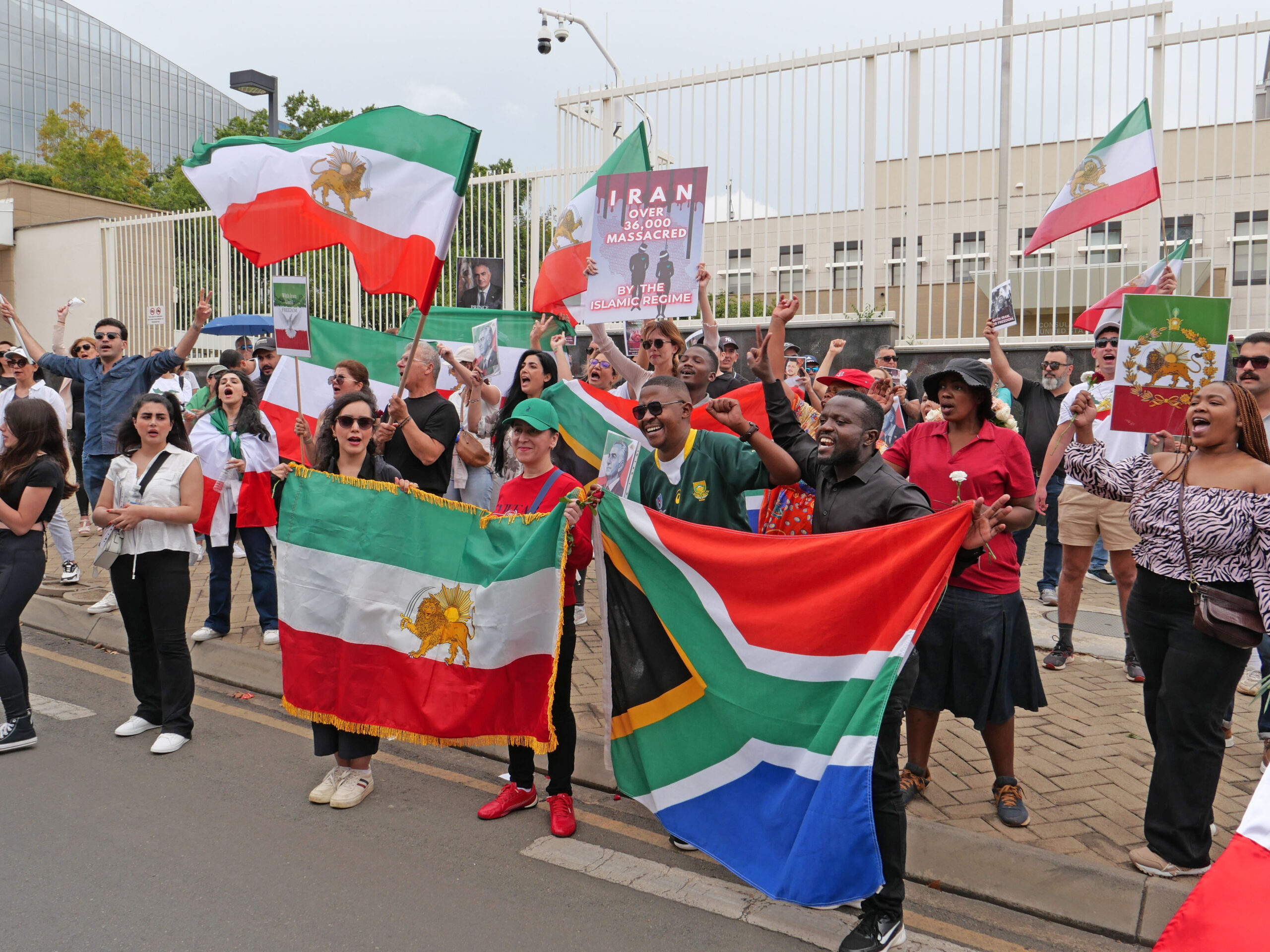
Hundreds of people gathered outside the United States Consulate in Sandton on 14 February, appealing to Washington to help stop the destruction of the Iranian people by the Islamic Republic of Iran.
They stood with photographs of people who had been killed in recent unrest in Iran, chanting a single, repeated appeal, “Please hear us.”
The demonstration, one of a series held in cities around the world, was intended to show that opposition to the Islamic Republic extended far beyond Iran’s borders, and that those living abroad believed international pressure was their only remaining leverage.
Organisers said most of the attendees were Iranian expatriates. Reza*, an Iranian living in South Africa and one of the organisers, described the turnout as good for a community that fears repercussions for relatives at home. “After we got the permit, many people called us and told us to cancel,” he said. Reza said the gathering was deliberately peaceful, and that participants handed out flowers to passersby “to show the nice face of the Iranian people”.
The protest formed part of coordinated global action by members of the Iranian diaspora following a surge of unrest inside Iran and reports by Iranian human rights organisations that tens of thousands of people were killed and hundreds of thousands injured during a crackdown in early January. Large demonstrations took place in cities including Toronto, Munich, and Los Angeles, where media outlets reported crowds in the hundreds of thousands.
In Gauteng, the choice of the US Consulate as a venue reflected the protesters’ focus on American policy. The organiser said participants didn’t want the US to negotiate with the Islamic Republic, and instead to support efforts to bring about political change. “We can’t do it alone,” he said.
For some attendees, the motivation was rooted in what Jacob*, a Jewish South African who attended the protest, described as a breach of the basic obligation between a state and its citizens. “The foremost duty of a government is to protect the lives of the people,” he said. “You are killing your own people. That’s it.” He linked the recent unrest to economic pressure, including high inflation and the collapse in the value of the currency, which he said had pushed traders and workers onto the streets before the violence began.
Fear was a recurring theme in accounts of the day. Jacob said many Iranians in South Africa were reluctant to attend because of concern for family members in Iran and uncertainty about future dealings with Iranian authorities. Some had passports due for renewal, and worried that their presence at the protest could be recorded.
Members of Johannesburg’s Jewish community attended in smaller numbers. Howard Sackstein, chairperson of the SA Jewish Report, said of his attendance at the gathering that it was important to “show solidarity with the people of Iran, who suffered such unbelievable terror in the past few months”, while stressing that the event was led by Iranians and that Jewish participation was limited. A brief counter-protest by two pro-Palestinian activists carrying flags highlighted the wider regional tensions surrounding Iran. Witnesses said they were met with boos before leaving the area.
The demonstration took place against the backdrop of nearly five decades of hostility between the Islamic Republic and the US and Israel. Since the 1979 revolution, Iran has defined itself in opposition to American influence, and has rejected Israel’s legitimacy. Its support for armed groups across the Middle East, including Hezbollah in Lebanon and Hamas in Gaza, has been a central element of its foreign policy and has drawn sanctions, diplomatic isolation, and periodic military confrontation.
For Israel, Iran is regarded as the most significant strategic threat because of its regional alliances, missile programme, and nuclear ambitions. For the US, relations have been marked by sanctions and intermittent negotiations over Iran’s nuclear activities. Those tensions have intensified since the start of the Gaza war, with Iranian-aligned groups launching attacks across the region and raising the risk of direct conflict.
Inside Iran, protests in recent years have been driven by a combination of economic hardship, political repression, and anger about corruption. Demonstrations have often been met with force. The scale of the most recent crackdown has been disputed, but Iranian diaspora activists and rights groups describe it as one of the deadliest episodes since the revolution.
The global response has been uneven. Iranian communities in North America and Europe have mobilised in large numbers, while the issue has struggled to gain sustained international attention amid other conflicts. In South Africa, the political context has added another layer of complexity for Iranian expatriates, some of whom said they felt exposed both to the authorities in Tehran and the domestic environment in which the protest took place.
Many of those who attended carried images of friends or relatives they said had been killed. Some chanted for political change and the return of a system they believed could lead to a secular and democratic order. Others focused on drawing attention to what they described as the suffering of ordinary Iranians. “Don’t see only the Iranian government,” Reza said. “We are also from Iran, although we prefer to be called Persian as we long for our King and the kingdom we had before.”
As the crowd dispersed, the flowers handed out during the protest remained with passersby. For participants, the gathering was an attempt to connect the events unfolding in Iranian cities to a street corner in Johannesburg, and to place their demands within the wider confrontation that has shaped Iran’s relations with the US and Israel for nearly half a century.
*Sources asked to have their names changed for security reasons.