OpEds
From world-class to water sparse: city of JoJoburg

On the day Dada Morero first sat in the mayor’s chair, he made a proclamation that still sticks with me: every household in Johannesburg, he said, should get a JoJo tank. Not a plan for new bulk pipelines. Not a plan for fixing our leaking reservoirs. Not a plan for reinvesting in reticulation that is decades past its lifespan. His “vision” was that each household must improvise its own backup, because the city wouldn’t bother.
When he stood up months later as Member of the Mayoral Committee of Finance in an Al Jama-ah–led government, he presented a budget that predictably lacked meaningful investment in water infrastructure.
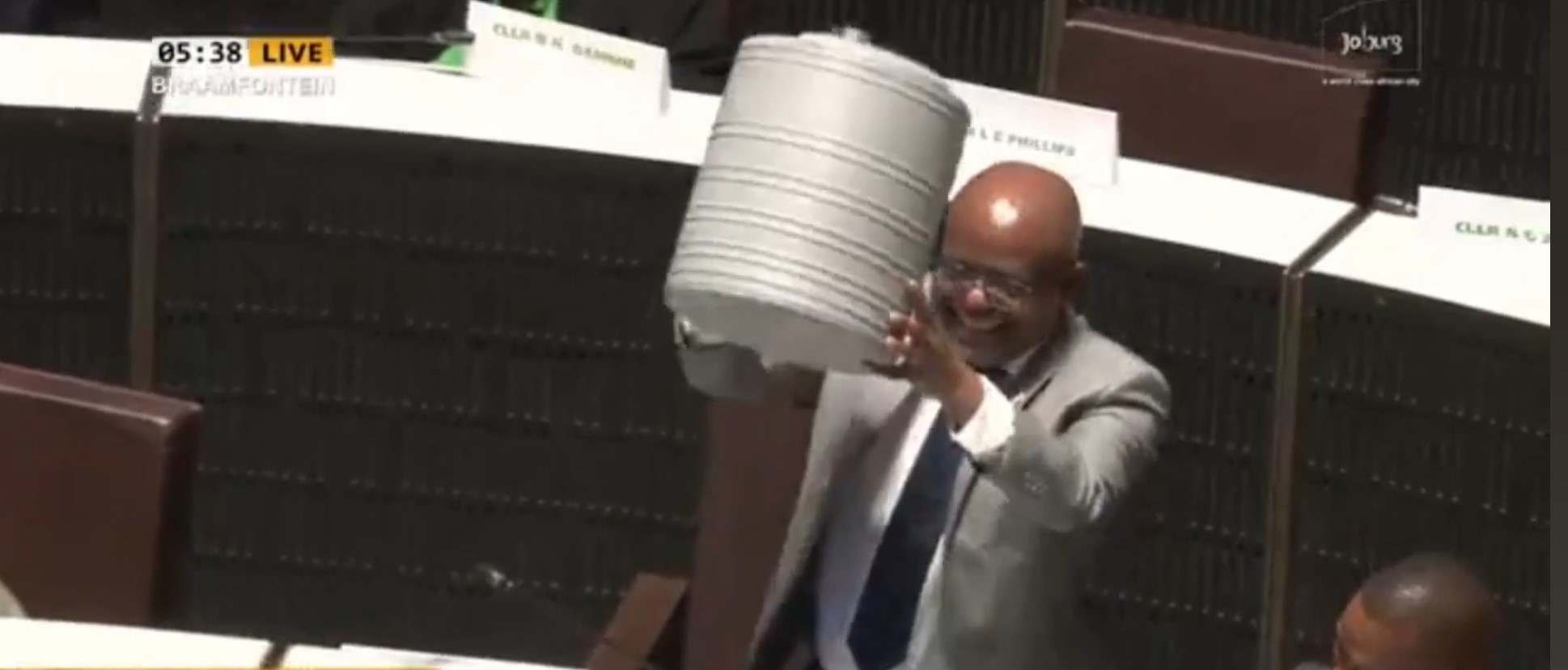
After my response speech in council, I gifted him a miniature JoJo tank – a tongue-in-cheek warning that his legacy would be to reduce Johannesburg to buckets and tanks rather than a functioning water network.
He accepted it graciously, but not without a jab. His reply was to accuse me of speaking from “white privilege”, that I had never known the experience of being without water, something he supposedly knew all too well under apartheid. He even dragged Palestine into it, claiming that Israelis turn off Palestinian water “whenever they like”.
It was a deflection – a way to shift conversation from his failures to political diversion. But here we are, in his second year as mayor, and Johannesburg is parched. Entire suburbs go days without water. Reservoirs run dry. Taps splutter and then go silent. And in the latest round of this ongoing water crisis, the mayor is missing in action. He has barely an opinion, certainly no plan, and the city is left leaderless at the very moment it needs direction most.
And now every Joburger – black, white, rich, or poor – knows the reality of being without water. The irony is almost too sharp: the lowest common denominator has been achieved. His “solution” has become prophecy.
The truth is that Johannesburg’s water network is collapsing because it has been allowed to rot for decades, a decay that has accelerated into a full-blown collapse under the current leadership.
Our pipes are overwhelmingly beyond their design lifespan, so brittle they burst under routine pressure changes. Much of the institutional knowledge that once lived in Johannesburg Water has long since been transferred to other municipalities, particularly Cape Town, leaving Joburg hollow at the top.
Reservoirs, which are supposed to be our safety net, have gone unmaintained for years. Structural cracks are no longer a risk, but a near certainty.
And Johannesburg Water itself put the maintenance backlog at R27 billion just last year. Whether that’s legitimate costing or African National Congress pricing hardly matters, it’s a fortune of money. And every day we delay, the bill only grows larger.
The bigger supply picture is no less dire. Gauteng depends on Rand Water, which in turn depends on the Vaal River and Lesotho Highlands Water Project. That project was meant to free us from praying for rain, to give Gauteng a guaranteed inflow regardless of the season.
With Phase II stalled for years thanks to political interference, we are once again hostage to rainfall. That failure multiplies Joburg’s leakage problem: because our pipes bleed so much, our demand exceeds what Rand Water can sustainably deliver. Without the Lesotho cushion, Rand Water has no choice but to throttle supply, and households pay the price with dry taps.
Even as I type this, a pipe in my ward is impersonating Old Faithful geyser in Wyoming, shooting water into the air, with Joburg Water nowhere to be seen. It’s not an act of G-d; it’s a failure of governance. And it doesn’t have to be this way.
A proper audit of supply tenders would expose the billions lost to inflated contracts and ghost projects. The tanker mafia – those who sabotage systems to create demand and then dump half their deliveries on the side of the road – needs to be eradicated. Neighbourhood rebates could incentivise communities to co-invest in upgrading local networks.
Developers should be allowed to upgrade infrastructure directly in their areas in lieu of bulk contributions that vanish into the ether. And reservoirs can be saved if we apply real engineering solutions instead of leaving them to decay.
But perhaps it’s time to confront the inevitable. After three decades of cascading failures, we must ask if the city’s water affairs wouldn’t be better off under different management.
The ruling party’s ineptitude has already forced residents into private solutions – from solar power for electricity to boreholes for water. Shouldn’t we at least consider a pragmatic concession for water distribution too?
A transparent, term-limited contract with strict performance milestones could bring in the expertise to stabilise our collapsing utility.
It would mean swallowing political pride, but can that truly be worse than the paralysis we have now? Every month of drift inflates that R27 billion backlog further, leaving an even bigger mountain for the next administration to climb.
It’s one thing to keep a JoJo tank as an emergency backup. It’s another when the mayor of Johannesburg presents it as the default water strategy for a city of six million people.
JoJo tanks should never be a substitute for pipelines, reservoirs, and bulk supply. They are a symptom of failure, not a plan for the future.
Morero once told me that, as a white councillor, I could never understand what it meant to grow up under apartheid without water. Ironically, under his leadership, the whole of Johannesburg now shares in that experience. Instead of taking the city forward, he has dragged everyone backwards into the very deprivation he claimed to have overcome.
Unless Johannesburg finds the will to fix its pipes, reservoirs, and supply, we won’t be talking about the City of Johannesburg anymore. Once branded a “World-Class African City”, it’s fast becoming JoJoburg – a water sparse African city.
But this doesn’t have to be the end of the story. The expertise still exists in South Africa. The engineering solutions are well known. The political will is what has been absent. And in politics, willpower isn’t eternal, it shifts with the tides of public anger and the demand for something better.
The waves of change are coming. Johannesburg doesn’t have to settle for JoJoburg.
With leadership that invests and delivers, this city can still be more than world-class, it can be water secure.
- Daniel Schay is a member of the City Council of Johannesburg, serving as the DA Shadow MMC of Development Planning and Ward Councillor for Ward 72.